

the incidence of blocking Web sites in our testing lists was approximately twice as high for
Web sites available in a local language compared to sites available only in English or other
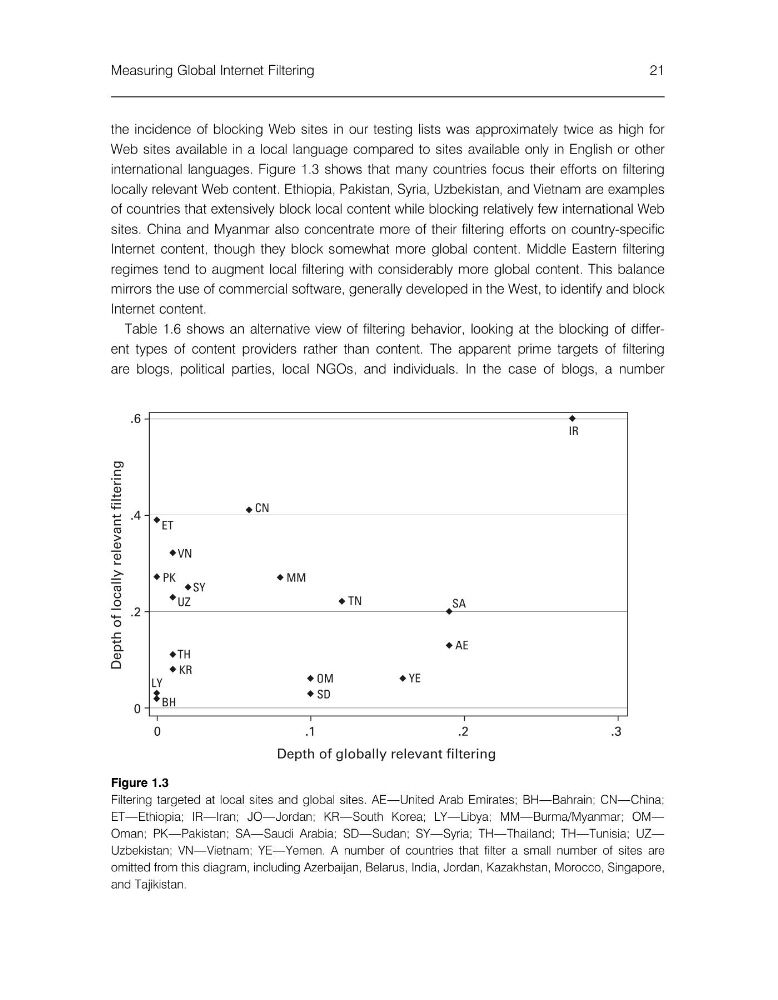
international languages. Figure 1.3 shows that many countries focus their efforts on filtering
locally relevant Web content. Ethiopia, Pakistan, Syria, Uzbekistan, and Vietnam are examples
of countries that extensively block local content while blocking relatively few international Web
sites. China and Myanmar also concentrate more of their filtering efforts on country-specific
Internet content, though they block somewhat more global content. Middle Eastern filtering
regimes tend to augment local filtering with considerably more global content. This balance
mirrors the use of commercial software, generally developed in the West, to identify and block
Internet content.
Table 1.6 shows an alternative view of filtering behavior, looking at the blocking of different types of content providers rather than content. The apparent prime targets of filtering
are blogs, political parties, local NGOs, and individuals. In the case of blogs, a number
Figure 1.3
Filtering targeted at local sites and global sites. AE—United Arab Emirates; BH—Bahrain; CN—China;
ET—Ethiopia; IR—Iran; JO—Jordan; KR—South Korea; LY—Libya; MM—Burma/Myanmar; OM—
Oman; PK—Pakistan; SA—Saudi Arabia; SD—Sudan; SY—Syria; TH—Thailand; TH—Tunisia; UZ—
Uzbekistan; VN—Vietnam; YE—Yemen. A number of countries that filter a small number of sites are
omitted from this diagram, including Azerbaijan, Belarus, India, Jordan, Kazakhstan, Morocco, Singapore,
and Tajikistan.
Measuring Global Internet Filtering
21
Web sites available in a local language compared to sites available only in English or other
international languages. Figure 1.3 shows that many countries focus their efforts on filtering
locally relevant Web content. Ethiopia, Pakistan, Syria, Uzbekistan, and Vietnam are examples
of countries that extensively block local content while blocking relatively few international Web
sites. China and Myanmar also concentrate more of their filtering efforts on country-specific
Internet content, though they block somewhat more global content. Middle Eastern filtering
regimes tend to augment local filtering with considerably more global content. This balance
mirrors the use of commercial software, generally developed in the West, to identify and block
Internet content.
Table 1.6 shows an alternative view of filtering behavior, looking at the blocking of different types of content providers rather than content. The apparent prime targets of filtering
are blogs, political parties, local NGOs, and individuals. In the case of blogs, a number
Figure 1.3
Filtering targeted at local sites and global sites. AE—United Arab Emirates; BH—Bahrain; CN—China;
ET—Ethiopia; IR—Iran; JO—Jordan; KR—South Korea; LY—Libya; MM—Burma/Myanmar; OM—
Oman; PK—Pakistan; SA—Saudi Arabia; SD—Sudan; SY—Syria; TH—Thailand; TH—Tunisia; UZ—
Uzbekistan; VN—Vietnam; YE—Yemen. A number of countries that filter a small number of sites are
omitted from this diagram, including Azerbaijan, Belarus, India, Jordan, Kazakhstan, Morocco, Singapore,
and Tajikistan.
Measuring Global Internet Filtering
21