

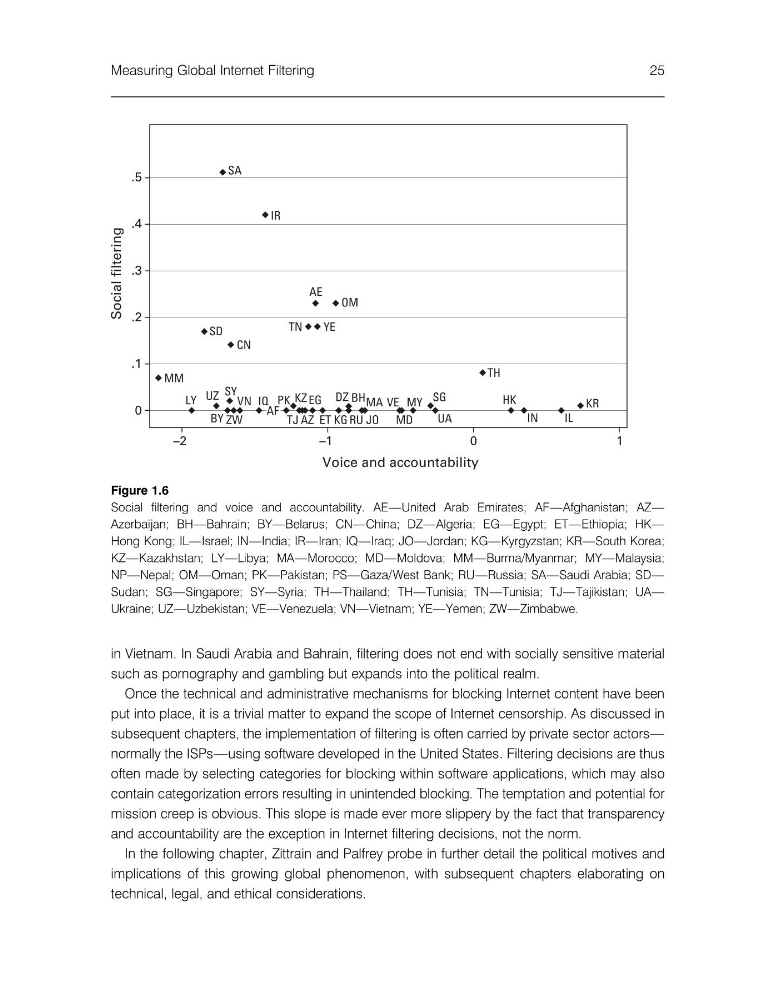
in Vietnam. In Saudi Arabia and Bahrain, filtering does not end with socially sensitive material
such as pornography and gambling but expands into the political realm.
Once the technical and administrative mechanisms for blocking Internet content have been
put into place, it is a trivial matter to expand the scope of Internet censorship. As discussed in
subsequent chapters, the implementation of filtering is often carried by private sector actors—
normally the ISPs—using software developed in the United States. Filtering decisions are thus
often made by selecting categories for blocking within software applications, which may also
contain categorization errors resulting in unintended blocking. The temptation and potential for
mission creep is obvious. This slope is made ever more slippery by the fact that transparency
and accountability are the exception in Internet filtering decisions, not the norm.
In the following chapter, Zittrain and Palfrey probe in further detail the political motives and
implications of this growing global phenomenon, with subsequent chapters elaborating on
technical, legal, and ethical considerations.
Figure 1.6
Social filtering and voice and accountability. AE—United Arab Emirates; AF—Afghanistan; AZ—
Azerbaijan; BH—Bahrain; BY—Belarus; CN—China; DZ—Algeria; EG—Egypt; ET—Ethiopia; HK—
Hong Kong; IL—Israel; IN—India; IR—Iran; IQ—Iraq; JO—Jordan; KG—Kyrgyzstan; KR—South Korea;
KZ—Kazakhstan; LY—Libya; MA—Morocco; MD—Moldova; MM—Burma/Myanmar; MY—Malaysia;
NP—Nepal; OM—Oman; PK—Pakistan; PS—Gaza/West Bank; RU—Russia; SA—Saudi Arabia; SD—
Sudan; SG—Singapore; SY—Syria; TH—Thailand; TH—Tunisia; TN—Tunisia; TJ—Tajikistan; UA—
Ukraine; UZ—Uzbekistan; VE—Venezuela; VN—Vietnam; YE—Yemen; ZW—Zimbabwe.
Measuring Global Internet Filtering
25
such as pornography and gambling but expands into the political realm.
Once the technical and administrative mechanisms for blocking Internet content have been
put into place, it is a trivial matter to expand the scope of Internet censorship. As discussed in
subsequent chapters, the implementation of filtering is often carried by private sector actors—
normally the ISPs—using software developed in the United States. Filtering decisions are thus
often made by selecting categories for blocking within software applications, which may also
contain categorization errors resulting in unintended blocking. The temptation and potential for
mission creep is obvious. This slope is made ever more slippery by the fact that transparency
and accountability are the exception in Internet filtering decisions, not the norm.
In the following chapter, Zittrain and Palfrey probe in further detail the political motives and
implications of this growing global phenomenon, with subsequent chapters elaborating on
technical, legal, and ethical considerations.
Figure 1.6
Social filtering and voice and accountability. AE—United Arab Emirates; AF—Afghanistan; AZ—
Azerbaijan; BH—Bahrain; BY—Belarus; CN—China; DZ—Algeria; EG—Egypt; ET—Ethiopia; HK—
Hong Kong; IL—Israel; IN—India; IR—Iran; IQ—Iraq; JO—Jordan; KG—Kyrgyzstan; KR—South Korea;
KZ—Kazakhstan; LY—Libya; MA—Morocco; MD—Moldova; MM—Burma/Myanmar; MY—Malaysia;
NP—Nepal; OM—Oman; PK—Pakistan; PS—Gaza/West Bank; RU—Russia; SA—Saudi Arabia; SD—
Sudan; SG—Singapore; SY—Syria; TH—Thailand; TH—Tunisia; TN—Tunisia; TJ—Tajikistan; UA—
Ukraine; UZ—Uzbekistan; VE—Venezuela; VN—Vietnam; YE—Yemen; ZW—Zimbabwe.
Measuring Global Internet Filtering
25