

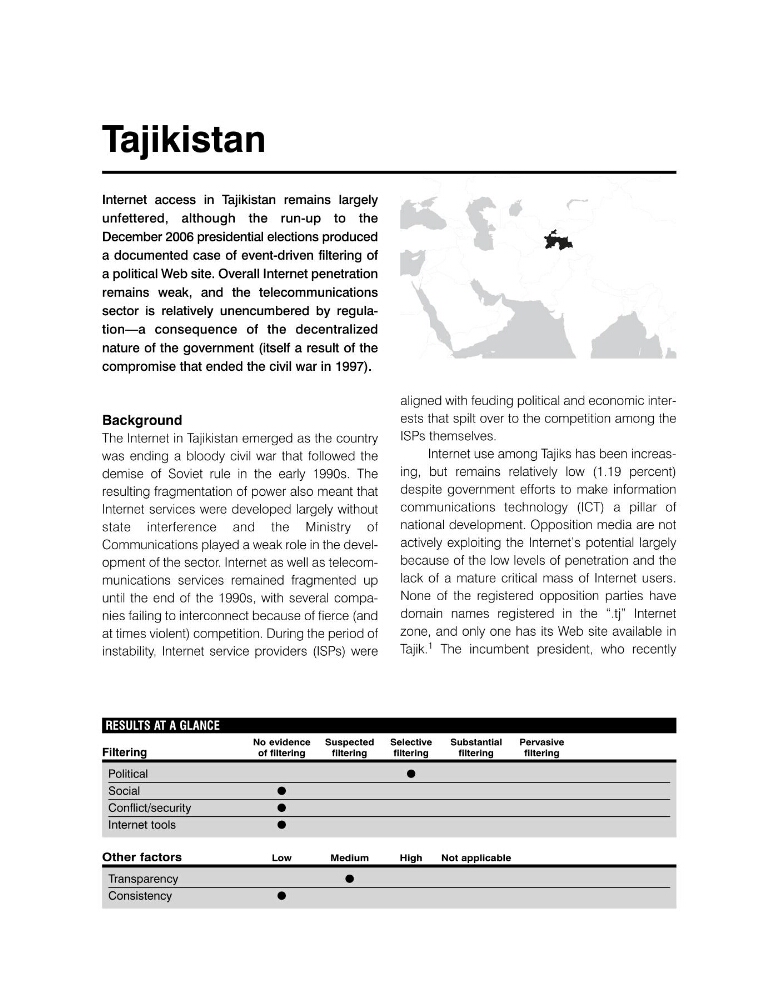
Internet access in Tajikistan remains largely
unfettered, although the run-up to the
December 2006 presidential elections produced
a documented case of event-driven filtering of
a political Web site. Overall Internet penetration
remains weak, and the telecommunications
sector is relatively unencumbered by regulation—a consequence of the decentralized
nature of the government (itself a result of the
compromise that ended the civil war in 1997).
Background
The Internet in Tajikistan emerged as the country
was ending a bloody civil war that followed the
demise of Soviet rule in the early 1990s. The
resulting fragmentation of power also meant that
Internet services were developed largely without
state interference and the Ministry of
Communications played a weak role in the development of the sector. Internet as well as telecommunications services remained fragmented up
until the end of the 1990s, with several companies failing to interconnect because of fierce (and
at times violent) competition. During the period of
instability, Internet service providers (ISPs) were
aligned with feuding political and economic interests that spilt over to the competition among the
ISPs themselves.
Internet use among Tajiks has been increasing, but remains relatively low (1.19 percent)
despite government efforts to make information
communications technology (ICT) a pillar of
national development. Opposition media are not
actively exploiting the Internet’s potential largely
because of the low levels of penetration and the
lack of a mature critical mass of Internet users.
None of the registered opposition parties have
domain names registered in the “.tj” Internet
zone, and only one has its Web site available in
Tajik. 1 The incumbent president, who recently
RESULTS AT A GLANCE
No evidence
Suspected
Selective
Substantial
Pervasive
Filtering
of filtering
filtering
filtering
filtering
filtering
Political
●
Social
●
Conflict/security
●
Internet tools
●
Other factors
Low
Medium
High
Not applicable
Transparency
●
Consistency
●
Tajikistan
unfettered, although the run-up to the
December 2006 presidential elections produced
a documented case of event-driven filtering of
a political Web site. Overall Internet penetration
remains weak, and the telecommunications
sector is relatively unencumbered by regulation—a consequence of the decentralized
nature of the government (itself a result of the
compromise that ended the civil war in 1997).
Background
The Internet in Tajikistan emerged as the country
was ending a bloody civil war that followed the
demise of Soviet rule in the early 1990s. The
resulting fragmentation of power also meant that
Internet services were developed largely without
state interference and the Ministry of
Communications played a weak role in the development of the sector. Internet as well as telecommunications services remained fragmented up
until the end of the 1990s, with several companies failing to interconnect because of fierce (and
at times violent) competition. During the period of
instability, Internet service providers (ISPs) were
aligned with feuding political and economic interests that spilt over to the competition among the
ISPs themselves.
Internet use among Tajiks has been increasing, but remains relatively low (1.19 percent)
despite government efforts to make information
communications technology (ICT) a pillar of
national development. Opposition media are not
actively exploiting the Internet’s potential largely
because of the low levels of penetration and the
lack of a mature critical mass of Internet users.
None of the registered opposition parties have
domain names registered in the “.tj” Internet
zone, and only one has its Web site available in
Tajik. 1 The incumbent president, who recently
RESULTS AT A GLANCE
No evidence
Suspected
Selective
Substantial
Pervasive
Filtering
of filtering
filtering
filtering
filtering
filtering
Political
●
Social
●
Conflict/security
●
Internet tools
●
Other factors
Low
Medium
High
Not applicable
Transparency
●
Consistency
●
Tajikistan