

started his third seven-year mandate,
2
exerts a
degree of control over the independent media
while suppressing the opposition with prosecutions based on broad and inconsistent interpretations of the relevant laws. 3
Internet in Tajikistan
The rate of Internet penetration in Tajikistan is
estimated between 0.075 percent
4
and 1.19 percent.
5
Empirical data show the number of active
Internet users to be growing rapidly, with estimated total numbers that are higher than the Ministry
of Communications’ estimate of 26,000. 6 The discrepancy in figures probably arises from the hesitancy of most commercial ISPs to disclose accurate user statistics in order to avoid a per user
charge. No official data exist on the number of
personal computers in Tajikistan. Khoma, 7 a local
nongovernmental organization (NGO), estimates
that 1 percent of households own personal computers and over 1 percent of those access
Internet from home, mostly using dialup technology. Access via DSL and Wi-Fi technologies is
affordable only to a handful of companies.
Satellite connection is widely used and few ISPs
use Mach 6 technology to connect mountain
towns and district regions. The state-owned
telecommunications company Tajiktelecom built
a connection to the Trans Asia Europe (TAE)
fiber-optic highway passing through Uzbekistan;
however, ISPs prefer to use their own infrastructure. The Internet exchange point in Tajikistan,
managed by the Association of Tajikistani ISPs,
connects only four of the eleven ISPs.
Internet access remains largely unaffordable, as the average monthly salary in the country amounts to USD30–40, while the minimum
salary drops to USD7. The price for one hour of
Internet access in cybercafés is USD0.41; unlimited monthly traffic by dialup access costs
USD29.41 and limited ADSL access costs
USD25. 8
Most Internet users are young and access
the Internet through cybercafés close to schools
and universities. In January 2006, the Ministry of
Communications estimated that some 400
cybercafés existed, most concentrated in large
cities. The cybercafés, operating as second-tier
ISPs, need to obtain licenses before starting their
activity. Although over 70 percent of the population resides in rural areas, the Internet is mainly
accessible in urban areas because of poor infrastructure and low affordability. A 2005 study
386
Country Summaries
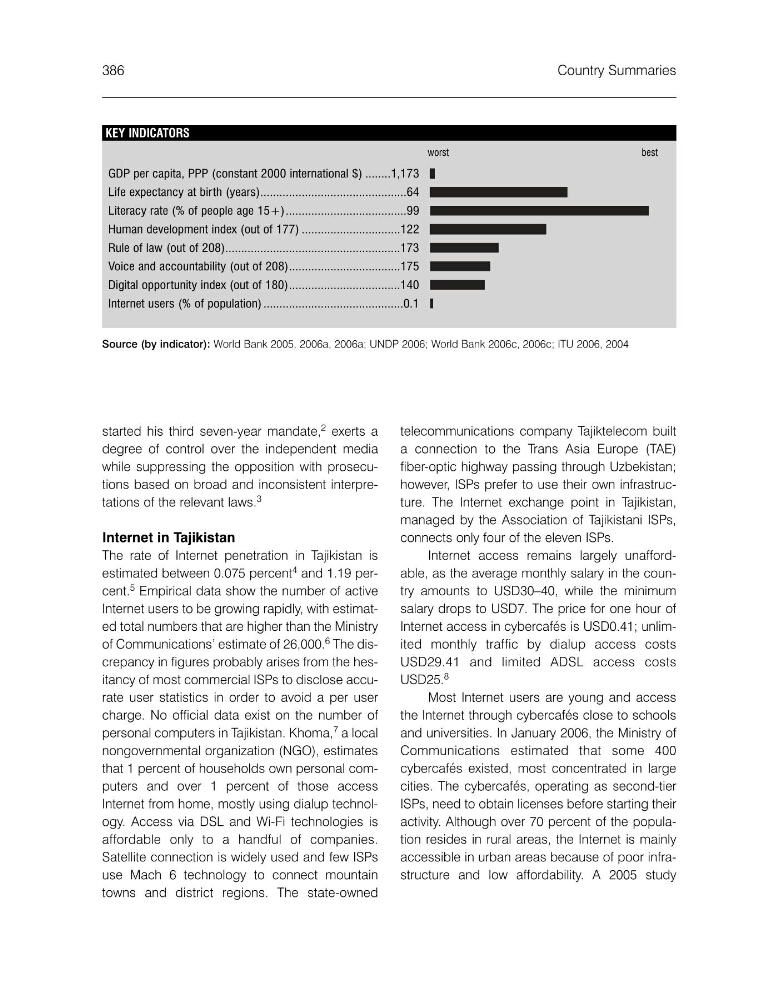
KEY INDICATORS
worst
best
GDP per capita, PPP (constant 2000 international $) ........1,173 3.45
Life expectancy at birth (years)..............................................64 4.67
Literacy rate (% of people age 15+)......................................99 6.87
Human development index (out of 177) ...............................122 4.33
Rule of law (out of 208).......................................................173 3.02
Voice and accountability (out of 208)...................................175 2.66
Digital opportunity index (out of 180)...................................140 3.13
Internet users (% of population) ............................................0.1 3.07
Source (by indicator): World Bank 2005, 2006a, 2006a; UNDP 2006; World Bank 2006c, 2006c; ITU 2006, 2004
2
exerts a
degree of control over the independent media
while suppressing the opposition with prosecutions based on broad and inconsistent interpretations of the relevant laws. 3
Internet in Tajikistan
The rate of Internet penetration in Tajikistan is
estimated between 0.075 percent
4
and 1.19 percent.
5
Empirical data show the number of active
Internet users to be growing rapidly, with estimated total numbers that are higher than the Ministry
of Communications’ estimate of 26,000. 6 The discrepancy in figures probably arises from the hesitancy of most commercial ISPs to disclose accurate user statistics in order to avoid a per user
charge. No official data exist on the number of
personal computers in Tajikistan. Khoma, 7 a local
nongovernmental organization (NGO), estimates
that 1 percent of households own personal computers and over 1 percent of those access
Internet from home, mostly using dialup technology. Access via DSL and Wi-Fi technologies is
affordable only to a handful of companies.
Satellite connection is widely used and few ISPs
use Mach 6 technology to connect mountain
towns and district regions. The state-owned
telecommunications company Tajiktelecom built
a connection to the Trans Asia Europe (TAE)
fiber-optic highway passing through Uzbekistan;
however, ISPs prefer to use their own infrastructure. The Internet exchange point in Tajikistan,
managed by the Association of Tajikistani ISPs,
connects only four of the eleven ISPs.
Internet access remains largely unaffordable, as the average monthly salary in the country amounts to USD30–40, while the minimum
salary drops to USD7. The price for one hour of
Internet access in cybercafés is USD0.41; unlimited monthly traffic by dialup access costs
USD29.41 and limited ADSL access costs
USD25. 8
Most Internet users are young and access
the Internet through cybercafés close to schools
and universities. In January 2006, the Ministry of
Communications estimated that some 400
cybercafés existed, most concentrated in large
cities. The cybercafés, operating as second-tier
ISPs, need to obtain licenses before starting their
activity. Although over 70 percent of the population resides in rural areas, the Internet is mainly
accessible in urban areas because of poor infrastructure and low affordability. A 2005 study
386
Country Summaries
KEY INDICATORS
worst
best
GDP per capita, PPP (constant 2000 international $) ........1,173 3.45
Life expectancy at birth (years)..............................................64 4.67
Literacy rate (% of people age 15+)......................................99 6.87
Human development index (out of 177) ...............................122 4.33
Rule of law (out of 208).......................................................173 3.02
Voice and accountability (out of 208)...................................175 2.66
Digital opportunity index (out of 180)...................................140 3.13
Internet users (% of population) ............................................0.1 3.07
Source (by indicator): World Bank 2005, 2006a, 2006a; UNDP 2006; World Bank 2006c, 2006c; ITU 2006, 2004