

growing rapidly—the result of a competitive
Internet service provider (ISP) market and low
Internet access prices.
6
Thirty-one private ISPs
offer Internet access to businesses and consumers, though two, Worldlink and Mercantile,
dominate the market with a combined share of
more than 70 percent. 7 Cybercafés are important
sources of Internet access for Nepalis; the country is believed to have the highest concentration
of cybercafés in the world. 8 Much of Nepal’s
Internet access is concentrated in the moredeveloped Katmandu Valley region, as the mountainous terrain and low income in remote regions
of the country make access more difficult.
However, one effort to bring Internet access to
rural
populations—the
Nepali
Wireless
Networking Project—has already wirelessly connected seven remote mountain villages to the
Internet, with plans to network twenty-one villages
in all. 9
Although relatively few Nepalis presently get
their news from the Internet, it has nevertheless
become an important source of independent
news in Nepal. 10 When King Gyanendra
assumed authoritarian control in 2005, for example, traditional media were either shut down or
heavily censored to ensure the publication of only
favorable news about the monarch. 11 Nepali
bloggers became an important political voice
and source of information to the world about the
situation unfolding inside the country. 12
Legal and regulatory frameworks
Nepal’s legal system is in flux because of its
unstable political landscape and its new constitution. The most recent collapse occurred in
February 2005, when the king assumed control of
the government and armed forces. 13 Mass civilian protests followed, and he was forced to reinstate parliament and ultimately relinquish all official powers to the prime minister and parliament. 14 The king sought to stifle the independent
media during his tenure, passing the repressive
Media Law, which prohibited criticism of the king
and royal family and the broadcast of news over
independent FM radio stations (an important
source of independent news in the country). The
Media Law also increased the penalties for
defamation tenfold. The law was repealed once
parliament was reinstated. 15
In December 2006, seven political parties
and the Maoists agreed on a new interim constitution that paves the way for the Maoists to join
the political mainstream and nationalizes royal
344
Country Summaries
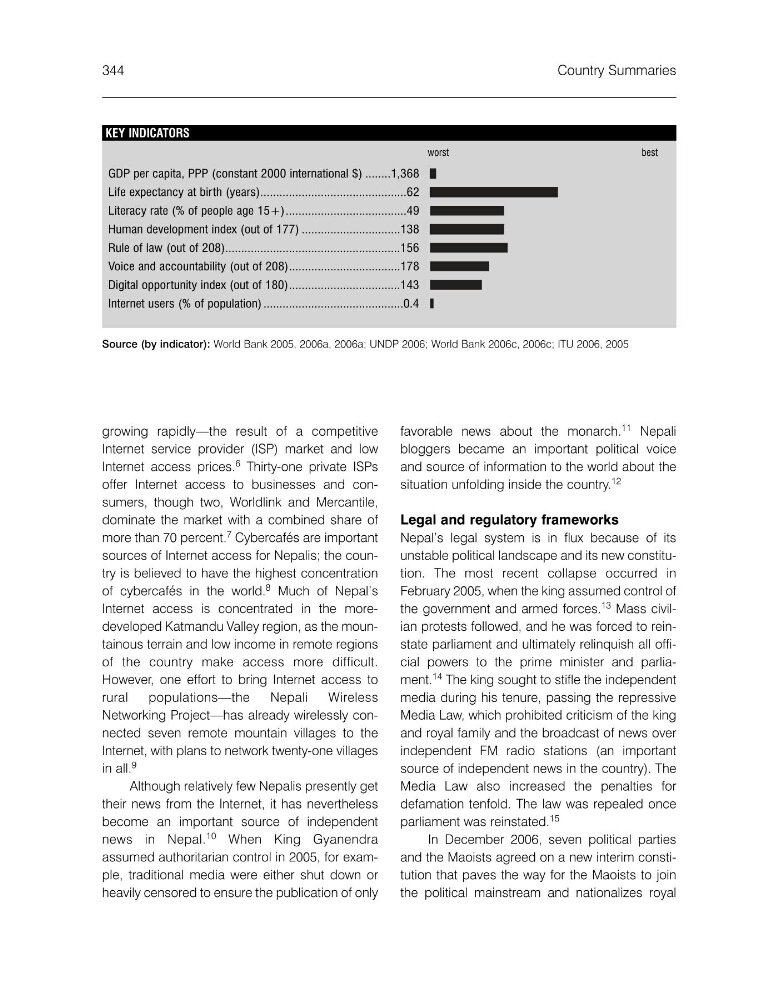
KEY INDICATORS
worst
best
GDP per capita, PPP (constant 2000 international $) ........1,368 3.48
Life expectancy at birth (years)..............................................62 4.35
Literacy rate (% of people age 15+)......................................49 2.00
Human development index (out of 177) ...............................138 2.91
Rule of law (out of 208).......................................................156 3.39
Voice and accountability (out of 208)...................................178 2.62
Digital opportunity index (out of 180)...................................143 3.02
Internet users (% of population) ............................................0.4 3.10
Source (by indicator): World Bank 2005, 2006a, 2006a; UNDP 2006; World Bank 2006c, 2006c; ITU 2006, 2005
Internet service provider (ISP) market and low
Internet access prices.
6
Thirty-one private ISPs
offer Internet access to businesses and consumers, though two, Worldlink and Mercantile,
dominate the market with a combined share of
more than 70 percent. 7 Cybercafés are important
sources of Internet access for Nepalis; the country is believed to have the highest concentration
of cybercafés in the world. 8 Much of Nepal’s
Internet access is concentrated in the moredeveloped Katmandu Valley region, as the mountainous terrain and low income in remote regions
of the country make access more difficult.
However, one effort to bring Internet access to
rural
populations—the
Nepali
Wireless
Networking Project—has already wirelessly connected seven remote mountain villages to the
Internet, with plans to network twenty-one villages
in all. 9
Although relatively few Nepalis presently get
their news from the Internet, it has nevertheless
become an important source of independent
news in Nepal. 10 When King Gyanendra
assumed authoritarian control in 2005, for example, traditional media were either shut down or
heavily censored to ensure the publication of only
favorable news about the monarch. 11 Nepali
bloggers became an important political voice
and source of information to the world about the
situation unfolding inside the country. 12
Legal and regulatory frameworks
Nepal’s legal system is in flux because of its
unstable political landscape and its new constitution. The most recent collapse occurred in
February 2005, when the king assumed control of
the government and armed forces. 13 Mass civilian protests followed, and he was forced to reinstate parliament and ultimately relinquish all official powers to the prime minister and parliament. 14 The king sought to stifle the independent
media during his tenure, passing the repressive
Media Law, which prohibited criticism of the king
and royal family and the broadcast of news over
independent FM radio stations (an important
source of independent news in the country). The
Media Law also increased the penalties for
defamation tenfold. The law was repealed once
parliament was reinstated. 15
In December 2006, seven political parties
and the Maoists agreed on a new interim constitution that paves the way for the Maoists to join
the political mainstream and nationalizes royal
344
Country Summaries
KEY INDICATORS
worst
best
GDP per capita, PPP (constant 2000 international $) ........1,368 3.48
Life expectancy at birth (years)..............................................62 4.35
Literacy rate (% of people age 15+)......................................49 2.00
Human development index (out of 177) ...............................138 2.91
Rule of law (out of 208).......................................................156 3.39
Voice and accountability (out of 208)...................................178 2.62
Digital opportunity index (out of 180)...................................143 3.02
Internet users (% of population) ............................................0.4 3.10
Source (by indicator): World Bank 2005, 2006a, 2006a; UNDP 2006; World Bank 2006c, 2006c; ITU 2006, 2005