

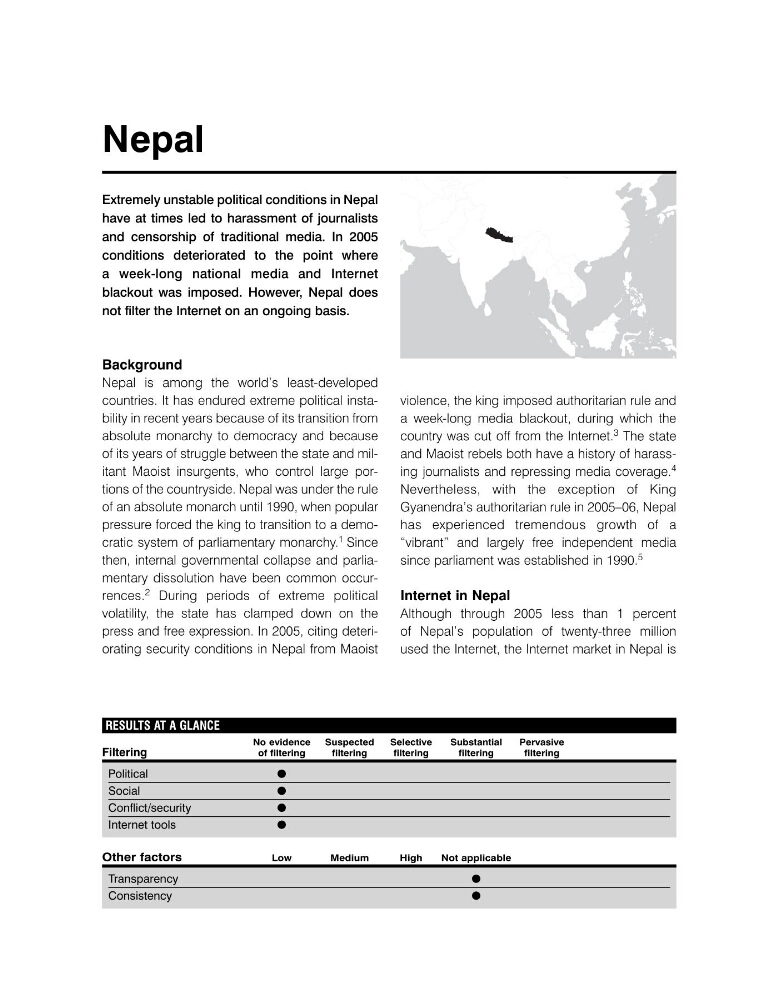
Extremely unstable political conditions in Nepal
have at times led to harassment of journalists
and censorship of traditional media. In 2005
conditions deteriorated to the point where
a week-long national media and Internet
blackout was imposed. However, Nepal does
not filter the Internet on an ongoing basis.
Background
Nepal is among the world’s least-developed
countries. It has endured extreme political instability in recent years because of its transition from
absolute monarchy to democracy and because
of its years of struggle between the state and militant Maoist insurgents, who control large portions of the countryside. Nepal was under the rule
of an absolute monarch until 1990, when popular
pressure forced the king to transition to a democratic system of parliamentary monarchy. 1 Since
then, internal governmental collapse and parliamentary dissolution have been common occurrences. 2 During periods of extreme political
volatility, the state has clamped down on the
press and free expression. In 2005, citing deteriorating security conditions in Nepal from Maoist
violence, the king imposed authoritarian rule and
a week-long media blackout, during which the
country was cut off from the Internet. 3 The state
and Maoist rebels both have a history of harassing journalists and repressing media coverage. 4
Nevertheless, with the exception of King
Gyanendra’s authoritarian rule in 2005–06, Nepal
has experienced tremendous growth of a
“vibrant” and largely free independent media
since parliament was established in 1990. 5
Internet in Nepal
Although through 2005 less than 1 percent
of Nepal’s population of twenty-three million
used the Internet, the Internet market in Nepal is
RESULTS AT A GLANCE
No evidence
Suspected
Selective
Substantial
Pervasive
Filtering
of filtering
filtering
filtering
filtering
filtering
Political
●
Social
●
Conflict/security
●
Internet tools
●
Other factors
Low
Medium
High
Not applicable
Transparency
●
Consistency
●
Nepal
have at times led to harassment of journalists
and censorship of traditional media. In 2005
conditions deteriorated to the point where
a week-long national media and Internet
blackout was imposed. However, Nepal does
not filter the Internet on an ongoing basis.
Background
Nepal is among the world’s least-developed
countries. It has endured extreme political instability in recent years because of its transition from
absolute monarchy to democracy and because
of its years of struggle between the state and militant Maoist insurgents, who control large portions of the countryside. Nepal was under the rule
of an absolute monarch until 1990, when popular
pressure forced the king to transition to a democratic system of parliamentary monarchy. 1 Since
then, internal governmental collapse and parliamentary dissolution have been common occurrences. 2 During periods of extreme political
volatility, the state has clamped down on the
press and free expression. In 2005, citing deteriorating security conditions in Nepal from Maoist
violence, the king imposed authoritarian rule and
a week-long media blackout, during which the
country was cut off from the Internet. 3 The state
and Maoist rebels both have a history of harassing journalists and repressing media coverage. 4
Nevertheless, with the exception of King
Gyanendra’s authoritarian rule in 2005–06, Nepal
has experienced tremendous growth of a
“vibrant” and largely free independent media
since parliament was established in 1990. 5
Internet in Nepal
Although through 2005 less than 1 percent
of Nepal’s population of twenty-three million
used the Internet, the Internet market in Nepal is
RESULTS AT A GLANCE
No evidence
Suspected
Selective
Substantial
Pervasive
Filtering
of filtering
filtering
filtering
filtering
filtering
Political
●
Social
●
Conflict/security
●
Internet tools
●
Other factors
Low
Medium
High
Not applicable
Transparency
●
Consistency
●
Nepal