

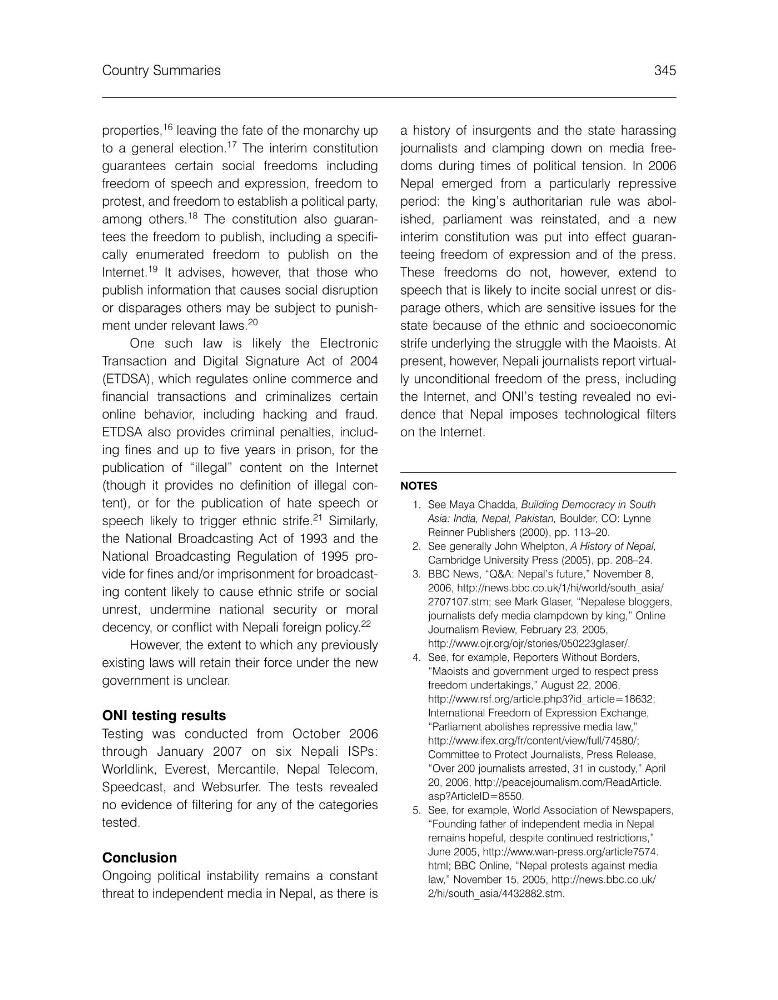
properties,
16
leaving the fate of the monarchy up
to a general election.
17
The interim constitution
guarantees certain social freedoms including
freedom of speech and expression, freedom to
protest, and freedom to establish a political party,
among others. 18 The constitution also guarantees the freedom to publish, including a specifically enumerated freedom to publish on the
Internet. 19 It advises, however, that those who
publish information that causes social disruption
or disparages others may be subject to punishment under relevant laws. 20
One such law is likely the Electronic
Transaction and Digital Signature Act of 2004
(ETDSA), which regulates online commerce and
financial transactions and criminalizes certain
online behavior, including hacking and fraud.
ETDSA also provides criminal penalties, including fines and up to five years in prison, for the
publication of “illegal” content on the Internet
(though it provides no definition of illegal content), or for the publication of hate speech or
speech likely to trigger ethnic strife. 21 Similarly,
the National Broadcasting Act of 1993 and the
National Broadcasting Regulation of 1995 provide for fines and/or imprisonment for broadcasting content likely to cause ethnic strife or social
unrest, undermine national security or moral
decency, or conflict with Nepali foreign policy. 22
However, the extent to which any previously
existing laws will retain their force under the new
government is unclear.
ONI testing results
Testing was conducted from October 2006
through January 2007 on six Nepali ISPs:
Worldlink, Everest, Mercantile, Nepal Telecom,
Speedcast, and Websurfer. The tests revealed
no evidence of filtering for any of the categories
tested.
Conclusion
Ongoing political instability remains a constant
threat to independent media in Nepal, as there is
a history of insurgents and the state harassing
journalists and clamping down on media freedoms during times of political tension. In 2006
Nepal emerged from a particularly repressive
period: the king’s authoritarian rule was abolished, parliament was reinstated, and a new
interim constitution was put into effect guaranteeing freedom of expression and of the press.
These freedoms do not, however, extend to
speech that is likely to incite social unrest or disparage others, which are sensitive issues for the
state because of the ethnic and socioeconomic
strife underlying the struggle with the Maoists. At
present, however, Nepali journalists report virtually unconditional freedom of the press, including
the Internet, and ONI’s testing revealed no evidence that Nepal imposes technological filters
on the Internet.
NOTES
1. See Maya Chadda, Building Democracy in South
Asia: India, Nepal, Pakistan, Boulder, CO: Lynne
Reinner Publishers (2000), pp. 113–20.
2. See generally John Whelpton, A History of Nepal,
Cambridge University Press (2005), pp. 208–24.
3. BBC News, “Q&A: Nepal’s future,” November 8,
2006, http://news.bbc.co.uk/1/hi/world/south_asia/
2707107.stm; see Mark Glaser, “Nepalese bloggers,
journalists defy media clampdown by king,” Online
Journalism Review, February 23, 2005,
http://www.ojr.org/ojr/stories/050223glaser/.
4. See, for example, Reporters Without Borders,
“Maoists and government urged to respect press
freedom undertakings,” August 22, 2006,
http://www.rsf.org/article.php3?id_article=18632;
International Freedom of Expression Exchange,
“Parliament abolishes repressive media law,”
http://www.ifex.org/fr/content/view/full/74580/;
Committee to Protect Journalists, Press Release,
“Over 200 journalists arrested, 31 in custody,” April
20, 2006, http://peacejournalism.com/ReadArticle.
asp?ArticleID=8550.
5. See, for example, World Association of Newspapers,
“Founding father of independent media in Nepal
remains hopeful, despite continued restrictions,”
June 2005, http://www.wan-press.org/article7574.
html; BBC Online, “Nepal protests against media
law,” November 15, 2005, http://news.bbc.co.uk/
2/hi/south_asia/4432882.stm.
Country Summaries
345
16
leaving the fate of the monarchy up
to a general election.
17
The interim constitution
guarantees certain social freedoms including
freedom of speech and expression, freedom to
protest, and freedom to establish a political party,
among others. 18 The constitution also guarantees the freedom to publish, including a specifically enumerated freedom to publish on the
Internet. 19 It advises, however, that those who
publish information that causes social disruption
or disparages others may be subject to punishment under relevant laws. 20
One such law is likely the Electronic
Transaction and Digital Signature Act of 2004
(ETDSA), which regulates online commerce and
financial transactions and criminalizes certain
online behavior, including hacking and fraud.
ETDSA also provides criminal penalties, including fines and up to five years in prison, for the
publication of “illegal” content on the Internet
(though it provides no definition of illegal content), or for the publication of hate speech or
speech likely to trigger ethnic strife. 21 Similarly,
the National Broadcasting Act of 1993 and the
National Broadcasting Regulation of 1995 provide for fines and/or imprisonment for broadcasting content likely to cause ethnic strife or social
unrest, undermine national security or moral
decency, or conflict with Nepali foreign policy. 22
However, the extent to which any previously
existing laws will retain their force under the new
government is unclear.
ONI testing results
Testing was conducted from October 2006
through January 2007 on six Nepali ISPs:
Worldlink, Everest, Mercantile, Nepal Telecom,
Speedcast, and Websurfer. The tests revealed
no evidence of filtering for any of the categories
tested.
Conclusion
Ongoing political instability remains a constant
threat to independent media in Nepal, as there is
a history of insurgents and the state harassing
journalists and clamping down on media freedoms during times of political tension. In 2006
Nepal emerged from a particularly repressive
period: the king’s authoritarian rule was abolished, parliament was reinstated, and a new
interim constitution was put into effect guaranteeing freedom of expression and of the press.
These freedoms do not, however, extend to
speech that is likely to incite social unrest or disparage others, which are sensitive issues for the
state because of the ethnic and socioeconomic
strife underlying the struggle with the Maoists. At
present, however, Nepali journalists report virtually unconditional freedom of the press, including
the Internet, and ONI’s testing revealed no evidence that Nepal imposes technological filters
on the Internet.
NOTES
1. See Maya Chadda, Building Democracy in South
Asia: India, Nepal, Pakistan, Boulder, CO: Lynne
Reinner Publishers (2000), pp. 113–20.
2. See generally John Whelpton, A History of Nepal,
Cambridge University Press (2005), pp. 208–24.
3. BBC News, “Q&A: Nepal’s future,” November 8,
2006, http://news.bbc.co.uk/1/hi/world/south_asia/
2707107.stm; see Mark Glaser, “Nepalese bloggers,
journalists defy media clampdown by king,” Online
Journalism Review, February 23, 2005,
http://www.ojr.org/ojr/stories/050223glaser/.
4. See, for example, Reporters Without Borders,
“Maoists and government urged to respect press
freedom undertakings,” August 22, 2006,
http://www.rsf.org/article.php3?id_article=18632;
International Freedom of Expression Exchange,
“Parliament abolishes repressive media law,”
http://www.ifex.org/fr/content/view/full/74580/;
Committee to Protect Journalists, Press Release,
“Over 200 journalists arrested, 31 in custody,” April
20, 2006, http://peacejournalism.com/ReadArticle.
asp?ArticleID=8550.
5. See, for example, World Association of Newspapers,
“Founding father of independent media in Nepal
remains hopeful, despite continued restrictions,”
June 2005, http://www.wan-press.org/article7574.
html; BBC Online, “Nepal protests against media
law,” November 15, 2005, http://news.bbc.co.uk/
2/hi/south_asia/4432882.stm.
Country Summaries
345