

imposed by the government on content, especially those on topics relating to Gaddafi or his
family or to the plight of the Berber minority.
7
The
press laws also make the formation of private
media illegal by restricting the right to publish to
only two public organizations. 8
At the same time as the Libyan opposition
has increasingly used the Internet to spread its
message,
9
the crackdown on journalistic freedom has moved into the realm of the Internet as
well. In the country’s most famous case, a fiftyone-year-old bookseller named Abdel Razak Al
Mansouri was arrested in January 2005 and interrogated about a number his posts on the Akbar
Libya Web site (www.akhbar-libya.com) that were
critical of the government. Though never charged
with a crime related to those posts, he was eventually charged, convicted, and sentenced to a
year and a half in jail for possession of a gun
without a license. He served a year before being
granted amnesty. 10
Internet in Libya
Internet access officially came to Libya at the end
of 1998, but it was not widely available until early
2000. 11 Internet penetration remains low, at
around 4 percent,
12
at least in part because of
the long-term economic sanctions imposed on
the country.
13
The primary means for people to
connect is through Internet cafés.
14
The state-owned General Post and
Telecommunications Company (GPTC), run by
Gaddafi’s son, Mohamed al-Gaddafi,
15
regulates
and operates Libya’s telecommunications infrastructure, providing “international and local voice
services, digital leased lines, telex, fax, mobile
(through a partially owned subsidiary) and
Internet services.” 16 The GPTC also owns the
country’s primary ISP, Libya Telecom and
Technology (LTT), which offers Internet services
via dialup, DSL, broadband, and satellite, 17
though at least seven companies other companies are licensed. These competitors are effectively subordinated to LTT, however, as LTT maintains a monopoly over the country’s international
Internet gateway. 18
In October 2006 the government of Libya
reached an agreement with One Laptop per
Child, a nonprofit United States group developing
an inexpensive, educational laptop computer,
with the goal of supplying machines to all 1.2
million Libyan schoolchildren by June 2008. 19
As the country only contained 130,000 computers in 2002,
20
this will be a major boost to the
322
Country Summaries
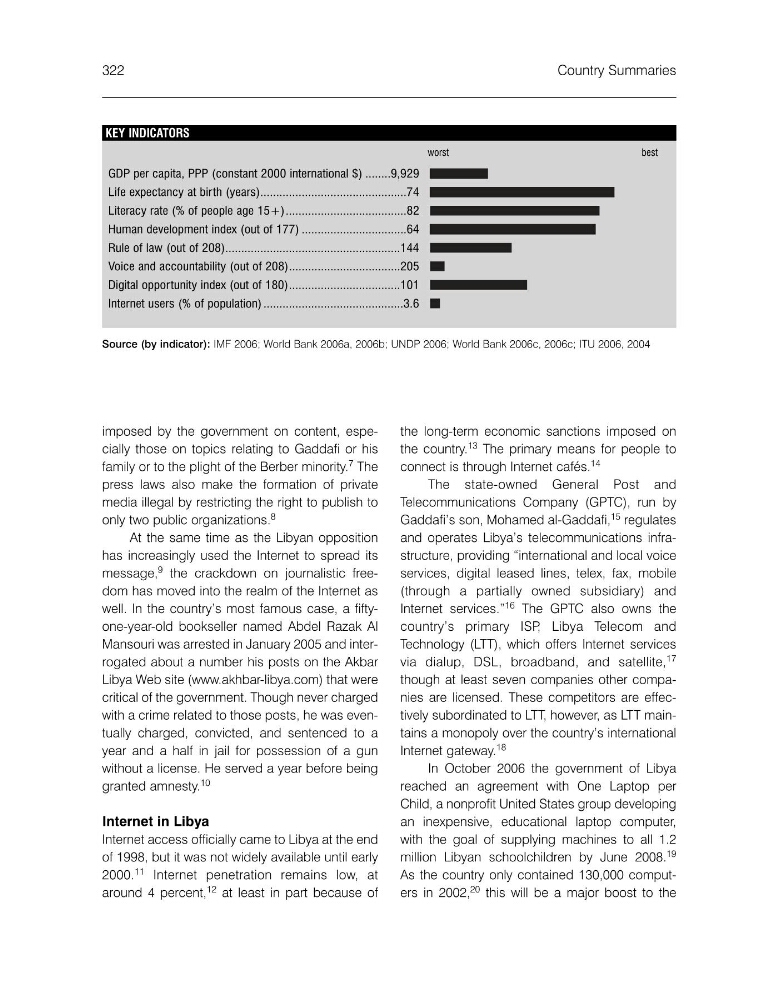
KEY INDICATORS
worst
best
GDP per capita, PPP (constant 2000 international $) ........9,929 5.13
Life expectancy at birth (years)..............................................74 6.28
Literacy rate (% of people age 15+)......................................82 5.22
Human development index (out of 177) .................................64 5.98
Rule of law (out of 208).......................................................144 3.54
Voice and accountability (out of 208)...................................205 1.14
Digital opportunity index (out of 180)...................................101 4.78
Internet users (% of population) ............................................3.6 3.40
Source (by indicator): IMF 2006; World Bank 2006a, 2006b; UNDP 2006; World Bank 2006c, 2006c; ITU 2006, 2004
family or to the plight of the Berber minority.
7
The
press laws also make the formation of private
media illegal by restricting the right to publish to
only two public organizations. 8
At the same time as the Libyan opposition
has increasingly used the Internet to spread its
message,
9
the crackdown on journalistic freedom has moved into the realm of the Internet as
well. In the country’s most famous case, a fiftyone-year-old bookseller named Abdel Razak Al
Mansouri was arrested in January 2005 and interrogated about a number his posts on the Akbar
Libya Web site (www.akhbar-libya.com) that were
critical of the government. Though never charged
with a crime related to those posts, he was eventually charged, convicted, and sentenced to a
year and a half in jail for possession of a gun
without a license. He served a year before being
granted amnesty. 10
Internet in Libya
Internet access officially came to Libya at the end
of 1998, but it was not widely available until early
2000. 11 Internet penetration remains low, at
around 4 percent,
12
at least in part because of
the long-term economic sanctions imposed on
the country.
13
The primary means for people to
connect is through Internet cafés.
14
The state-owned General Post and
Telecommunications Company (GPTC), run by
Gaddafi’s son, Mohamed al-Gaddafi,
15
regulates
and operates Libya’s telecommunications infrastructure, providing “international and local voice
services, digital leased lines, telex, fax, mobile
(through a partially owned subsidiary) and
Internet services.” 16 The GPTC also owns the
country’s primary ISP, Libya Telecom and
Technology (LTT), which offers Internet services
via dialup, DSL, broadband, and satellite, 17
though at least seven companies other companies are licensed. These competitors are effectively subordinated to LTT, however, as LTT maintains a monopoly over the country’s international
Internet gateway. 18
In October 2006 the government of Libya
reached an agreement with One Laptop per
Child, a nonprofit United States group developing
an inexpensive, educational laptop computer,
with the goal of supplying machines to all 1.2
million Libyan schoolchildren by June 2008. 19
As the country only contained 130,000 computers in 2002,
20
this will be a major boost to the
322
Country Summaries
KEY INDICATORS
worst
best
GDP per capita, PPP (constant 2000 international $) ........9,929 5.13
Life expectancy at birth (years)..............................................74 6.28
Literacy rate (% of people age 15+)......................................82 5.22
Human development index (out of 177) .................................64 5.98
Rule of law (out of 208).......................................................144 3.54
Voice and accountability (out of 208)...................................205 1.14
Digital opportunity index (out of 180)...................................101 4.78
Internet users (% of population) ............................................3.6 3.40
Source (by indicator): IMF 2006; World Bank 2006a, 2006b; UNDP 2006; World Bank 2006c, 2006c; ITU 2006, 2004