

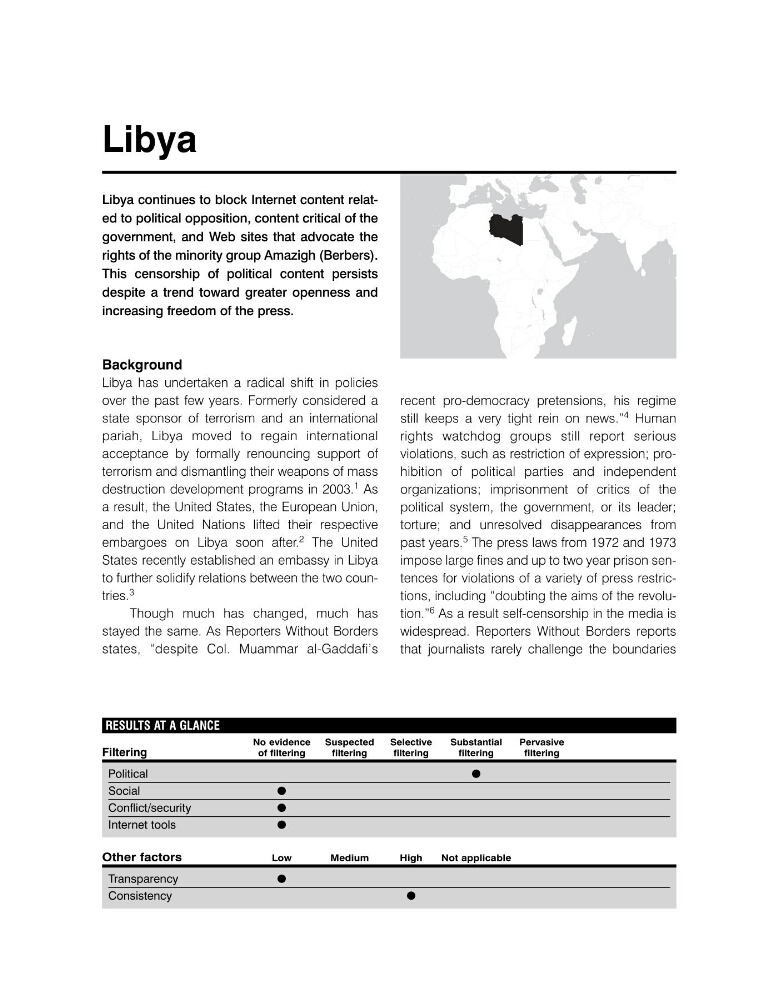
Libya continues to block Internet content related to political opposition, content critical of the
government, and Web sites that advocate the
rights of the minority group Amazigh (Berbers).
This censorship of political content persists
despite a trend toward greater openness and
increasing freedom of the press.
Background
Libya has undertaken a radical shift in policies
over the past few years. Formerly considered a
state sponsor of terrorism and an international
pariah, Libya moved to regain international
acceptance by formally renouncing support of
terrorism and dismantling their weapons of mass
destruction development programs in 2003. 1 As
a result, the United States, the European Union,
and the United Nations lifted their respective
embargoes on Libya soon after. 2 The United
States recently established an embassy in Libya
to further solidify relations between the two countries. 3
Though much has changed, much has
stayed the same. As Reporters Without Borders
states, “despite Col. Muammar al-Gaddafi’s
recent pro-democracy pretensions, his regime
still keeps a very tight rein on news.” 4 Human
rights watchdog groups still report serious
violations, such as restriction of expression; prohibition of political parties and independent
organizations; imprisonment of critics of the
political system, the government, or its leader;
torture; and unresolved disappearances from
past years. 5 The press laws from 1972 and 1973
impose large fines and up to two year prison sentences for violations of a variety of press restrictions, including “doubting the aims of the revolution.” 6 As a result self-censorship in the media is
widespread. Reporters Without Borders reports
that journalists rarely challenge the boundaries
RESULTS AT A GLANCE
No evidence
Suspected
Selective
Substantial
Pervasive
Filtering
of filtering
filtering
filtering
filtering
filtering
Political
●
Social
●
Conflict/security
●
Internet tools
●
Other factors
Low
Medium
High
Not applicable
Transparency
●
Consistency
●
Libya
government, and Web sites that advocate the
rights of the minority group Amazigh (Berbers).
This censorship of political content persists
despite a trend toward greater openness and
increasing freedom of the press.
Background
Libya has undertaken a radical shift in policies
over the past few years. Formerly considered a
state sponsor of terrorism and an international
pariah, Libya moved to regain international
acceptance by formally renouncing support of
terrorism and dismantling their weapons of mass
destruction development programs in 2003. 1 As
a result, the United States, the European Union,
and the United Nations lifted their respective
embargoes on Libya soon after. 2 The United
States recently established an embassy in Libya
to further solidify relations between the two countries. 3
Though much has changed, much has
stayed the same. As Reporters Without Borders
states, “despite Col. Muammar al-Gaddafi’s
recent pro-democracy pretensions, his regime
still keeps a very tight rein on news.” 4 Human
rights watchdog groups still report serious
violations, such as restriction of expression; prohibition of political parties and independent
organizations; imprisonment of critics of the
political system, the government, or its leader;
torture; and unresolved disappearances from
past years. 5 The press laws from 1972 and 1973
impose large fines and up to two year prison sentences for violations of a variety of press restrictions, including “doubting the aims of the revolution.” 6 As a result self-censorship in the media is
widespread. Reporters Without Borders reports
that journalists rarely challenge the boundaries
RESULTS AT A GLANCE
No evidence
Suspected
Selective
Substantial
Pervasive
Filtering
of filtering
filtering
filtering
filtering
filtering
Political
●
Social
●
Conflict/security
●
Internet tools
●
Other factors
Low
Medium
High
Not applicable
Transparency
●
Consistency
●
Libya