

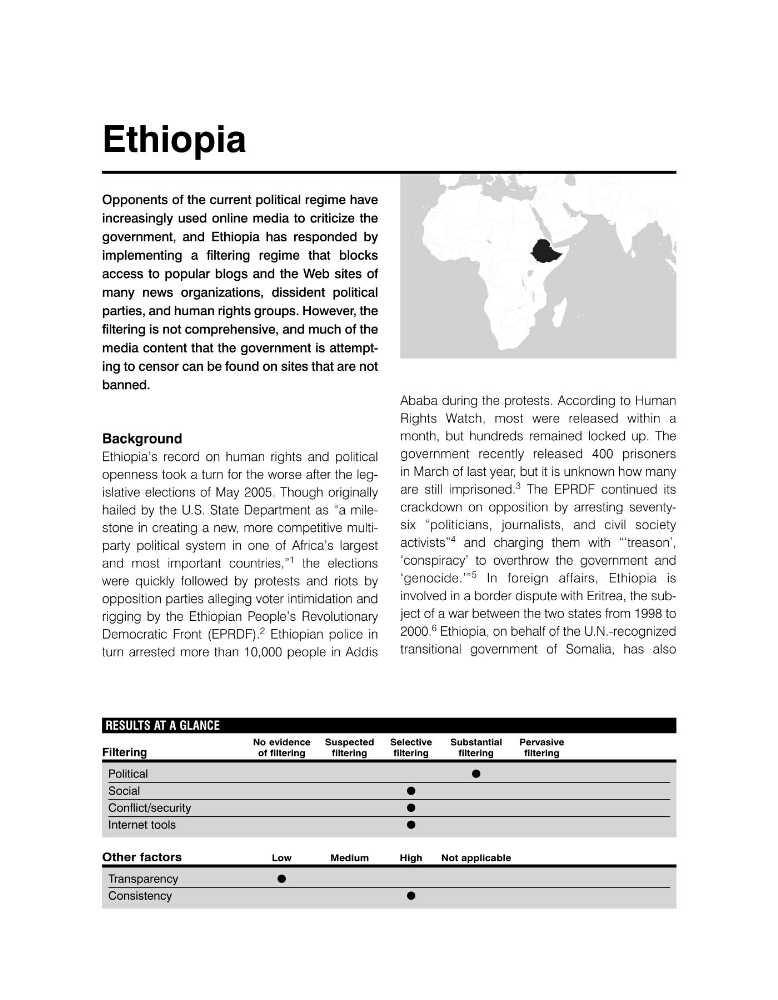
Opponents of the current political regime have
increasingly used online media to criticize the
government, and Ethiopia has responded by
implementing a filtering regime that blocks
access to popular blogs and the Web sites of
many news organizations, dissident political
parties, and human rights groups. However, the
filtering is not comprehensive, and much of the
media content that the government is attempting to censor can be found on sites that are not
banned.
Background
Ethiopia’s record on human rights and political
openness took a turn for the worse after the legislative elections of May 2005. Though originally
hailed by the U.S. State Department as “a milestone in creating a new, more competitive multiparty political system in one of Africa’s largest
and most important countries,” 1 the elections
were quickly followed by protests and riots by
opposition parties alleging voter intimidation and
rigging by the Ethiopian People’s Revolutionary
Democratic Front (EPRDF). 2 Ethiopian police in
turn arrested more than 10,000 people in Addis
Ababa during the protests. According to Human
Rights Watch, most were released within a
month, but hundreds remained locked up. The
government recently released 400 prisoners
in March of last year, but it is unknown how many
are still imprisoned. 3 The EPRDF continued its
crackdown on opposition by arresting seventysix “politicians, journalists, and civil society
activists” 4 and charging them with “‘treason’,
‘conspiracy’ to overthrow the government and
‘genocide.’” 5 In foreign affairs, Ethiopia is
involved in a border dispute with Eritrea, the subject of a war between the two states from 1998 to
2000. 6 Ethiopia, on behalf of the U.N.-recognized
transitional government of Somalia, has also
RESULTS AT A GLANCE
No evidence
Suspected
Selective
Substantial
Pervasive
Filtering
of filtering
filtering
filtering
filtering
filtering
Political
●
Social
●
Conflict/security
●
Internet tools
●
Other factors
Low
Medium
High
Not applicable
Transparency
●
Consistency
●
Ethiopia
increasingly used online media to criticize the
government, and Ethiopia has responded by
implementing a filtering regime that blocks
access to popular blogs and the Web sites of
many news organizations, dissident political
parties, and human rights groups. However, the
filtering is not comprehensive, and much of the
media content that the government is attempting to censor can be found on sites that are not
banned.
Background
Ethiopia’s record on human rights and political
openness took a turn for the worse after the legislative elections of May 2005. Though originally
hailed by the U.S. State Department as “a milestone in creating a new, more competitive multiparty political system in one of Africa’s largest
and most important countries,” 1 the elections
were quickly followed by protests and riots by
opposition parties alleging voter intimidation and
rigging by the Ethiopian People’s Revolutionary
Democratic Front (EPRDF). 2 Ethiopian police in
turn arrested more than 10,000 people in Addis
Ababa during the protests. According to Human
Rights Watch, most were released within a
month, but hundreds remained locked up. The
government recently released 400 prisoners
in March of last year, but it is unknown how many
are still imprisoned. 3 The EPRDF continued its
crackdown on opposition by arresting seventysix “politicians, journalists, and civil society
activists” 4 and charging them with “‘treason’,
‘conspiracy’ to overthrow the government and
‘genocide.’” 5 In foreign affairs, Ethiopia is
involved in a border dispute with Eritrea, the subject of a war between the two states from 1998 to
2000. 6 Ethiopia, on behalf of the U.N.-recognized
transitional government of Somalia, has also
RESULTS AT A GLANCE
No evidence
Suspected
Selective
Substantial
Pervasive
Filtering
of filtering
filtering
filtering
filtering
filtering
Political
●
Social
●
Conflict/security
●
Internet tools
●
Other factors
Low
Medium
High
Not applicable
Transparency
●
Consistency
●
Ethiopia