

entered into conflict with the Union of Islamic
Courts (UIC). The UIC is an Islamist group vying
for control of Somalia.
7
Because of the rise of
Islamist extremism in Somalia, the United States
views Ethiopia as an important ally in the global
war on terror. As a result, Ethiopia still receives
the largest amount of U.S. aid in sub-Saharan
Africa despite U.S. disapproval of the repression
following the elections of May 2005. 8 Self-censorship in the media is driven by the fear of government reprisal. Foreign journalists have difficulties
acquiring authorization to work in Ethiopia, and
an Associated Press reporter was sent out of the
country in early 2007 after “tarnish[ing] the image
of the country.” 9 The government has reportedly
entered into censorship of blogs and opposition
Web sites, though it officially denies doing so.
10
Internet in Ethiopia
Ethiopia lags behind much of Africa in Internet
availability and is currently attempting a broad
expansion of access throughout the country,
though efforts have been hampered by the largely rural makeup of the Ethiopian population and
the government’s refusal to permit any privatization of the telecommunications market. Only
113,000 people had Internet access in 2005, for
a penetration rate of 0.2 percent, one of the lowest in Africa. 11 The state-owned Ethiopian
Telecommunications Corporation is the sole
Internet service provider (ISP) in the country.
Internet cafés are a major source of access in
urban areas, and an active community of bloggers and online journalists now plays an important role in offering alternative news sources and
venues for political dialogue. However, threequarters of the country’s Internet cafés are in the
capital city, and even there access is often slow
and unreliable. 12
In 2005, Ethiopia announced plans to spend
hundreds of millions of dollars over the next three
years to connect all of the country’s schools, hospitals, and government offices—and most of its
rural population—to broadband Internet via satellite or fiber-optic cable. 13 Currently satellite
Internet is available to some large corporations,
but individuals are not permitted to have private
satellite connections. The Ethiopian Telecommunications Commission (ETC) also bans the use of
Voice-over Internet Protocol (VoIP) in Internet
cafés and by the general population. 14
282
Country Summaries
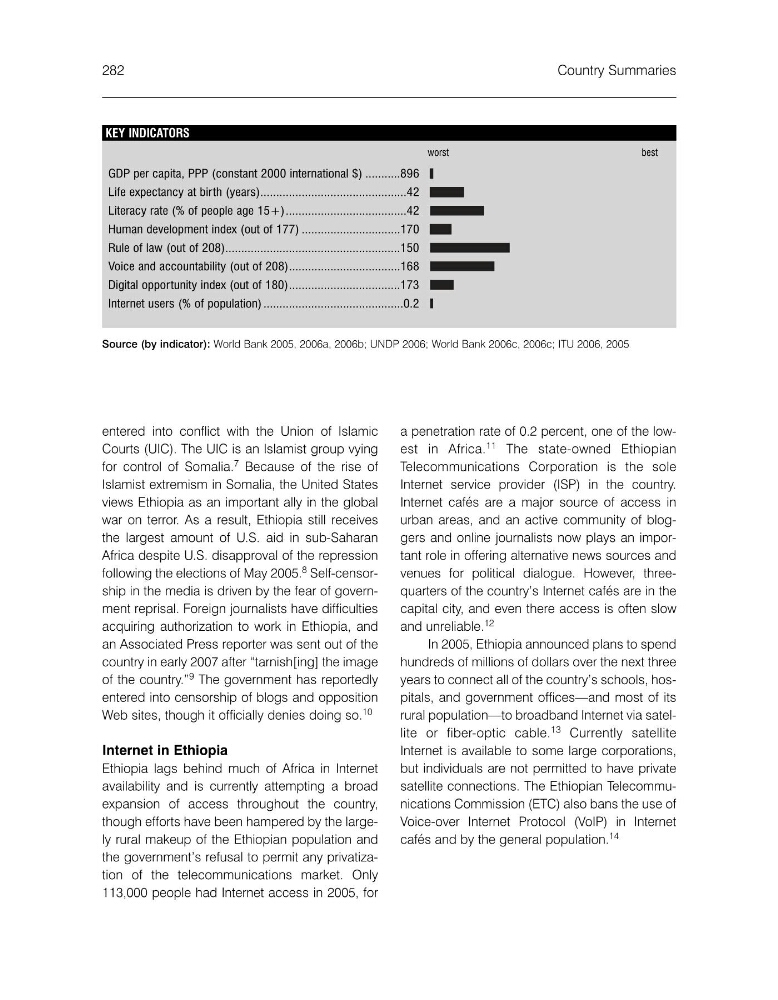
KEY INDICATORS
worst
best
GDP per capita, PPP (constant 2000 international $) ...........896 3.39
Life expectancy at birth (years)..............................................42 1.13
Literacy rate (% of people age 15+)......................................42 1.31
Human development index (out of 177) ...............................170 1.15
Rule of law (out of 208).......................................................150 3.46
Voice and accountability (out of 208)...................................168 2.80
Digital opportunity index (out of 180)...................................173 1.91
Internet users (% of population) ............................................0.2 3.08
Source (by indicator): World Bank 2005, 2006a, 2006b; UNDP 2006; World Bank 2006c, 2006c; ITU 2006, 2005
Courts (UIC). The UIC is an Islamist group vying
for control of Somalia.
7
Because of the rise of
Islamist extremism in Somalia, the United States
views Ethiopia as an important ally in the global
war on terror. As a result, Ethiopia still receives
the largest amount of U.S. aid in sub-Saharan
Africa despite U.S. disapproval of the repression
following the elections of May 2005. 8 Self-censorship in the media is driven by the fear of government reprisal. Foreign journalists have difficulties
acquiring authorization to work in Ethiopia, and
an Associated Press reporter was sent out of the
country in early 2007 after “tarnish[ing] the image
of the country.” 9 The government has reportedly
entered into censorship of blogs and opposition
Web sites, though it officially denies doing so.
10
Internet in Ethiopia
Ethiopia lags behind much of Africa in Internet
availability and is currently attempting a broad
expansion of access throughout the country,
though efforts have been hampered by the largely rural makeup of the Ethiopian population and
the government’s refusal to permit any privatization of the telecommunications market. Only
113,000 people had Internet access in 2005, for
a penetration rate of 0.2 percent, one of the lowest in Africa. 11 The state-owned Ethiopian
Telecommunications Corporation is the sole
Internet service provider (ISP) in the country.
Internet cafés are a major source of access in
urban areas, and an active community of bloggers and online journalists now plays an important role in offering alternative news sources and
venues for political dialogue. However, threequarters of the country’s Internet cafés are in the
capital city, and even there access is often slow
and unreliable. 12
In 2005, Ethiopia announced plans to spend
hundreds of millions of dollars over the next three
years to connect all of the country’s schools, hospitals, and government offices—and most of its
rural population—to broadband Internet via satellite or fiber-optic cable. 13 Currently satellite
Internet is available to some large corporations,
but individuals are not permitted to have private
satellite connections. The Ethiopian Telecommunications Commission (ETC) also bans the use of
Voice-over Internet Protocol (VoIP) in Internet
cafés and by the general population. 14
282
Country Summaries
KEY INDICATORS
worst
best
GDP per capita, PPP (constant 2000 international $) ...........896 3.39
Life expectancy at birth (years)..............................................42 1.13
Literacy rate (% of people age 15+)......................................42 1.31
Human development index (out of 177) ...............................170 1.15
Rule of law (out of 208).......................................................150 3.46
Voice and accountability (out of 208)...................................168 2.80
Digital opportunity index (out of 180)...................................173 1.91
Internet users (% of population) ............................................0.2 3.08
Source (by indicator): World Bank 2005, 2006a, 2006b; UNDP 2006; World Bank 2006c, 2006c; ITU 2006, 2005