

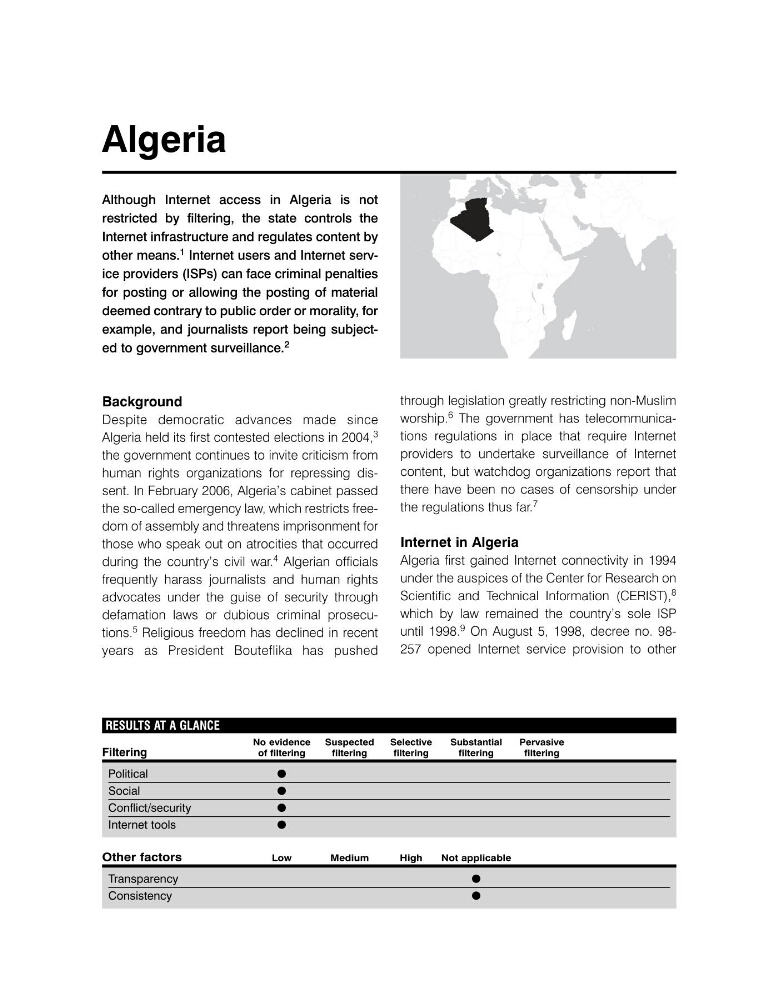
Although Internet access in Algeria is not
restricted by filtering, the state controls the
Internet infrastructure and regulates content by
other means.
1 Internet users and Internet service providers (ISPs) can face criminal penalties
for posting or allowing the posting of material
deemed contrary to public order or morality, for
example, and journalists report being subjected to government surveillance.
2
Background
Despite democratic advances made since
Algeria held its first contested elections in 2004,
3
the government continues to invite criticism from
human rights organizations for repressing dissent. In February 2006, Algeria’s cabinet passed
the so-called emergency law, which restricts freedom of assembly and threatens imprisonment for
those who speak out on atrocities that occurred
during the country’s civil war. 4 Algerian officials
frequently harass journalists and human rights
advocates under the guise of security through
defamation laws or dubious criminal prosecutions. 5 Religious freedom has declined in recent
years as President Bouteflika has pushed
through legislation greatly restricting non-Muslim
worship. 6 The government has telecommunications regulations in place that require Internet
providers to undertake surveillance of Internet
content, but watchdog organizations report that
there have been no cases of censorship under
the regulations thus far. 7
Internet in Algeria
Algeria first gained Internet connectivity in 1994
under the auspices of the Center for Research on
Scientific and Technical Information (CERIST), 8
which by law remained the country’s sole ISP
until 1998.
9
On August 5, 1998, decree no. 98257 opened Internet service provision to other
RESULTS AT A GLANCE
No evidence
Suspected
Selective
Substantial
Pervasive
Filtering
of filtering
filtering
filtering
filtering
filtering
Political
●
Social
●
Conflict/security
●
Internet tools
●
Other factors
Low
Medium
High
Not applicable
Transparency
●
Consistency
●
Algeria
restricted by filtering, the state controls the
Internet infrastructure and regulates content by
other means.
1 Internet users and Internet service providers (ISPs) can face criminal penalties
for posting or allowing the posting of material
deemed contrary to public order or morality, for
example, and journalists report being subjected to government surveillance.
2
Background
Despite democratic advances made since
Algeria held its first contested elections in 2004,
3
the government continues to invite criticism from
human rights organizations for repressing dissent. In February 2006, Algeria’s cabinet passed
the so-called emergency law, which restricts freedom of assembly and threatens imprisonment for
those who speak out on atrocities that occurred
during the country’s civil war. 4 Algerian officials
frequently harass journalists and human rights
advocates under the guise of security through
defamation laws or dubious criminal prosecutions. 5 Religious freedom has declined in recent
years as President Bouteflika has pushed
through legislation greatly restricting non-Muslim
worship. 6 The government has telecommunications regulations in place that require Internet
providers to undertake surveillance of Internet
content, but watchdog organizations report that
there have been no cases of censorship under
the regulations thus far. 7
Internet in Algeria
Algeria first gained Internet connectivity in 1994
under the auspices of the Center for Research on
Scientific and Technical Information (CERIST), 8
which by law remained the country’s sole ISP
until 1998.
9
On August 5, 1998, decree no. 98257 opened Internet service provision to other
RESULTS AT A GLANCE
No evidence
Suspected
Selective
Substantial
Pervasive
Filtering
of filtering
filtering
filtering
filtering
filtering
Political
●
Social
●
Conflict/security
●
Internet tools
●
Other factors
Low
Medium
High
Not applicable
Transparency
●
Consistency
●
Algeria