

providers, but private entry into the market proceeded slowly.
10
Two years later, law no. 2000-03
created the Ministry of Post and Telecommunications (MoPT), which included the Internet regulatory agency Algérie Télécom. 11 Algérie
Télécom launched the ISP Djaweb in 2001
12
to
extend service beyond universities and research
centers.
13
Today, Algérie Télécom lists twenty-six
ISP partners operating in the country, including
CERIST.
14
CERIST continues to develop the academic, noncommercial Internet
15
under the influence of the state
16
and has created nodes in
Algiers, Oran, Constantine, and Ourgla.
17
The MoPT—the government agency responsible for the Internet in Algeria—has expressed its
desire to promote the Internet as a source of
investment and job creation. 18 Though Internet
penetration has increased dramatically over the
past few years, jumping from approximately
1,500 in 1999 19 to nearly 850,000 in 2006,
20
this
still represents only 2.6 percent of the population.
The government has supported programs that
allow users to access the Internet on a “pay-asyou-go” basis, without requiring a monthly subscription. 21 Although most ISPs offer broadband,
ADSL, or satellite plans, the prices of these
services remain prohibitively high for many
Algerians. 22 Consequently, most Algerian Internet
users rely on dialup connections and cybercafés
for access.
Legal and regulatory frameworks
The establishment of the MoPT in 2000 signaled
the government’s desire to catch up to some
of its neighbors and develop the economic
potential of the Internet. 23 At the same time, the
government has moved to modernize information-control infrastructure and legislation, including extending criminal penalties for publishing
material “contrary to public order” to Internet
publications. 24 All connections between the
Algerian network and the Internet at large pass
through government-controlled content caching
servers, an arrangement that reduces bandwidth
costs but could also facilitate filtering. 25
In January 2004 Algeria Telecom announced
a deal with Daewoo to introduce high-speed connections. MoPT acts as an independent regulator
and is not legally obligated to consult with or
inform any other organizations before making
decisions. 26 Algeria’s network topology is highly
centralized,
27
and all Internet connections pass
through state-controlled content caching servers
before reaching the global Internet. 28 ISPs are
246
Country Summaries
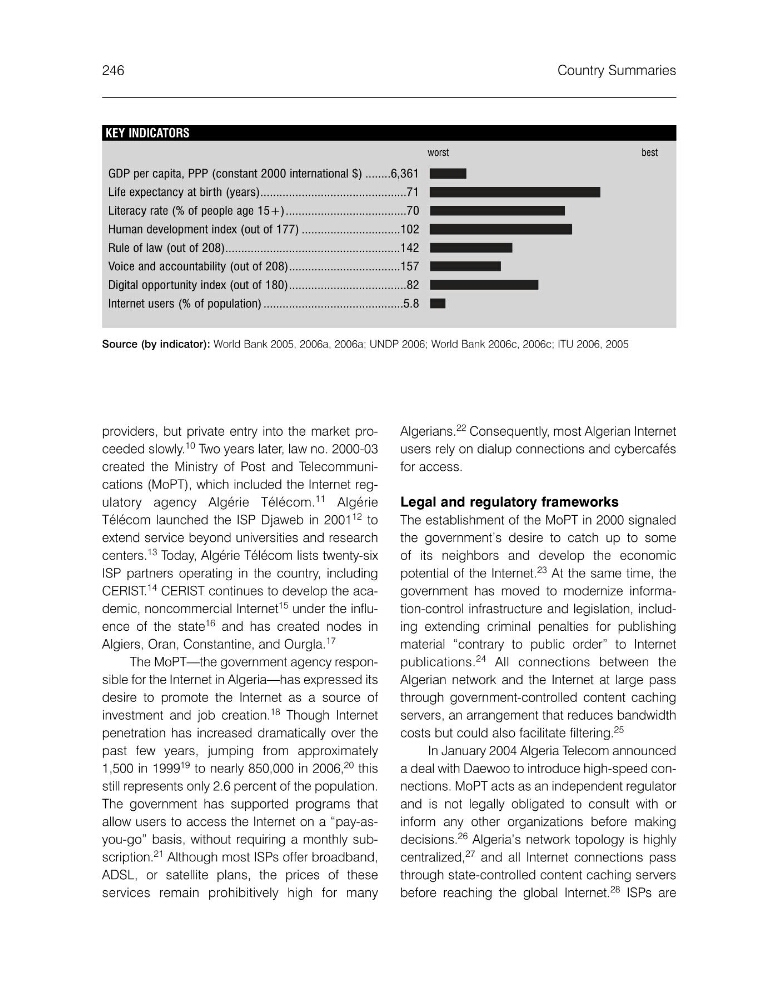
KEY INDICATORS
worst
best
GDP per capita, PPP (constant 2000 international $) ........6,361 4.44
Life expectancy at birth (years)..............................................71 5.80
Literacy rate (% of people age 15+)......................................70 4.05
Human development index (out of 177) ...............................102 5.18
Rule of law (out of 208).......................................................142 3.57
Voice and accountability (out of 208)...................................157 3.17
Digital opportunity index (out of 180).....................................82 5.22
Internet users (% of population) ............................................5.8 3.61
Source (by indicator): World Bank 2005, 2006a, 2006a; UNDP 2006; World Bank 2006c, 2006c; ITU 2006, 2005
10
Two years later, law no. 2000-03
created the Ministry of Post and Telecommunications (MoPT), which included the Internet regulatory agency Algérie Télécom. 11 Algérie
Télécom launched the ISP Djaweb in 2001
12
to
extend service beyond universities and research
centers.
13
Today, Algérie Télécom lists twenty-six
ISP partners operating in the country, including
CERIST.
14
CERIST continues to develop the academic, noncommercial Internet
15
under the influence of the state
16
and has created nodes in
Algiers, Oran, Constantine, and Ourgla.
17
The MoPT—the government agency responsible for the Internet in Algeria—has expressed its
desire to promote the Internet as a source of
investment and job creation. 18 Though Internet
penetration has increased dramatically over the
past few years, jumping from approximately
1,500 in 1999 19 to nearly 850,000 in 2006,
20
this
still represents only 2.6 percent of the population.
The government has supported programs that
allow users to access the Internet on a “pay-asyou-go” basis, without requiring a monthly subscription. 21 Although most ISPs offer broadband,
ADSL, or satellite plans, the prices of these
services remain prohibitively high for many
Algerians. 22 Consequently, most Algerian Internet
users rely on dialup connections and cybercafés
for access.
Legal and regulatory frameworks
The establishment of the MoPT in 2000 signaled
the government’s desire to catch up to some
of its neighbors and develop the economic
potential of the Internet. 23 At the same time, the
government has moved to modernize information-control infrastructure and legislation, including extending criminal penalties for publishing
material “contrary to public order” to Internet
publications. 24 All connections between the
Algerian network and the Internet at large pass
through government-controlled content caching
servers, an arrangement that reduces bandwidth
costs but could also facilitate filtering. 25
In January 2004 Algeria Telecom announced
a deal with Daewoo to introduce high-speed connections. MoPT acts as an independent regulator
and is not legally obligated to consult with or
inform any other organizations before making
decisions. 26 Algeria’s network topology is highly
centralized,
27
and all Internet connections pass
through state-controlled content caching servers
before reaching the global Internet. 28 ISPs are
246
Country Summaries
KEY INDICATORS
worst
best
GDP per capita, PPP (constant 2000 international $) ........6,361 4.44
Life expectancy at birth (years)..............................................71 5.80
Literacy rate (% of people age 15+)......................................70 4.05
Human development index (out of 177) ...............................102 5.18
Rule of law (out of 208).......................................................142 3.57
Voice and accountability (out of 208)...................................157 3.17
Digital opportunity index (out of 180).....................................82 5.22
Internet users (% of population) ............................................5.8 3.61
Source (by indicator): World Bank 2005, 2006a, 2006a; UNDP 2006; World Bank 2006c, 2006c; ITU 2006, 2005