

3.4 Influence of Agitation Speed
63
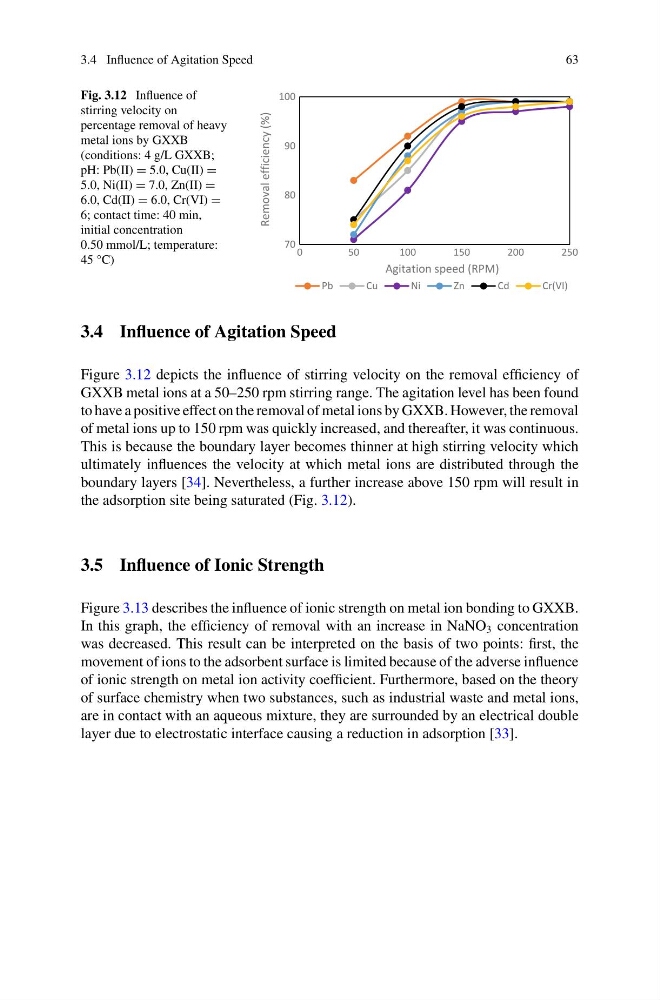
Fig. 3.12 Influence of
stirring velocity on
percentage removal of heavy
metal ions by GXXB
(conditions: 4 g/L GXXB;
pH: Pb(II) = 5.0, Cu(II) =
5.0, Ni(II) = 7.0, Zn(II) =
6.0, Cd(II) = 6.0, Cr(VI) =
6; contact time: 40 min,
initial concentration
0.50 mmol/L; temperature:
45 °C)
70
80
90
100
0
50
100
150
200
250
Removal efficiency (%)
Agitation speed (RPM)
Pb
Cu
Ni
Zn
Cd
Cr(VI)
3.4 Influence of Agitation Speed
Figure 3.12 depicts the influence of stirring velocity on the removal efficiency of
GXXB metal ions at a 50–250 rpm stirring range. The agitation level has been found
to have a positive effect on the removal of metal ions by GXXB. However, the removal
of metal ions up to 150 rpm was quickly increased, and thereafter, it was continuous.
This is because the boundary layer becomes thinner at high stirring velocity which
ultimately influences the velocity at which metal ions are distributed through the
boundary layers [34]. Nevertheless, a further increase above 150 rpm will result in
the adsorption site being saturated (Fig. 3.12).
3.5 Influence of Ionic Strength
Figure 3.13 describes the influence of ionic strength on metal ion bonding to GXXB.
In this graph, the efficiency of removal with an increase in NaNO 3 concentration
was decreased. This result can be interpreted on the basis of two points: first, the
movement of ions to the adsorbent surface is limited because of the adverse influence
of ionic strength on metal ion activity coefficient. Furthermore, based on the theory
of surface chemistry when two substances, such as industrial waste and metal ions,
are in contact with an aqueous mixture, they are surrounded by an electrical double
layer due to electrostatic interface causing a reduction in adsorption [33].
63
Fig. 3.12 Influence of
stirring velocity on
percentage removal of heavy
metal ions by GXXB
(conditions: 4 g/L GXXB;
pH: Pb(II) = 5.0, Cu(II) =
5.0, Ni(II) = 7.0, Zn(II) =
6.0, Cd(II) = 6.0, Cr(VI) =
6; contact time: 40 min,
initial concentration
0.50 mmol/L; temperature:
45 °C)
70
80
90
100
0
50
100
150
200
250
Removal efficiency (%)
Agitation speed (RPM)
Pb
Cu
Ni
Zn
Cd
Cr(VI)
3.4 Influence of Agitation Speed
Figure 3.12 depicts the influence of stirring velocity on the removal efficiency of
GXXB metal ions at a 50–250 rpm stirring range. The agitation level has been found
to have a positive effect on the removal of metal ions by GXXB. However, the removal
of metal ions up to 150 rpm was quickly increased, and thereafter, it was continuous.
This is because the boundary layer becomes thinner at high stirring velocity which
ultimately influences the velocity at which metal ions are distributed through the
boundary layers [34]. Nevertheless, a further increase above 150 rpm will result in
the adsorption site being saturated (Fig. 3.12).
3.5 Influence of Ionic Strength
Figure 3.13 describes the influence of ionic strength on metal ion bonding to GXXB.
In this graph, the efficiency of removal with an increase in NaNO 3 concentration
was decreased. This result can be interpreted on the basis of two points: first, the
movement of ions to the adsorbent surface is limited because of the adverse influence
of ionic strength on metal ion activity coefficient. Furthermore, based on the theory
of surface chemistry when two substances, such as industrial waste and metal ions,
are in contact with an aqueous mixture, they are surrounded by an electrical double
layer due to electrostatic interface causing a reduction in adsorption [33].