

64
3 Adsorption of Pb(II), Cu(II), Ni(II), Zn(II), Cr(VI) …
3.6 Isotherm Outcome
The power of the models used was calculated by coefficient of correlation (R
2 ).
The more R
2 is to one better the model fits [27]. The parameters for the respective metal ions in the isotherm models are presented in Table 3.1. The values
of R
2 (almost 0.98) suggest that the adsorption isotherm data for the investigated metal ions are very well represented by the model Langmuir, Temkin
and DKR as opposed to the Freundlich model’s R
2 (almost 0.78). The Langmuir model supports single-layer adsorption from aqueous solution to the GXXB
surface of the considered metal ions. Q m values derived from the Langmuir equation decreased in the order of Cu(II)(4.43), Pb(II)(4.22), Ni(II)(3.87), Cd(II)(3.80),
Cr(VI)(2.93), Cr(VI)(2.57) (mmol/g), whereas K L values followed a decreasing trend
of Cu(II)(3.98), Pb(II)(3.46), Ni(II)(2.93), Cd(II)(2.63), Cr(VI)(1.98) (L/mmol). The
higher value obtained for Cu(II) ions indicates greater affinity for GXXB’s multifunctional group. The higher K L values also suggest heavy electrostatic interface
between the multifunctional GXXB group and the metal ions studied. The R L values
for the ions Cu(II), Pb(II), Ni(II), Cd(II), Cr(VI) and Zn(II) were correspondingly
0.33, 0.37, 0.39, 0.41, 0.43 and 0.50, and these values are favourable. The Freundlich
model had failed to explain the experimental results the values of n suggested desirable adsorption for the metal ions considered. The Temkin model represented the
adsorption data very well owing to the fact that the filling of the more energetic
binding sites is taken into consideration at first. Can et al. (2016) tabled a similar
paper. The adsorption energy values from the DKR model indicates that ion exchange
mechanism may also define the process.
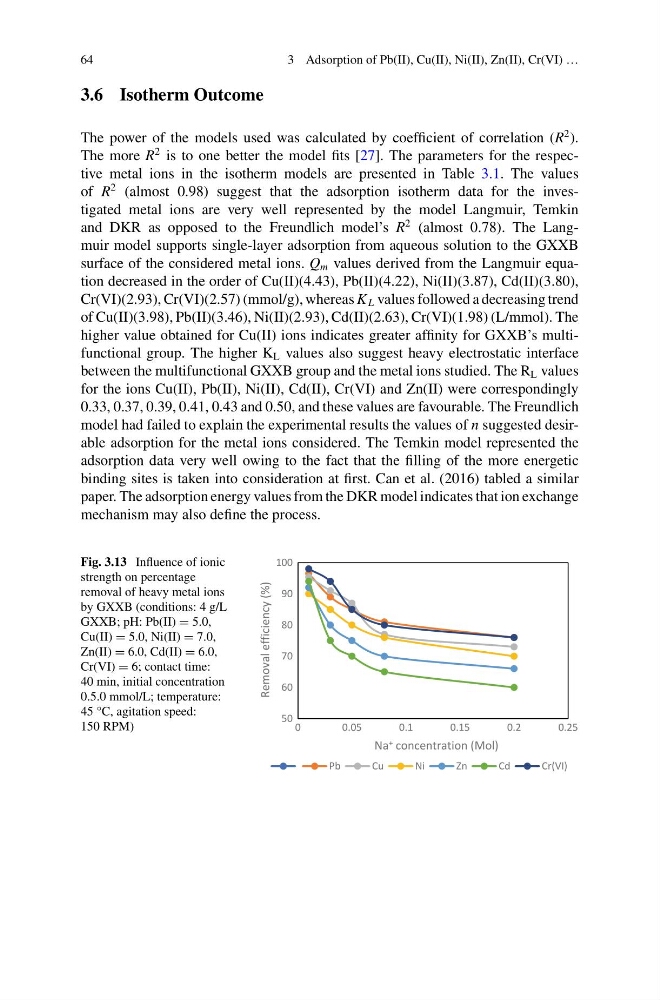
Fig. 3.13 Influence of ionic
strength on percentage
removal of heavy metal ions
by GXXB (conditions: 4 g/L
GXXB; pH: Pb(II) = 5.0,
Cu(II) = 5.0, Ni(II) = 7.0,
Zn(II) = 6.0, Cd(II) = 6.0,
Cr(VI) = 6; contact time:
40 min, initial concentration
0.5.0 mmol/L; temperature:
45 °C, agitation speed:
150 RPM)
50
60
70
80
90
100
0
0.05
0.1
0.15
0.2
0.25
Removal efficiency (%)
Na + concentration (Mol)
Pb
Cu
Ni
Zn
Cd
Cr(VI)
3 Adsorption of Pb(II), Cu(II), Ni(II), Zn(II), Cr(VI) …
3.6 Isotherm Outcome
The power of the models used was calculated by coefficient of correlation (R
2 ).
The more R
2 is to one better the model fits [27]. The parameters for the respective metal ions in the isotherm models are presented in Table 3.1. The values
of R
2 (almost 0.98) suggest that the adsorption isotherm data for the investigated metal ions are very well represented by the model Langmuir, Temkin
and DKR as opposed to the Freundlich model’s R
2 (almost 0.78). The Langmuir model supports single-layer adsorption from aqueous solution to the GXXB
surface of the considered metal ions. Q m values derived from the Langmuir equation decreased in the order of Cu(II)(4.43), Pb(II)(4.22), Ni(II)(3.87), Cd(II)(3.80),
Cr(VI)(2.93), Cr(VI)(2.57) (mmol/g), whereas K L values followed a decreasing trend
of Cu(II)(3.98), Pb(II)(3.46), Ni(II)(2.93), Cd(II)(2.63), Cr(VI)(1.98) (L/mmol). The
higher value obtained for Cu(II) ions indicates greater affinity for GXXB’s multifunctional group. The higher K L values also suggest heavy electrostatic interface
between the multifunctional GXXB group and the metal ions studied. The R L values
for the ions Cu(II), Pb(II), Ni(II), Cd(II), Cr(VI) and Zn(II) were correspondingly
0.33, 0.37, 0.39, 0.41, 0.43 and 0.50, and these values are favourable. The Freundlich
model had failed to explain the experimental results the values of n suggested desirable adsorption for the metal ions considered. The Temkin model represented the
adsorption data very well owing to the fact that the filling of the more energetic
binding sites is taken into consideration at first. Can et al. (2016) tabled a similar
paper. The adsorption energy values from the DKR model indicates that ion exchange
mechanism may also define the process.
Fig. 3.13 Influence of ionic
strength on percentage
removal of heavy metal ions
by GXXB (conditions: 4 g/L
GXXB; pH: Pb(II) = 5.0,
Cu(II) = 5.0, Ni(II) = 7.0,
Zn(II) = 6.0, Cd(II) = 6.0,
Cr(VI) = 6; contact time:
40 min, initial concentration
0.5.0 mmol/L; temperature:
45 °C, agitation speed:
150 RPM)
50
60
70
80
90
100
0
0.05
0.1
0.15
0.2
0.25
Removal efficiency (%)
Na + concentration (Mol)
Pb
Cu
Ni
Zn
Cd
Cr(VI)