

62
3 Adsorption of Pb(II), Cu(II), Ni(II), Zn(II), Cr(VI) …
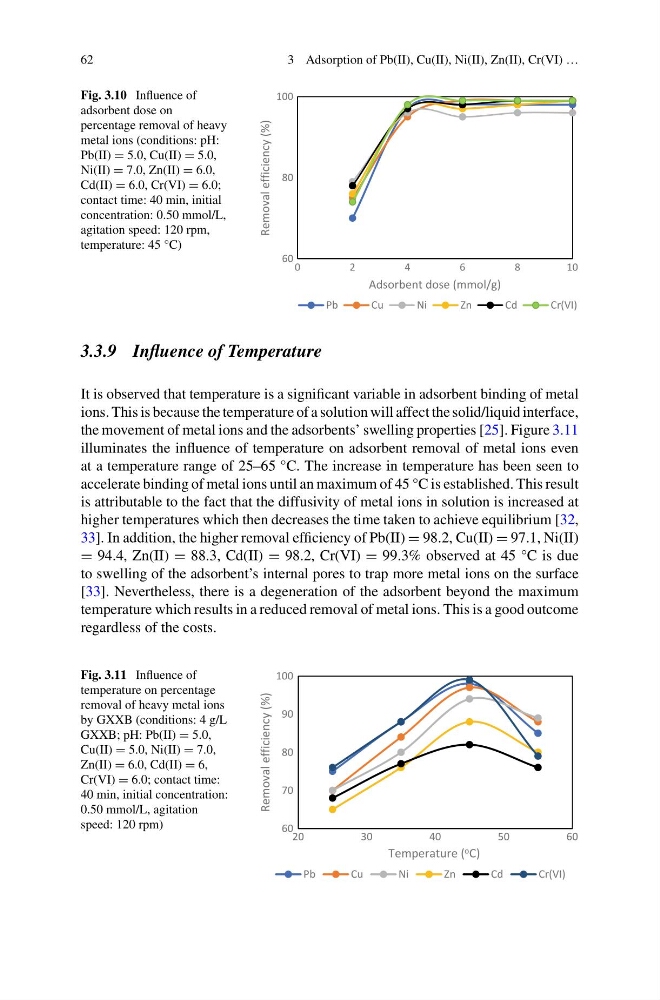
Fig. 3.10 Influence of
adsorbent dose on
percentage removal of heavy
metal ions (conditions: pH:
Pb(II) = 5.0, Cu(II) = 5.0,
Ni(II) = 7.0, Zn(II) = 6.0,
Cd(II) = 6.0, Cr(VI) = 6.0;
contact time: 40 min, initial
concentration: 0.50 mmol/L,
agitation speed: 120 rpm,
temperature: 45 °C)
60
80
100
0
2
4
6
8
1 0
Removal efficiency (%)
Adsorbent dose (mmol/g)
Pb
Cu
Ni
Zn
Cd
Cr(VI)
3.3.9 Influence of Temperature
It is observed that temperature is a significant variable in adsorbent binding of metal
ions. This is because the temperature of a solution will affect the solid/liquid interface,
the movement of metal ions and the adsorbents’ swelling properties [25]. Figure 3.11
illuminates the influence of temperature on adsorbent removal of metal ions even
at a temperature range of 25–65 °C. The increase in temperature has been seen to
accelerate binding of metal ions until an maximum of 45 °C is established. This result
is attributable to the fact that the diffusivity of metal ions in solution is increased at
higher temperatures which then decreases the time taken to achieve equilibrium [32,
33]. In addition, the higher removal efficiency of Pb(II) = 98.2, Cu(II) = 97.1, Ni(II)
= 94.4, Zn(II) = 88.3, Cd(II) = 98.2, Cr(VI) = 99.3% observed at 45 °C is due
to swelling of the adsorbent’s internal pores to trap more metal ions on the surface
[33]. Nevertheless, there is a degeneration of the adsorbent beyond the maximum
temperature which results in a reduced removal of metal ions. This is a good outcome
regardless of the costs.
Fig. 3.11 Influence of
temperature on percentage
removal of heavy metal ions
by GXXB (conditions: 4 g/L
GXXB; pH: Pb(II) = 5.0,
Cu(II) = 5.0, Ni(II) = 7.0,
Zn(II) = 6.0, Cd(II) = 6,
Cr(VI) = 6.0; contact time:
40 min, initial concentration:
0.50 mmol/L, agitation
speed: 120 rpm)
60
70
80
90
100
20
30
40
50
60
Removal efficiency (%)
Temperature ( o C)
Pb
Cu
Ni
Zn
Cd
Cr(VI)
3 Adsorption of Pb(II), Cu(II), Ni(II), Zn(II), Cr(VI) …
Fig. 3.10 Influence of
adsorbent dose on
percentage removal of heavy
metal ions (conditions: pH:
Pb(II) = 5.0, Cu(II) = 5.0,
Ni(II) = 7.0, Zn(II) = 6.0,
Cd(II) = 6.0, Cr(VI) = 6.0;
contact time: 40 min, initial
concentration: 0.50 mmol/L,
agitation speed: 120 rpm,
temperature: 45 °C)
60
80
100
0
2
4
6
8
1 0
Removal efficiency (%)
Adsorbent dose (mmol/g)
Pb
Cu
Ni
Zn
Cd
Cr(VI)
3.3.9 Influence of Temperature
It is observed that temperature is a significant variable in adsorbent binding of metal
ions. This is because the temperature of a solution will affect the solid/liquid interface,
the movement of metal ions and the adsorbents’ swelling properties [25]. Figure 3.11
illuminates the influence of temperature on adsorbent removal of metal ions even
at a temperature range of 25–65 °C. The increase in temperature has been seen to
accelerate binding of metal ions until an maximum of 45 °C is established. This result
is attributable to the fact that the diffusivity of metal ions in solution is increased at
higher temperatures which then decreases the time taken to achieve equilibrium [32,
33]. In addition, the higher removal efficiency of Pb(II) = 98.2, Cu(II) = 97.1, Ni(II)
= 94.4, Zn(II) = 88.3, Cd(II) = 98.2, Cr(VI) = 99.3% observed at 45 °C is due
to swelling of the adsorbent’s internal pores to trap more metal ions on the surface
[33]. Nevertheless, there is a degeneration of the adsorbent beyond the maximum
temperature which results in a reduced removal of metal ions. This is a good outcome
regardless of the costs.
Fig. 3.11 Influence of
temperature on percentage
removal of heavy metal ions
by GXXB (conditions: 4 g/L
GXXB; pH: Pb(II) = 5.0,
Cu(II) = 5.0, Ni(II) = 7.0,
Zn(II) = 6.0, Cd(II) = 6,
Cr(VI) = 6.0; contact time:
40 min, initial concentration:
0.50 mmol/L, agitation
speed: 120 rpm)
60
70
80
90
100
20
30
40
50
60
Removal efficiency (%)
Temperature ( o C)
Pb
Cu
Ni
Zn
Cd
Cr(VI)