

3.3 Result
61
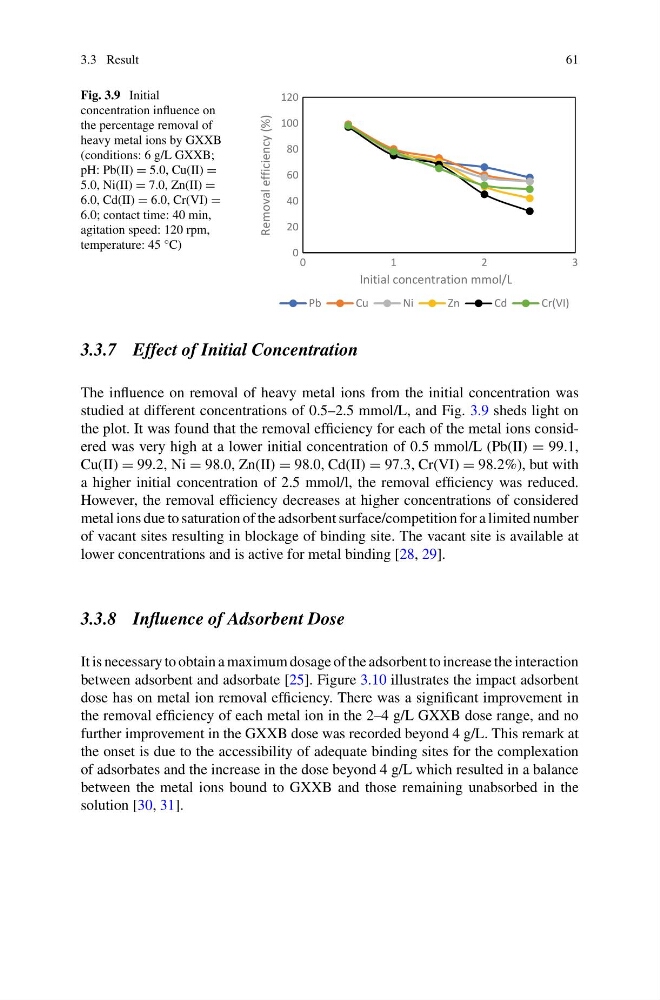
Fig. 3.9 Initial
concentration influence on
the percentage removal of
heavy metal ions by GXXB
(conditions: 6 g/L GXXB;
pH: Pb(II) = 5.0, Cu(II) =
5.0, Ni(II) = 7.0, Zn(II) =
6.0, Cd(II) = 6.0, Cr(VI) =
6.0; contact time: 40 min,
agitation speed: 120 rpm,
temperature: 45 °C)
0
20
40
60
80
100
120
0
1
2
3
Removal efficiency (%)
Initial concentration mmol/L
Pb
Cu
Ni
Zn
Cd
Cr(VI)
3.3.7 Effect of Initial Concentration
The influence on removal of heavy metal ions from the initial concentration was
studied at different concentrations of 0.5–2.5 mmol/L, and Fig. 3.9 sheds light on
the plot. It was found that the removal efficiency for each of the metal ions considered was very high at a lower initial concentration of 0.5 mmol/L (Pb(II) = 99.1,
Cu(II) = 99.2, Ni = 98.0, Zn(II) = 98.0, Cd(II) = 97.3, Cr(VI) = 98.2%), but with
a higher initial concentration of 2.5 mmol/l, the removal efficiency was reduced.
However, the removal efficiency decreases at higher concentrations of considered
metal ions due to saturation of the adsorbent surface/competition for a limited number
of vacant sites resulting in blockage of binding site. The vacant site is available at
lower concentrations and is active for metal binding [28, 29].
3.3.8 Influence of Adsorbent Dose
It is necessary to obtain a maximum dosage of the adsorbent to increase the interaction
between adsorbent and adsorbate [25]. Figure 3.10 illustrates the impact adsorbent
dose has on metal ion removal efficiency. There was a significant improvement in
the removal efficiency of each metal ion in the 2–4 g/L GXXB dose range, and no
further improvement in the GXXB dose was recorded beyond 4 g/L. This remark at
the onset is due to the accessibility of adequate binding sites for the complexation
of adsorbates and the increase in the dose beyond 4 g/L which resulted in a balance
between the metal ions bound to GXXB and those remaining unabsorbed in the
solution [30, 31].
61
Fig. 3.9 Initial
concentration influence on
the percentage removal of
heavy metal ions by GXXB
(conditions: 6 g/L GXXB;
pH: Pb(II) = 5.0, Cu(II) =
5.0, Ni(II) = 7.0, Zn(II) =
6.0, Cd(II) = 6.0, Cr(VI) =
6.0; contact time: 40 min,
agitation speed: 120 rpm,
temperature: 45 °C)
0
20
40
60
80
100
120
0
1
2
3
Removal efficiency (%)
Initial concentration mmol/L
Pb
Cu
Ni
Zn
Cd
Cr(VI)
3.3.7 Effect of Initial Concentration
The influence on removal of heavy metal ions from the initial concentration was
studied at different concentrations of 0.5–2.5 mmol/L, and Fig. 3.9 sheds light on
the plot. It was found that the removal efficiency for each of the metal ions considered was very high at a lower initial concentration of 0.5 mmol/L (Pb(II) = 99.1,
Cu(II) = 99.2, Ni = 98.0, Zn(II) = 98.0, Cd(II) = 97.3, Cr(VI) = 98.2%), but with
a higher initial concentration of 2.5 mmol/l, the removal efficiency was reduced.
However, the removal efficiency decreases at higher concentrations of considered
metal ions due to saturation of the adsorbent surface/competition for a limited number
of vacant sites resulting in blockage of binding site. The vacant site is available at
lower concentrations and is active for metal binding [28, 29].
3.3.8 Influence of Adsorbent Dose
It is necessary to obtain a maximum dosage of the adsorbent to increase the interaction
between adsorbent and adsorbate [25]. Figure 3.10 illustrates the impact adsorbent
dose has on metal ion removal efficiency. There was a significant improvement in
the removal efficiency of each metal ion in the 2–4 g/L GXXB dose range, and no
further improvement in the GXXB dose was recorded beyond 4 g/L. This remark at
the onset is due to the accessibility of adequate binding sites for the complexation
of adsorbates and the increase in the dose beyond 4 g/L which resulted in a balance
between the metal ions bound to GXXB and those remaining unabsorbed in the
solution [30, 31].