

60
3 Adsorption of Pb(II), Cu(II), Ni(II), Zn(II), Cr(VI) …
7. Higher absorption at these pH values may be due to the presence of free lone
pair of electrons on nitrogen atoms, ideal to combine with metal ions to give the
corresponding metal ions/adsorbent complex [21]. Due to the formation of metal
hydroxides and insoluble precipitation of metal ions, the decrease in the removal
efficiency of metal ions above the optimum pH value. The pH effect can also unfold
in terms of the adsorbent zero-charge point (pH PZC ) (Fig. 3.7b). PH PZC is the point
where the acidic surface or the basic functional group no longer imparts to the
solution pH [3]. Nevertheless, the adsorbent surface is charged negatively at pH >
pH PZC , positively charged at pH < pH PZC and neutral at pH = pH PZC . Adsorbent
pH PZC was 4.3 which favoured adsorption because surface charging is negative.
3.3.6 Outcome of Contact Time
Increasing the time of contact accelerates the interface existing between the active
sites in the adsorbent and the metal ions in solution which ultimately increases
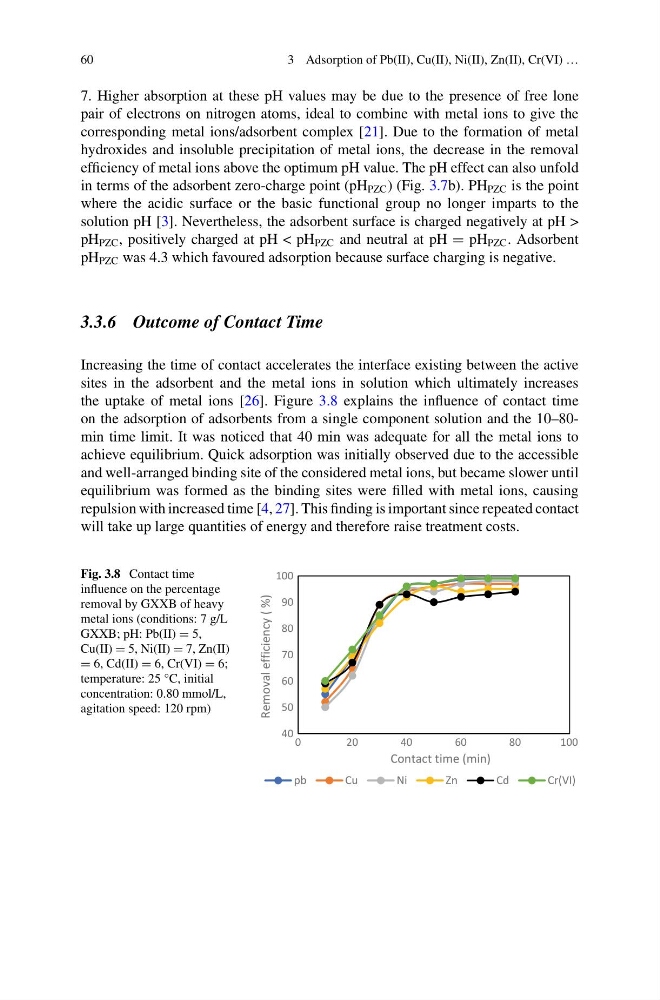
the uptake of metal ions [26]. Figure 3.8 explains the influence of contact time
on the adsorption of adsorbents from a single component solution and the 10–80min time limit. It was noticed that 40 min was adequate for all the metal ions to
achieve equilibrium. Quick adsorption was initially observed due to the accessible
and well-arranged binding site of the considered metal ions, but became slower until
equilibrium was formed as the binding sites were filled with metal ions, causing
repulsion with increased time [4, 27]. This finding is important since repeated contact
will take up large quantities of energy and therefore raise treatment costs.
Fig. 3.8 Contact time
influence on the percentage
removal by GXXB of heavy
metal ions (conditions: 7 g/L
GXXB; pH: Pb(II) = 5,
Cu(II) = 5, Ni(II) = 7, Zn(II)
= 6, Cd(II) = 6, Cr(VI) = 6;
temperature: 25 °C, initial
concentration: 0.80 mmol/L,
agitation speed: 120 rpm)
40
50
60
70
80
90
100
0
2 0
4 0
6 0
8 0
1 0 0
Removal efficiency ( %)
Contact time (min)
pb
Cu
Ni
Zn
Cd
Cr(VI)
3 Adsorption of Pb(II), Cu(II), Ni(II), Zn(II), Cr(VI) …
7. Higher absorption at these pH values may be due to the presence of free lone
pair of electrons on nitrogen atoms, ideal to combine with metal ions to give the
corresponding metal ions/adsorbent complex [21]. Due to the formation of metal
hydroxides and insoluble precipitation of metal ions, the decrease in the removal
efficiency of metal ions above the optimum pH value. The pH effect can also unfold
in terms of the adsorbent zero-charge point (pH PZC ) (Fig. 3.7b). PH PZC is the point
where the acidic surface or the basic functional group no longer imparts to the
solution pH [3]. Nevertheless, the adsorbent surface is charged negatively at pH >
pH PZC , positively charged at pH < pH PZC and neutral at pH = pH PZC . Adsorbent
pH PZC was 4.3 which favoured adsorption because surface charging is negative.
3.3.6 Outcome of Contact Time
Increasing the time of contact accelerates the interface existing between the active
sites in the adsorbent and the metal ions in solution which ultimately increases
the uptake of metal ions [26]. Figure 3.8 explains the influence of contact time
on the adsorption of adsorbents from a single component solution and the 10–80min time limit. It was noticed that 40 min was adequate for all the metal ions to
achieve equilibrium. Quick adsorption was initially observed due to the accessible
and well-arranged binding site of the considered metal ions, but became slower until
equilibrium was formed as the binding sites were filled with metal ions, causing
repulsion with increased time [4, 27]. This finding is important since repeated contact
will take up large quantities of energy and therefore raise treatment costs.
Fig. 3.8 Contact time
influence on the percentage
removal by GXXB of heavy
metal ions (conditions: 7 g/L
GXXB; pH: Pb(II) = 5,
Cu(II) = 5, Ni(II) = 7, Zn(II)
= 6, Cd(II) = 6, Cr(VI) = 6;
temperature: 25 °C, initial
concentration: 0.80 mmol/L,
agitation speed: 120 rpm)
40
50
60
70
80
90
100
0
2 0
4 0
6 0
8 0
1 0 0
Removal efficiency ( %)
Contact time (min)
pb
Cu
Ni
Zn
Cd
Cr(VI)