

3.3 Result
59
weight loss of 31% up to 330 °C. There was a 10% weight loss over 500 °C in the
third stage This weight loss in the first, second and third stages leads to the absorption
of surface water, the depolymerization and the decomposition of the acetylated and
deacetylated adsorbent units and the decomposition of the cross-linked chitosan,
respectively [10, 23].
In the first stage of deterioration, the GXXB shows a 13% weight loss at temperatures between 46 and 200 °C. The second stage began at 252 °C and proceeded with a
weight loss of 28% up to 311 °C. There was a 17% weight loss over 470 °C in the third
stage. This weight loss in the 1st, 2nd and 3rd stages leads to the absorption of surface
water, depolymerization and decomposition of the adsorbent and deacetylated units
of GXXB correspondingly [10, 23].
3.3.5 pH Effect
The pH associated with the adsorbent and functional binding site groups plays an
significant role in the adsorption of metal ions in that it influences the degree of
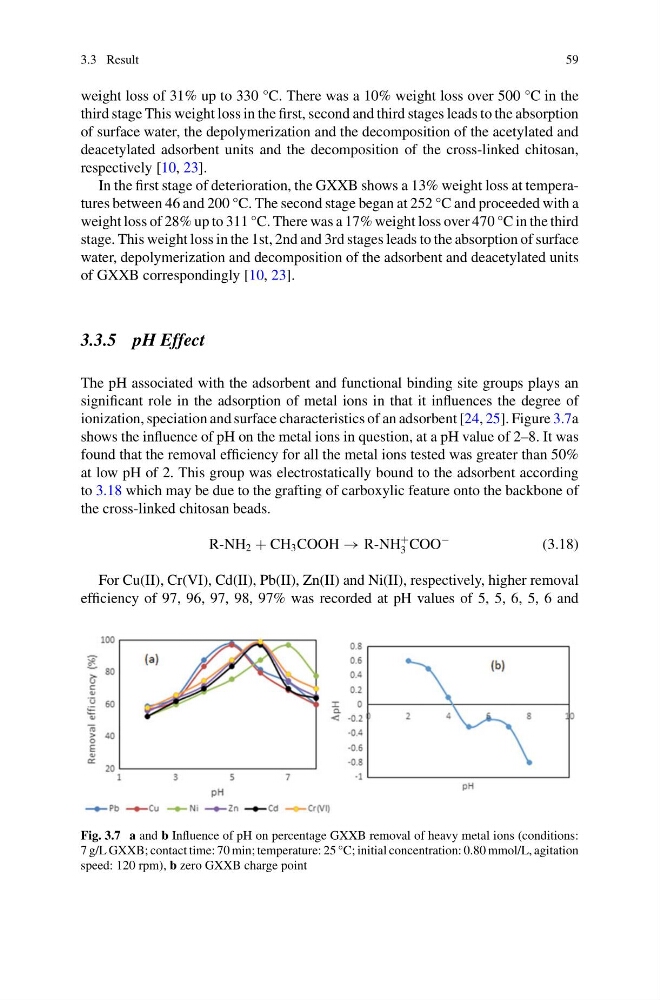
ionization, speciation and surface characteristics of an adsorbent [24, 25]. Figure 3.7a
shows the influence of pH on the metal ions in question, at a pH value of 2–8. It was
found that the removal efficiency for all the metal ions tested was greater than 50%
at low pH of 2. This group was electrostatically bound to the adsorbent according
to 3.18 which may be due to the grafting of carboxylic feature onto the backbone of
the cross-linked chitosan beads.
R-NH 2 + CH 3 COOH → R-NH
+
3 COO
−
(3.18)
For Cu(II), Cr(VI), Cd(II), Pb(II), Zn(II) and Ni(II), respectively, higher removal
efficiency of 97, 96, 97, 98, 97% was recorded at pH values of 5, 5, 6, 5, 6 and
Fig. 3.7 a and b Influence of pH on percentage GXXB removal of heavy metal ions (conditions:
7 g/L GXXB; contact time: 70 min; temperature: 25 °C; initial concentration: 0.80 mmol/L, agitation
speed: 120 rpm), b zero GXXB charge point
59
weight loss of 31% up to 330 °C. There was a 10% weight loss over 500 °C in the
third stage This weight loss in the first, second and third stages leads to the absorption
of surface water, the depolymerization and the decomposition of the acetylated and
deacetylated adsorbent units and the decomposition of the cross-linked chitosan,
respectively [10, 23].
In the first stage of deterioration, the GXXB shows a 13% weight loss at temperatures between 46 and 200 °C. The second stage began at 252 °C and proceeded with a
weight loss of 28% up to 311 °C. There was a 17% weight loss over 470 °C in the third
stage. This weight loss in the 1st, 2nd and 3rd stages leads to the absorption of surface
water, depolymerization and decomposition of the adsorbent and deacetylated units
of GXXB correspondingly [10, 23].
3.3.5 pH Effect
The pH associated with the adsorbent and functional binding site groups plays an
significant role in the adsorption of metal ions in that it influences the degree of
ionization, speciation and surface characteristics of an adsorbent [24, 25]. Figure 3.7a
shows the influence of pH on the metal ions in question, at a pH value of 2–8. It was
found that the removal efficiency for all the metal ions tested was greater than 50%
at low pH of 2. This group was electrostatically bound to the adsorbent according
to 3.18 which may be due to the grafting of carboxylic feature onto the backbone of
the cross-linked chitosan beads.
R-NH 2 + CH 3 COOH → R-NH
+
3 COO
−
(3.18)
For Cu(II), Cr(VI), Cd(II), Pb(II), Zn(II) and Ni(II), respectively, higher removal
efficiency of 97, 96, 97, 98, 97% was recorded at pH values of 5, 5, 6, 5, 6 and
Fig. 3.7 a and b Influence of pH on percentage GXXB removal of heavy metal ions (conditions:
7 g/L GXXB; contact time: 70 min; temperature: 25 °C; initial concentration: 0.80 mmol/L, agitation
speed: 120 rpm), b zero GXXB charge point