

1.3 Adsorbents
9
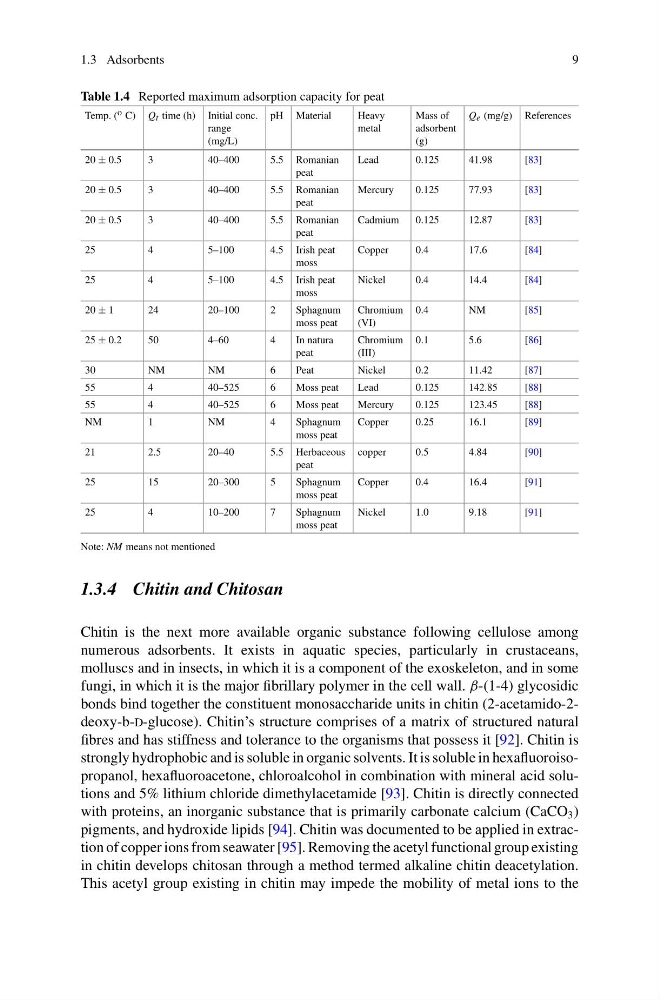
Table 1.4 Reported maximum adsorption capacity for peat
Temp. ( o C) Q t time (h) Initial conc.
range
(mg/L)
pH Material
Heavy
metal
Mass of
adsorbent
(g)
Q e (mg/g) References
20 ± 0.5
3
40–400
5.5 Romanian
peat
Lead
0.125
41.98
[83]
20 ± 0.5
3
40–400
5.5 Romanian
peat
Mercury
0.125
77.93
[83]
20 ± 0.5
3
40–400
5.5 Romanian
peat
Cadmium
0.125
12.87
[83]
25
4
5–100
4.5 Irish peat
moss
Copper
0.4
17.6
[84]
25
4
5–100
4.5 Irish peat
moss
Nickel
0.4
14.4
[84]
20 ± 1
24
20–100
2
Sphagnum
moss peat
Chromium
(VI)
0.4
NM
[85]
25 ± 0.2
50
4–60
4
In natura
peat
Chromium
(III)
0.1
5.6
[86]
30
NM
NM
6
Peat
Nickel
0.2
11.42
[87]
55
4
40–525
6
Moss peat
Lead
0.125
142.85
[88]
55
4
40–525
6
Moss peat
Mercury
0.125
123.45
[88]
NM
1
NM
4
Sphagnum
moss peat
Copper
0.25
16.1
[89]
21
2.5
20–40
5.5 Herbaceous
peat
copper
0.5
4.84
[90]
25
15
20–300
5
Sphagnum
moss peat
Copper
0.4
16.4
[91]
25
4
10–200
7
Sphagnum
moss peat
Nickel
1.0
9.18
[91]
Note: NM means not mentioned
1.3.4 Chitin and Chitosan
Chitin is the next more available organic substance following cellulose among
numerous adsorbents. It exists in aquatic species, particularly in crustaceans,
molluscs and in insects, in which it is a component of the exoskeleton, and in some
fungi, in which it is the major fibrillary polymer in the cell wall. β-(1-4) glycosidic
bonds bind together the constituent monosaccharide units in chitin (2-acetamido-2deoxy-b-d-glucose). Chitin’s structure comprises of a matrix of structured natural
fibres and has stiffness and tolerance to the organisms that possess it [92]. Chitin is
strongly hydrophobic and is soluble in organic solvents. It is soluble in hexafluoroisopropanol, hexafluoroacetone, chloroalcohol in combination with mineral acid solutions and 5% lithium chloride dimethylacetamide [93]. Chitin is directly connected
with proteins, an inorganic substance that is primarily carbonate calcium (CaCO 3 )
pigments, and hydroxide lipids [94]. Chitin was documented to be applied in extraction of copper ions from seawater [95]. Removing the acetyl functional group existing
in chitin develops chitosan through a method termed alkaline chitin deacetylation.
This acetyl group existing in chitin may impede the mobility of metal ions to the
9
Table 1.4 Reported maximum adsorption capacity for peat
Temp. ( o C) Q t time (h) Initial conc.
range
(mg/L)
pH Material
Heavy
metal
Mass of
adsorbent
(g)
Q e (mg/g) References
20 ± 0.5
3
40–400
5.5 Romanian
peat
Lead
0.125
41.98
[83]
20 ± 0.5
3
40–400
5.5 Romanian
peat
Mercury
0.125
77.93
[83]
20 ± 0.5
3
40–400
5.5 Romanian
peat
Cadmium
0.125
12.87
[83]
25
4
5–100
4.5 Irish peat
moss
Copper
0.4
17.6
[84]
25
4
5–100
4.5 Irish peat
moss
Nickel
0.4
14.4
[84]
20 ± 1
24
20–100
2
Sphagnum
moss peat
Chromium
(VI)
0.4
NM
[85]
25 ± 0.2
50
4–60
4
In natura
peat
Chromium
(III)
0.1
5.6
[86]
30
NM
NM
6
Peat
Nickel
0.2
11.42
[87]
55
4
40–525
6
Moss peat
Lead
0.125
142.85
[88]
55
4
40–525
6
Moss peat
Mercury
0.125
123.45
[88]
NM
1
NM
4
Sphagnum
moss peat
Copper
0.25
16.1
[89]
21
2.5
20–40
5.5 Herbaceous
peat
copper
0.5
4.84
[90]
25
15
20–300
5
Sphagnum
moss peat
Copper
0.4
16.4
[91]
25
4
10–200
7
Sphagnum
moss peat
Nickel
1.0
9.18
[91]
Note: NM means not mentioned
1.3.4 Chitin and Chitosan
Chitin is the next more available organic substance following cellulose among
numerous adsorbents. It exists in aquatic species, particularly in crustaceans,
molluscs and in insects, in which it is a component of the exoskeleton, and in some
fungi, in which it is the major fibrillary polymer in the cell wall. β-(1-4) glycosidic
bonds bind together the constituent monosaccharide units in chitin (2-acetamido-2deoxy-b-d-glucose). Chitin’s structure comprises of a matrix of structured natural
fibres and has stiffness and tolerance to the organisms that possess it [92]. Chitin is
strongly hydrophobic and is soluble in organic solvents. It is soluble in hexafluoroisopropanol, hexafluoroacetone, chloroalcohol in combination with mineral acid solutions and 5% lithium chloride dimethylacetamide [93]. Chitin is directly connected
with proteins, an inorganic substance that is primarily carbonate calcium (CaCO 3 )
pigments, and hydroxide lipids [94]. Chitin was documented to be applied in extraction of copper ions from seawater [95]. Removing the acetyl functional group existing
in chitin develops chitosan through a method termed alkaline chitin deacetylation.
This acetyl group existing in chitin may impede the mobility of metal ions to the