

10
1 A Comprehensive Approach to Heavy Metal Removal by Adsorption …
adsorption site. Chitosan comprises of 2-amino-2-deoxy-d-glucopyranose that is also
connected by glycosidic β-(1-4) bonds. This polymer is correlated mostly with its
degree of deacetylation (DD), an estimate of the accessible amine group existing in
the chitosan backbone [96].
Chitosan can be used in several application areas, including water treatment,
pharmaceutical and health technologies, sustainability of the environment, fabrics,
bioengineering, cosmetics, food manufacturing and agricultural development [97].
Sewvandi and Adikary [98] stated that chitosan’s considerable pore size distribution
contributes to its unique binding characteristics for metal ions including cadmium,
copper, lead, mercury, zinc and chromium. Additionally, chitosan will reduce the
concentration of metal ions close to zero [99]. The adsorption mechanism of chitosan
onto metal ions is believed to be due to the presence of amine. This group activates a metallic ion coordination bond [98, 100]. The link is established between
the nitrogen-free electron pairs in the amine group and the metal’s void orbitals.
Whichever is the process and manner (chelation vs. electrostatic attraction), chitosan
adsorption of a metal relies on the percentage of deacetylated units (free amine
groups), the size of the polymer matrix, crystalline nature, molecular mass, polymer
conditioning, chitosan structural attributes, solution pH, nature and amount of the
acid utilized for solution, solution concentration, metal ion selectivity and speciation.
In addition, very few of the primary amino groups are available for metal binding, as
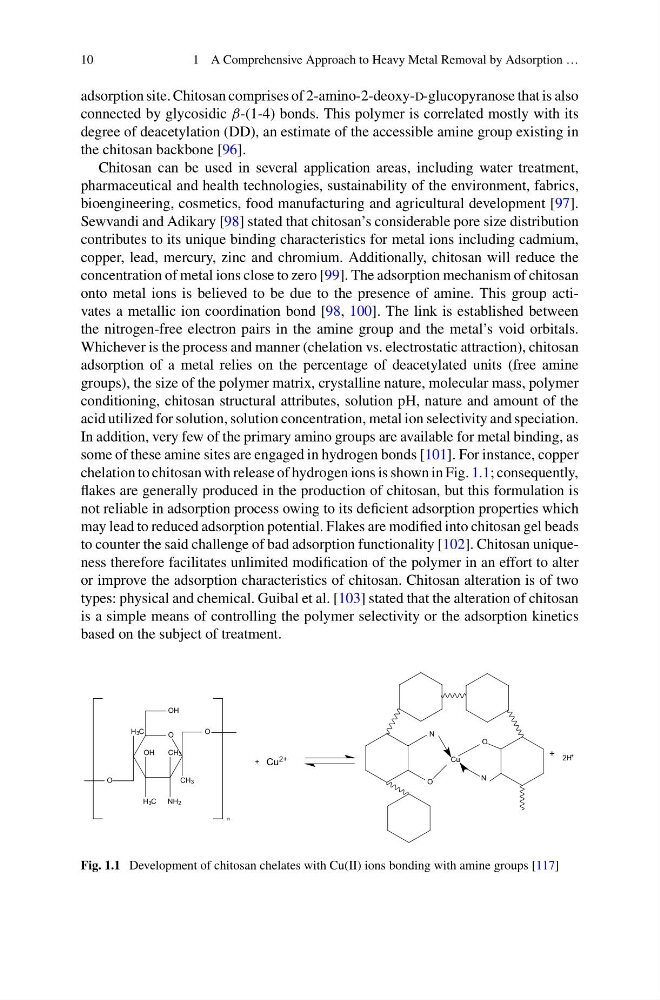
some of these amine sites are engaged in hydrogen bonds [101]. For instance, copper
chelation to chitosan with release of hydrogen ions is shown in Fig. 1.1; consequently,
flakes are generally produced in the production of chitosan, but this formulation is
not reliable in adsorption process owing to its deficient adsorption properties which
may lead to reduced adsorption potential. Flakes are modified into chitosan gel beads
to counter the said challenge of bad adsorption functionality [102]. Chitosan uniqueness therefore facilitates unlimited modification of the polymer in an effort to alter
or improve the adsorption characteristics of chitosan. Chitosan alteration is of two
types: physical and chemical. Guibal et al. [103] stated that the alteration of chitosan
is a simple means of controlling the polymer selectivity or the adsorption kinetics
based on the subject of treatment.
O
H3C
OH
NH2
CH3
CH3
O
O
H3C
OH
Cu
2+
+
n
O
N
N
Cu
O
2H
+
+
Fig. 1.1 Development of chitosan chelates with Cu(II) ions bonding with amine groups [117]
1 A Comprehensive Approach to Heavy Metal Removal by Adsorption …
adsorption site. Chitosan comprises of 2-amino-2-deoxy-d-glucopyranose that is also
connected by glycosidic β-(1-4) bonds. This polymer is correlated mostly with its
degree of deacetylation (DD), an estimate of the accessible amine group existing in
the chitosan backbone [96].
Chitosan can be used in several application areas, including water treatment,
pharmaceutical and health technologies, sustainability of the environment, fabrics,
bioengineering, cosmetics, food manufacturing and agricultural development [97].
Sewvandi and Adikary [98] stated that chitosan’s considerable pore size distribution
contributes to its unique binding characteristics for metal ions including cadmium,
copper, lead, mercury, zinc and chromium. Additionally, chitosan will reduce the
concentration of metal ions close to zero [99]. The adsorption mechanism of chitosan
onto metal ions is believed to be due to the presence of amine. This group activates a metallic ion coordination bond [98, 100]. The link is established between
the nitrogen-free electron pairs in the amine group and the metal’s void orbitals.
Whichever is the process and manner (chelation vs. electrostatic attraction), chitosan
adsorption of a metal relies on the percentage of deacetylated units (free amine
groups), the size of the polymer matrix, crystalline nature, molecular mass, polymer
conditioning, chitosan structural attributes, solution pH, nature and amount of the
acid utilized for solution, solution concentration, metal ion selectivity and speciation.
In addition, very few of the primary amino groups are available for metal binding, as
some of these amine sites are engaged in hydrogen bonds [101]. For instance, copper
chelation to chitosan with release of hydrogen ions is shown in Fig. 1.1; consequently,
flakes are generally produced in the production of chitosan, but this formulation is
not reliable in adsorption process owing to its deficient adsorption properties which
may lead to reduced adsorption potential. Flakes are modified into chitosan gel beads
to counter the said challenge of bad adsorption functionality [102]. Chitosan uniqueness therefore facilitates unlimited modification of the polymer in an effort to alter
or improve the adsorption characteristics of chitosan. Chitosan alteration is of two
types: physical and chemical. Guibal et al. [103] stated that the alteration of chitosan
is a simple means of controlling the polymer selectivity or the adsorption kinetics
based on the subject of treatment.
O
H3C
OH
NH2
CH3
CH3
O
O
H3C
OH
Cu
2+
+
n
O
N
N
Cu
O
2H
+
+
Fig. 1.1 Development of chitosan chelates with Cu(II) ions bonding with amine groups [117]