

150
7 Use of Diethylenetriamine Grafted onto Glyoxal Cross-Linked …
ln
C(t)
C o
against t in minutes
where C(t) is the solution concentration in mmol/L, C o is the concentration of the
initial metal ions in mmol L
−1 , A is the adsorbent region in m
2 , and V is the solution
volume in litres.
Re =
n D
2
i ρ
μ 1
(7.19)
where n is the stirring velocity (RPM), D i is the impeller diameter (m), the solute
solution viscosity (pa s) and the density of the fluid (kg/m
3 ).
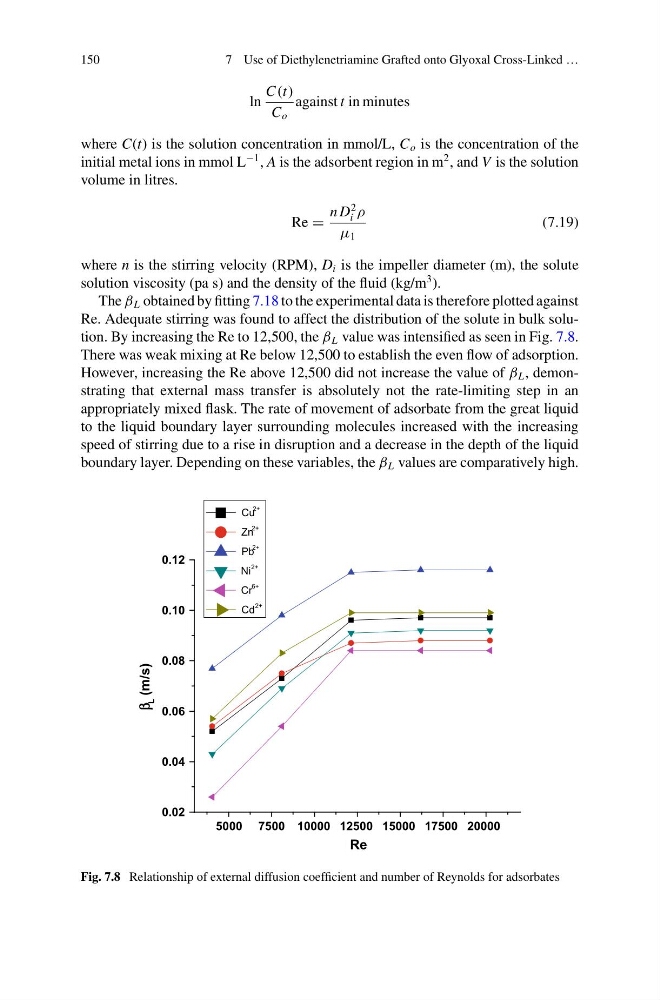
The β L obtained by fitting 7.18 to the experimental data is therefore plotted against
Re. Adequate stirring was found to affect the distribution of the solute in bulk solution. By increasing the Re to 12,500, the β L value was intensified as seen in Fig. 7.8.
There was weak mixing at Re below 12,500 to establish the even flow of adsorption.
However, increasing the Re above 12,500 did not increase the value of β L , demonstrating that external mass transfer is absolutely not the rate-limiting step in an
appropriately mixed flask. The rate of movement of adsorbate from the great liquid
to the liquid boundary layer surrounding molecules increased with the increasing
speed of stirring due to a rise in disruption and a decrease in the depth of the liquid
boundary layer. Depending on these variables, the β L values are comparatively high.
5000 7500 10000 12500 15000 17500 20000
0.02
0.04
0.06
0.08
0.10
0.12
β
L
(m/s)
Re
Cu
2+
Zn
2+
Pb
2+
Ni
2+
Cr
6+
Cd
2+
Fig. 7.8 Relationship of external diffusion coefficient and number of Reynolds for adsorbates
7 Use of Diethylenetriamine Grafted onto Glyoxal Cross-Linked …
ln
C(t)
C o
against t in minutes
where C(t) is the solution concentration in mmol/L, C o is the concentration of the
initial metal ions in mmol L
−1 , A is the adsorbent region in m
2 , and V is the solution
volume in litres.
Re =
n D
2
i ρ
μ 1
(7.19)
where n is the stirring velocity (RPM), D i is the impeller diameter (m), the solute
solution viscosity (pa s) and the density of the fluid (kg/m
3 ).
The β L obtained by fitting 7.18 to the experimental data is therefore plotted against
Re. Adequate stirring was found to affect the distribution of the solute in bulk solution. By increasing the Re to 12,500, the β L value was intensified as seen in Fig. 7.8.
There was weak mixing at Re below 12,500 to establish the even flow of adsorption.
However, increasing the Re above 12,500 did not increase the value of β L , demonstrating that external mass transfer is absolutely not the rate-limiting step in an
appropriately mixed flask. The rate of movement of adsorbate from the great liquid
to the liquid boundary layer surrounding molecules increased with the increasing
speed of stirring due to a rise in disruption and a decrease in the depth of the liquid
boundary layer. Depending on these variables, the β L values are comparatively high.
5000 7500 10000 12500 15000 17500 20000
0.02
0.04
0.06
0.08
0.10
0.12
β
L
(m/s)
Re
Cu
2+
Zn
2+
Pb
2+
Ni
2+
Cr
6+
Cd
2+
Fig. 7.8 Relationship of external diffusion coefficient and number of Reynolds for adsorbates