

148
7 Use of Diethylenetriamine Grafted onto Glyoxal Cross-Linked …
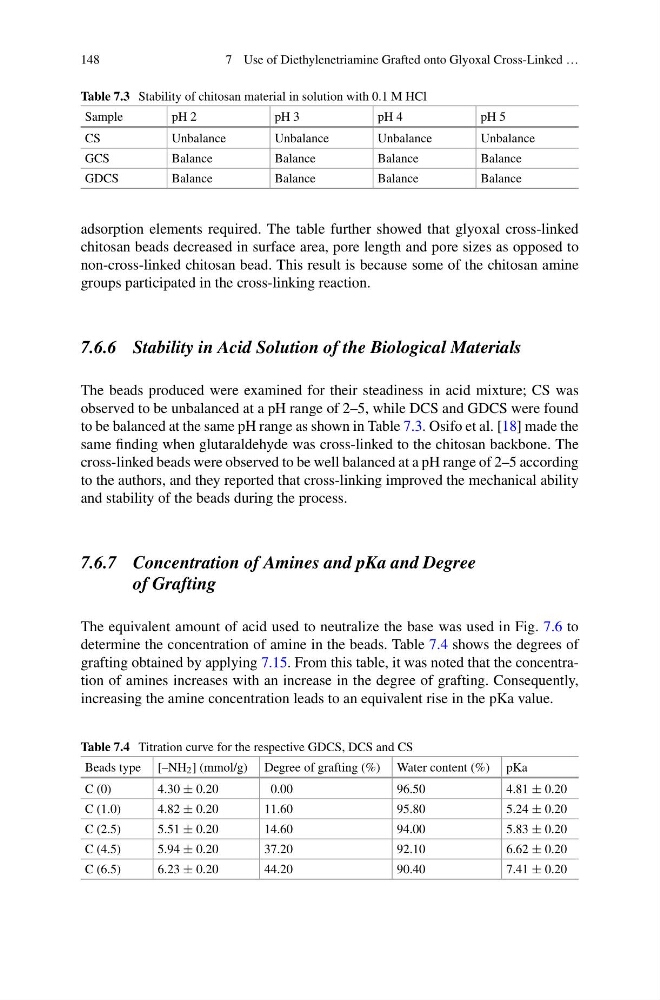
Table 7.3 Stability of chitosan material in solution with 0.1 M HCl
Sample
pH 2
pH 3
pH 4
pH 5
CS
Unbalance
Unbalance
Unbalance
Unbalance
GCS
Balance
Balance
Balance
Balance
GDCS
Balance
Balance
Balance
Balance
adsorption elements required. The table further showed that glyoxal cross-linked
chitosan beads decreased in surface area, pore length and pore sizes as opposed to
non-cross-linked chitosan bead. This result is because some of the chitosan amine
groups participated in the cross-linking reaction.
7.6.6 Stability in Acid Solution of the Biological Materials
The beads produced were examined for their steadiness in acid mixture; CS was
observed to be unbalanced at a pH range of 2–5, while DCS and GDCS were found
to be balanced at the same pH range as shown in Table 7.3. Osifo et al. [18] made the
same finding when glutaraldehyde was cross-linked to the chitosan backbone. The
cross-linked beads were observed to be well balanced at a pH range of 2–5 according
to the authors, and they reported that cross-linking improved the mechanical ability
and stability of the beads during the process.
7.6.7 Concentration of Amines and pKa and Degree
of Grafting
The equivalent amount of acid used to neutralize the base was used in Fig. 7.6 to
determine the concentration of amine in the beads. Table 7.4 shows the degrees of
grafting obtained by applying 7.15. From this table, it was noted that the concentration of amines increases with an increase in the degree of grafting. Consequently,
increasing the amine concentration leads to an equivalent rise in the pKa value.
Table 7.4 Titration curve for the respective GDCS, DCS and CS
Beads type [–NH 2 ] (mmol/g) Degree of grafting (%) Water content (%) pKa
C (0)
4.30 ± 0.20
0.00
96.50
4.81 ± 0.20
C (1.0)
4.82 ± 0.20
11.60
95.80
5.24 ± 0.20
C (2.5)
5.51 ± 0.20
14.60
94.00
5.83 ± 0.20
C (4.5)
5.94 ± 0.20
37.20
92.10
6.62 ± 0.20
C (6.5)
6.23 ± 0.20
44.20
90.40
7.41 ± 0.20
7 Use of Diethylenetriamine Grafted onto Glyoxal Cross-Linked …
Table 7.3 Stability of chitosan material in solution with 0.1 M HCl
Sample
pH 2
pH 3
pH 4
pH 5
CS
Unbalance
Unbalance
Unbalance
Unbalance
GCS
Balance
Balance
Balance
Balance
GDCS
Balance
Balance
Balance
Balance
adsorption elements required. The table further showed that glyoxal cross-linked
chitosan beads decreased in surface area, pore length and pore sizes as opposed to
non-cross-linked chitosan bead. This result is because some of the chitosan amine
groups participated in the cross-linking reaction.
7.6.6 Stability in Acid Solution of the Biological Materials
The beads produced were examined for their steadiness in acid mixture; CS was
observed to be unbalanced at a pH range of 2–5, while DCS and GDCS were found
to be balanced at the same pH range as shown in Table 7.3. Osifo et al. [18] made the
same finding when glutaraldehyde was cross-linked to the chitosan backbone. The
cross-linked beads were observed to be well balanced at a pH range of 2–5 according
to the authors, and they reported that cross-linking improved the mechanical ability
and stability of the beads during the process.
7.6.7 Concentration of Amines and pKa and Degree
of Grafting
The equivalent amount of acid used to neutralize the base was used in Fig. 7.6 to
determine the concentration of amine in the beads. Table 7.4 shows the degrees of
grafting obtained by applying 7.15. From this table, it was noted that the concentration of amines increases with an increase in the degree of grafting. Consequently,
increasing the amine concentration leads to an equivalent rise in the pKa value.
Table 7.4 Titration curve for the respective GDCS, DCS and CS
Beads type [–NH 2 ] (mmol/g) Degree of grafting (%) Water content (%) pKa
C (0)
4.30 ± 0.20
0.00
96.50
4.81 ± 0.20
C (1.0)
4.82 ± 0.20
11.60
95.80
5.24 ± 0.20
C (2.5)
5.51 ± 0.20
14.60
94.00
5.83 ± 0.20
C (4.5)
5.94 ± 0.20
37.20
92.10
6.62 ± 0.20
C (6.5)
6.23 ± 0.20
44.20
90.40
7.41 ± 0.20