

7.6 Outcome of Characterization
143
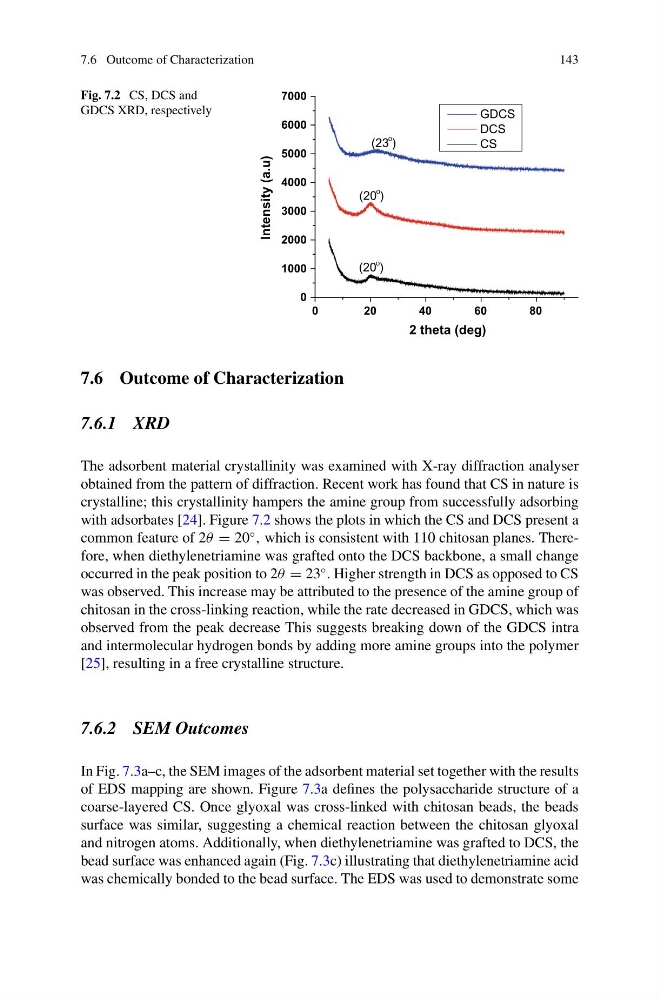
Fig. 7.2 CS, DCS and
GDCS XRD, respectively
0
20
40
60
80
0
1000
2000
3000
4000
5000
6000
7000
Intensity (a.u)
2 theta (deg)
GDCS
DCS
CS
(20
o
)
(20
o
)
(23
o
)
7.6 Outcome of Characterization
7.6.1 XRD
The adsorbent material crystallinity was examined with X-ray diffraction analyser
obtained from the pattern of diffraction. Recent work has found that CS in nature is
crystalline; this crystallinity hampers the amine group from successfully adsorbing
with adsorbates [24]. Figure 7.2 shows the plots in which the CS and DCS present a
common feature of 2θ = 20
◦
, which is consistent with 110 chitosan planes. Therefore, when diethylenetriamine was grafted onto the DCS backbone, a small change
occurred in the peak position to 2θ = 23
◦ . Higher strength in DCS as opposed to CS
was observed. This increase may be attributed to the presence of the amine group of
chitosan in the cross-linking reaction, while the rate decreased in GDCS, which was
observed from the peak decrease This suggests breaking down of the GDCS intra
and intermolecular hydrogen bonds by adding more amine groups into the polymer
[25], resulting in a free crystalline structure.
7.6.2 SEM Outcomes
In Fig. 7.3a–c, the SEM images of the adsorbent material set together with the results
of EDS mapping are shown. Figure 7.3a defines the polysaccharide structure of a
coarse-layered CS. Once glyoxal was cross-linked with chitosan beads, the beads
surface was similar, suggesting a chemical reaction between the chitosan glyoxal
and nitrogen atoms. Additionally, when diethylenetriamine was grafted to DCS, the
bead surface was enhanced again (Fig. 7.3c) illustrating that diethylenetriamine acid
was chemically bonded to the bead surface. The EDS was used to demonstrate some
143
Fig. 7.2 CS, DCS and
GDCS XRD, respectively
0
20
40
60
80
0
1000
2000
3000
4000
5000
6000
7000
Intensity (a.u)
2 theta (deg)
GDCS
DCS
CS
(20
o
)
(20
o
)
(23
o
)
7.6 Outcome of Characterization
7.6.1 XRD
The adsorbent material crystallinity was examined with X-ray diffraction analyser
obtained from the pattern of diffraction. Recent work has found that CS in nature is
crystalline; this crystallinity hampers the amine group from successfully adsorbing
with adsorbates [24]. Figure 7.2 shows the plots in which the CS and DCS present a
common feature of 2θ = 20
◦
, which is consistent with 110 chitosan planes. Therefore, when diethylenetriamine was grafted onto the DCS backbone, a small change
occurred in the peak position to 2θ = 23
◦ . Higher strength in DCS as opposed to CS
was observed. This increase may be attributed to the presence of the amine group of
chitosan in the cross-linking reaction, while the rate decreased in GDCS, which was
observed from the peak decrease This suggests breaking down of the GDCS intra
and intermolecular hydrogen bonds by adding more amine groups into the polymer
[25], resulting in a free crystalline structure.
7.6.2 SEM Outcomes
In Fig. 7.3a–c, the SEM images of the adsorbent material set together with the results
of EDS mapping are shown. Figure 7.3a defines the polysaccharide structure of a
coarse-layered CS. Once glyoxal was cross-linked with chitosan beads, the beads
surface was similar, suggesting a chemical reaction between the chitosan glyoxal
and nitrogen atoms. Additionally, when diethylenetriamine was grafted to DCS, the
bead surface was enhanced again (Fig. 7.3c) illustrating that diethylenetriamine acid
was chemically bonded to the bead surface. The EDS was used to demonstrate some