

142
7 Use of Diethylenetriamine Grafted onto Glyoxal Cross-Linked …
water. A magnetic stirrer mixed the mixture and titrated with 1 M of HCl. The pH of
the mixture was recorded at various time periods during the stirring phase. Eventually, the findings obtained from the experiment were applied to estimate the amine
concentration of adsorbent and pKa in mmol/g. The grafting degree was computed
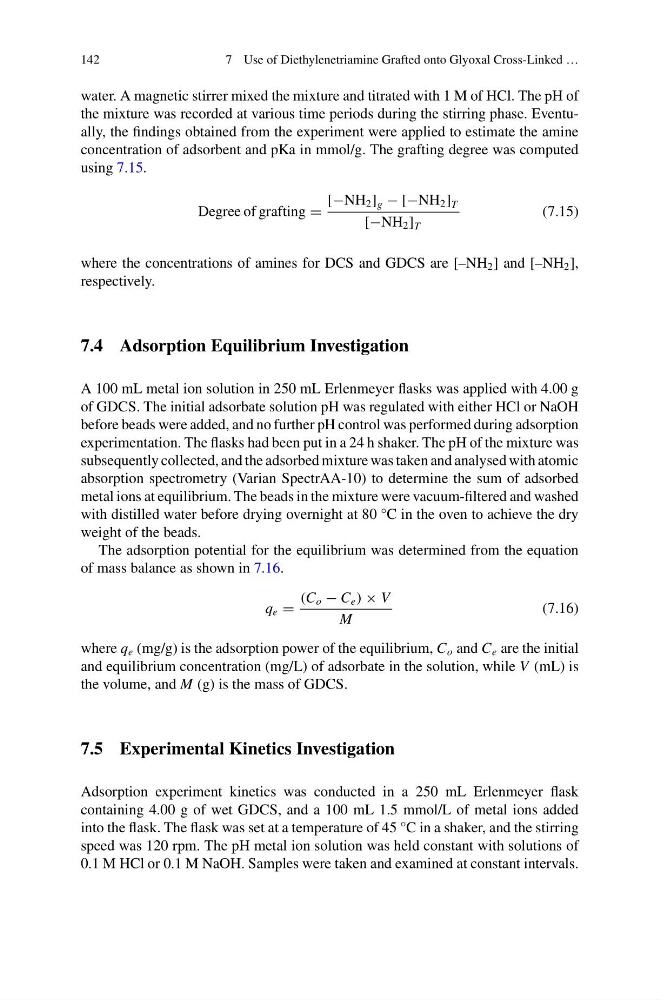
using 7.15.
Degree of grafting =
[−NH 2 ] g − [−NH 2 ] T
[−NH 2 ] T
(7.15)
where the concentrations of amines for DCS and GDCS are [–NH 2 ] and [–NH 2 ],
respectively.
7.4 Adsorption Equilibrium Investigation
A 100 mL metal ion solution in 250 mL Erlenmeyer flasks was applied with 4.00 g
of GDCS. The initial adsorbate solution pH was regulated with either HCl or NaOH
before beads were added, and no further pH control was performed during adsorption
experimentation. The flasks had been put in a 24 h shaker. The pH of the mixture was
subsequently collected, and the adsorbed mixture was taken and analysed with atomic
absorption spectrometry (Varian SpectrAA-10) to determine the sum of adsorbed
metal ions at equilibrium. The beads in the mixture were vacuum-filtered and washed
with distilled water before drying overnight at 80 °C in the oven to achieve the dry
weight of the beads.
The adsorption potential for the equilibrium was determined from the equation
of mass balance as shown in 7.16.
q e =
(C o − C e ) × V
M
(7.16)
where q e (mg/g) is the adsorption power of the equilibrium, C o and C e are the initial
and equilibrium concentration (mg/L) of adsorbate in the solution, while V (mL) is
the volume, and M (g) is the mass of GDCS.
7.5 Experimental Kinetics Investigation
Adsorption experiment kinetics was conducted in a 250 mL Erlenmeyer flask
containing 4.00 g of wet GDCS, and a 100 mL 1.5 mmol/L of metal ions added
into the flask. The flask was set at a temperature of 45 °C in a shaker, and the stirring
speed was 120 rpm. The pH metal ion solution was held constant with solutions of
0.1 M HCl or 0.1 M NaOH. Samples were taken and examined at constant intervals.
7 Use of Diethylenetriamine Grafted onto Glyoxal Cross-Linked …
water. A magnetic stirrer mixed the mixture and titrated with 1 M of HCl. The pH of
the mixture was recorded at various time periods during the stirring phase. Eventually, the findings obtained from the experiment were applied to estimate the amine
concentration of adsorbent and pKa in mmol/g. The grafting degree was computed
using 7.15.
Degree of grafting =
[−NH 2 ] g − [−NH 2 ] T
[−NH 2 ] T
(7.15)
where the concentrations of amines for DCS and GDCS are [–NH 2 ] and [–NH 2 ],
respectively.
7.4 Adsorption Equilibrium Investigation
A 100 mL metal ion solution in 250 mL Erlenmeyer flasks was applied with 4.00 g
of GDCS. The initial adsorbate solution pH was regulated with either HCl or NaOH
before beads were added, and no further pH control was performed during adsorption
experimentation. The flasks had been put in a 24 h shaker. The pH of the mixture was
subsequently collected, and the adsorbed mixture was taken and analysed with atomic
absorption spectrometry (Varian SpectrAA-10) to determine the sum of adsorbed
metal ions at equilibrium. The beads in the mixture were vacuum-filtered and washed
with distilled water before drying overnight at 80 °C in the oven to achieve the dry
weight of the beads.
The adsorption potential for the equilibrium was determined from the equation
of mass balance as shown in 7.16.
q e =
(C o − C e ) × V
M
(7.16)
where q e (mg/g) is the adsorption power of the equilibrium, C o and C e are the initial
and equilibrium concentration (mg/L) of adsorbate in the solution, while V (mL) is
the volume, and M (g) is the mass of GDCS.
7.5 Experimental Kinetics Investigation
Adsorption experiment kinetics was conducted in a 250 mL Erlenmeyer flask
containing 4.00 g of wet GDCS, and a 100 mL 1.5 mmol/L of metal ions added
into the flask. The flask was set at a temperature of 45 °C in a shaker, and the stirring
speed was 120 rpm. The pH metal ion solution was held constant with solutions of
0.1 M HCl or 0.1 M NaOH. Samples were taken and examined at constant intervals.