

6.4 Materials and Methods
123
6.4.2.2 Preparation of Adsorbent
In 1 L of 5.0% (v/v) solution of acetic acid, 30 g of chitosan powder was dissolved.
The solution was filtered to eliminate any remaining un-dissolved solute particles,
and the filtrate were released through a glass pipette with the assistance of a peristaltic
pump to a 1 M sodium hydroxide solution producing pure chitosan bead (CS). The
beads were rinsed with distilled water to ensure that excess sodium hydroxide was
removed. The pure CS was then cross-linked with 2.5% glutaraldehyde solution in
a hand irritated beaker for 6 h. The cross-linked beads were combined with aniline
of 0.5 M and using a medium-low power oven to heat for 20 min. This enables graft
polymerization reaction to occur. The grafted cross-linked beads (G/CR-CS) were
rinsed with distilled water several times and were ready for characterization and
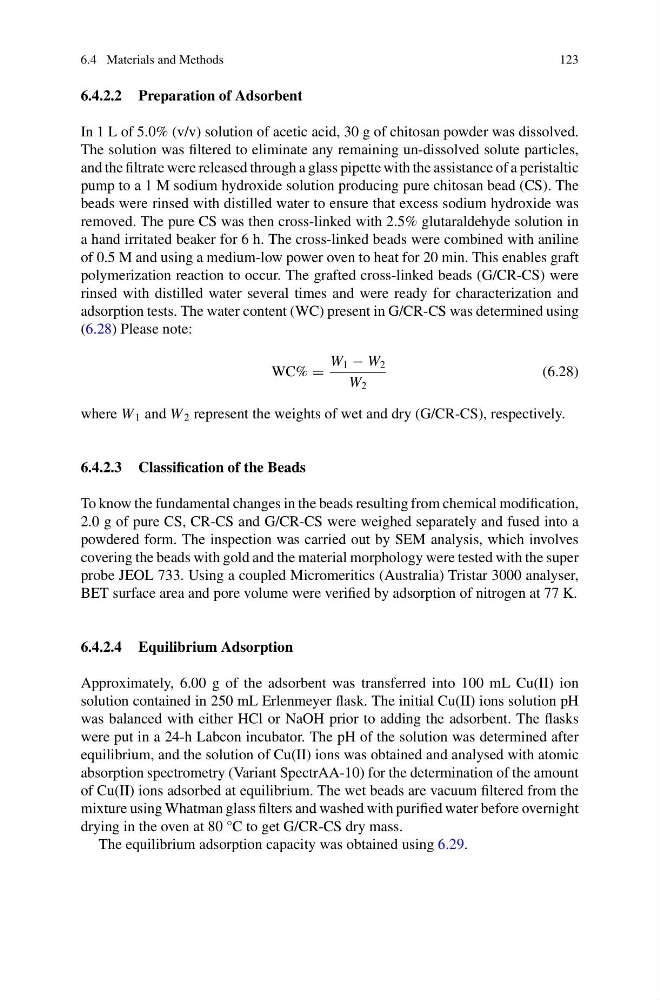
adsorption tests. The water content (WC) present in G/CR-CS was determined using
(6.28) Please note:
WC% =
W 1 − W 2
W 2
(6.28)
where W 1 and W 2 represent the weights of wet and dry (G/CR-CS), respectively.
6.4.2.3 Classification of the Beads
To know the fundamental changes in the beads resulting from chemical modification,
2.0 g of pure CS, CR-CS and G/CR-CS were weighed separately and fused into a
powdered form. The inspection was carried out by SEM analysis, which involves
covering the beads with gold and the material morphology were tested with the super
probe JEOL 733. Using a coupled Micromeritics (Australia) Tristar 3000 analyser,
BET surface area and pore volume were verified by adsorption of nitrogen at 77 K.
6.4.2.4 Equilibrium Adsorption
Approximately, 6.00 g of the adsorbent was transferred into 100 mL Cu(II) ion
solution contained in 250 mL Erlenmeyer flask. The initial Cu(II) ions solution pH
was balanced with either HCl or NaOH prior to adding the adsorbent. The flasks
were put in a 24-h Labcon incubator. The pH of the solution was determined after
equilibrium, and the solution of Cu(II) ions was obtained and analysed with atomic
absorption spectrometry (Variant SpectrAA-10) for the determination of the amount
of Cu(II) ions adsorbed at equilibrium. The wet beads are vacuum filtered from the
mixture using Whatman glass filters and washed with purified water before overnight
drying in the oven at 80 °C to get G/CR-CS dry mass.
The equilibrium adsorption capacity was obtained using 6.29.
123
6.4.2.2 Preparation of Adsorbent
In 1 L of 5.0% (v/v) solution of acetic acid, 30 g of chitosan powder was dissolved.
The solution was filtered to eliminate any remaining un-dissolved solute particles,
and the filtrate were released through a glass pipette with the assistance of a peristaltic
pump to a 1 M sodium hydroxide solution producing pure chitosan bead (CS). The
beads were rinsed with distilled water to ensure that excess sodium hydroxide was
removed. The pure CS was then cross-linked with 2.5% glutaraldehyde solution in
a hand irritated beaker for 6 h. The cross-linked beads were combined with aniline
of 0.5 M and using a medium-low power oven to heat for 20 min. This enables graft
polymerization reaction to occur. The grafted cross-linked beads (G/CR-CS) were
rinsed with distilled water several times and were ready for characterization and
adsorption tests. The water content (WC) present in G/CR-CS was determined using
(6.28) Please note:
WC% =
W 1 − W 2
W 2
(6.28)
where W 1 and W 2 represent the weights of wet and dry (G/CR-CS), respectively.
6.4.2.3 Classification of the Beads
To know the fundamental changes in the beads resulting from chemical modification,
2.0 g of pure CS, CR-CS and G/CR-CS were weighed separately and fused into a
powdered form. The inspection was carried out by SEM analysis, which involves
covering the beads with gold and the material morphology were tested with the super
probe JEOL 733. Using a coupled Micromeritics (Australia) Tristar 3000 analyser,
BET surface area and pore volume were verified by adsorption of nitrogen at 77 K.
6.4.2.4 Equilibrium Adsorption
Approximately, 6.00 g of the adsorbent was transferred into 100 mL Cu(II) ion
solution contained in 250 mL Erlenmeyer flask. The initial Cu(II) ions solution pH
was balanced with either HCl or NaOH prior to adding the adsorbent. The flasks
were put in a 24-h Labcon incubator. The pH of the solution was determined after
equilibrium, and the solution of Cu(II) ions was obtained and analysed with atomic
absorption spectrometry (Variant SpectrAA-10) for the determination of the amount
of Cu(II) ions adsorbed at equilibrium. The wet beads are vacuum filtered from the
mixture using Whatman glass filters and washed with purified water before overnight
drying in the oven at 80 °C to get G/CR-CS dry mass.
The equilibrium adsorption capacity was obtained using 6.29.