

122
6 Modelling of Packed Bed Column for the Adsorption …
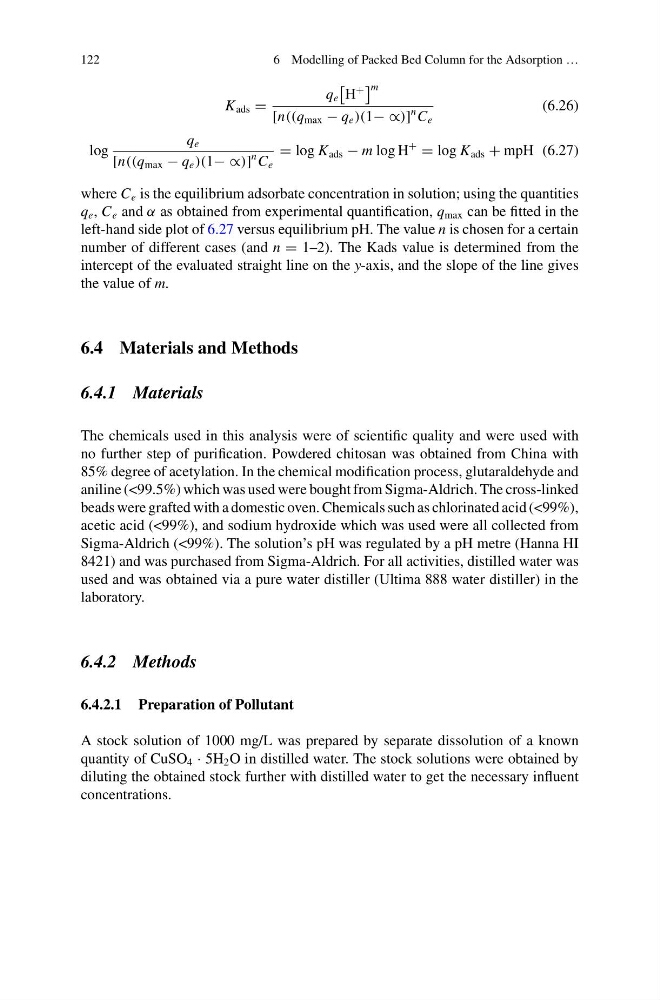
K ads =
q e
H
+
m
[n((q max − q e )(1− ∝)]
n C e
(6.26)
log
q e
[n((q max − q e )(1− ∝)]
n C e
= log K ads − m log H
+
= log K ads + mpH (6.27)
where C e is the equilibrium adsorbate concentration in solution; using the quantities
q e , C e and α as obtained from experimental quantification, q max can be fitted in the
left-hand side plot of 6.27 versus equilibrium pH. The value n is chosen for a certain
number of different cases (and n = 1–2). The Kads value is determined from the
intercept of the evaluated straight line on the y-axis, and the slope of the line gives
the value of m.
6.4 Materials and Methods
6.4.1 Materials
The chemicals used in this analysis were of scientific quality and were used with
no further step of purification. Powdered chitosan was obtained from China with
85% degree of acetylation. In the chemical modification process, glutaraldehyde and
aniline (<99.5%) which was used were bought from Sigma-Aldrich. The cross-linked
beads were grafted with a domestic oven. Chemicals such as chlorinated acid (<99%),
acetic acid (<99%), and sodium hydroxide which was used were all collected from
Sigma-Aldrich (<99%). The solution’s pH was regulated by a pH metre (Hanna HI
8421) and was purchased from Sigma-Aldrich. For all activities, distilled water was
used and was obtained via a pure water distiller (Ultima 888 water distiller) in the
laboratory.
6.4.2 Methods
6.4.2.1 Preparation of Pollutant
A stock solution of 1000 mg/L was prepared by separate dissolution of a known
quantity of CuSO 4 · 5H 2 O in distilled water. The stock solutions were obtained by
diluting the obtained stock further with distilled water to get the necessary influent
concentrations.
6 Modelling of Packed Bed Column for the Adsorption …
K ads =
q e
H
+
m
[n((q max − q e )(1− ∝)]
n C e
(6.26)
log
q e
[n((q max − q e )(1− ∝)]
n C e
= log K ads − m log H
+
= log K ads + mpH (6.27)
where C e is the equilibrium adsorbate concentration in solution; using the quantities
q e , C e and α as obtained from experimental quantification, q max can be fitted in the
left-hand side plot of 6.27 versus equilibrium pH. The value n is chosen for a certain
number of different cases (and n = 1–2). The Kads value is determined from the
intercept of the evaluated straight line on the y-axis, and the slope of the line gives
the value of m.
6.4 Materials and Methods
6.4.1 Materials
The chemicals used in this analysis were of scientific quality and were used with
no further step of purification. Powdered chitosan was obtained from China with
85% degree of acetylation. In the chemical modification process, glutaraldehyde and
aniline (<99.5%) which was used were bought from Sigma-Aldrich. The cross-linked
beads were grafted with a domestic oven. Chemicals such as chlorinated acid (<99%),
acetic acid (<99%), and sodium hydroxide which was used were all collected from
Sigma-Aldrich (<99%). The solution’s pH was regulated by a pH metre (Hanna HI
8421) and was purchased from Sigma-Aldrich. For all activities, distilled water was
used and was obtained via a pure water distiller (Ultima 888 water distiller) in the
laboratory.
6.4.2 Methods
6.4.2.1 Preparation of Pollutant
A stock solution of 1000 mg/L was prepared by separate dissolution of a known
quantity of CuSO 4 · 5H 2 O in distilled water. The stock solutions were obtained by
diluting the obtained stock further with distilled water to get the necessary influent
concentrations.