

6.3 Application to Column Systems
121
M
2+
aq + n(−NH 2 ) + mH 2 O
M(−NH 2 ) n,
OH
−
m
(2−m) + mH
+
(6.17)
K ads =
M
∗
H
+
m
[−NH 2 ]
M
2+
aq
(6.18)
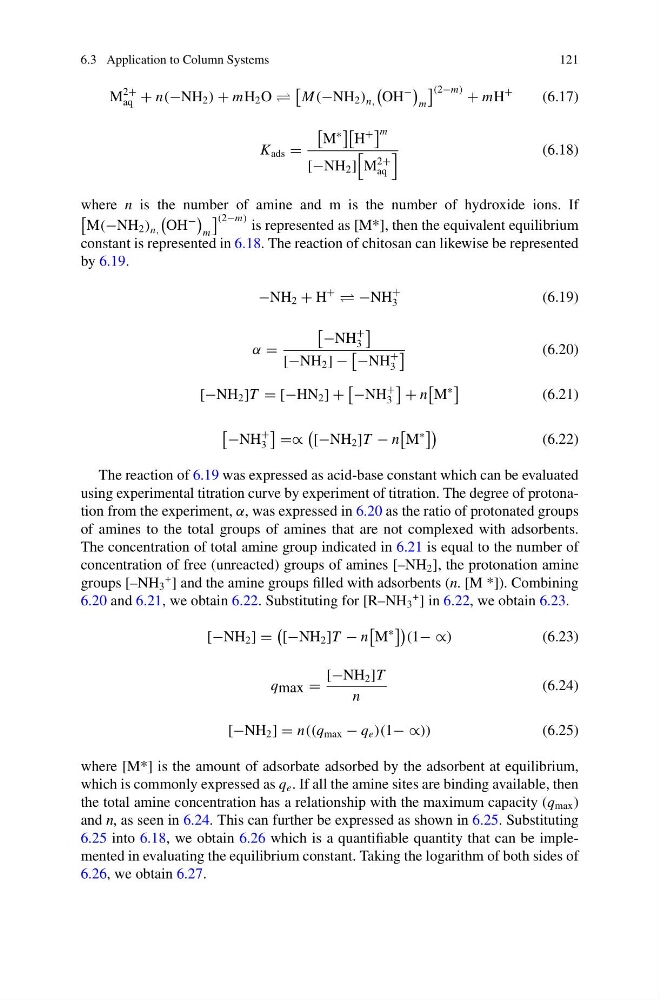
where n is the number of amine and m is the number of hydroxide ions. If
M(−NH 2 ) n,
OH
−
m
(2−m) is represented as [M*], then the equivalent equilibrium
constant is represented in 6.18. The reaction of chitosan can likewise be represented
by 6.19.
−NH 2 + H
+
−NH
+
3
(6.19)
α =
−NH
+
3
[−NH 2 ] −
−NH
+
3
(6.20)
[−NH 2 ]T = [−HN 2 ] +
−NH
+
3
+ n
M
∗
(6.21)
−NH
+
3
=∝
[−NH 2 ]T − n
M
∗
(6.22)
The reaction of 6.19 was expressed as acid-base constant which can be evaluated
using experimental titration curve by experiment of titration. The degree of protonation from the experiment, α, was expressed in 6.20 as the ratio of protonated groups
of amines to the total groups of amines that are not complexed with adsorbents.
The concentration of total amine group indicated in 6.21 is equal to the number of
concentration of free (unreacted) groups of amines [–NH 2 ], the protonation amine
groups [–NH 3
+ ] and the amine groups filled with adsorbents (n. [M *]). Combining
6.20 and 6.21, we obtain 6.22. Substituting for [R–NH 3
+ ] in 6.22, we obtain 6.23.
[−NH 2 ] =
[−NH 2 ]T − n
M
∗
(1− ∝)
(6.23)
q max =
[−NH 2 ]T
n
(6.24)
[−NH 2 ] = n((q max − q e )(1− ∝))
(6.25)
where [M*] is the amount of adsorbate adsorbed by the adsorbent at equilibrium,
which is commonly expressed as q e . If all the amine sites are binding available, then
the total amine concentration has a relationship with the maximum capacity (q max )
and n, as seen in 6.24. This can further be expressed as shown in 6.25. Substituting
6.25 into 6.18, we obtain 6.26 which is a quantifiable quantity that can be implemented in evaluating the equilibrium constant. Taking the logarithm of both sides of
6.26, we obtain 6.27.
121
M
2+
aq + n(−NH 2 ) + mH 2 O
M(−NH 2 ) n,
OH
−
m
(2−m) + mH
+
(6.17)
K ads =
M
∗
H
+
m
[−NH 2 ]
M
2+
aq
(6.18)
where n is the number of amine and m is the number of hydroxide ions. If
M(−NH 2 ) n,
OH
−
m
(2−m) is represented as [M*], then the equivalent equilibrium
constant is represented in 6.18. The reaction of chitosan can likewise be represented
by 6.19.
−NH 2 + H
+
−NH
+
3
(6.19)
α =
−NH
+
3
[−NH 2 ] −
−NH
+
3
(6.20)
[−NH 2 ]T = [−HN 2 ] +
−NH
+
3
+ n
M
∗
(6.21)
−NH
+
3
=∝
[−NH 2 ]T − n
M
∗
(6.22)
The reaction of 6.19 was expressed as acid-base constant which can be evaluated
using experimental titration curve by experiment of titration. The degree of protonation from the experiment, α, was expressed in 6.20 as the ratio of protonated groups
of amines to the total groups of amines that are not complexed with adsorbents.
The concentration of total amine group indicated in 6.21 is equal to the number of
concentration of free (unreacted) groups of amines [–NH 2 ], the protonation amine
groups [–NH 3
+ ] and the amine groups filled with adsorbents (n. [M *]). Combining
6.20 and 6.21, we obtain 6.22. Substituting for [R–NH 3
+ ] in 6.22, we obtain 6.23.
[−NH 2 ] =
[−NH 2 ]T − n
M
∗
(1− ∝)
(6.23)
q max =
[−NH 2 ]T
n
(6.24)
[−NH 2 ] = n((q max − q e )(1− ∝))
(6.25)
where [M*] is the amount of adsorbate adsorbed by the adsorbent at equilibrium,
which is commonly expressed as q e . If all the amine sites are binding available, then
the total amine concentration has a relationship with the maximum capacity (q max )
and n, as seen in 6.24. This can further be expressed as shown in 6.25. Substituting
6.25 into 6.18, we obtain 6.26 which is a quantifiable quantity that can be implemented in evaluating the equilibrium constant. Taking the logarithm of both sides of
6.26, we obtain 6.27.