

5.8 The Effect of Cations and Anions on Membrane Adsorption
109
5.8 The Effect of Cations and Anions on Membrane
Adsorption
A control sample of 7.65 mmol L
−1 zinc (ZnSO 4 · 7H 2 O) was considered to analyse
the influence of several other pollutants on the chitosan adsorption. The control
sample was separated into nine samples, and these samples were subsequently separated into three sample sets. They compared all pollutants to the controlled sample.
The first collection of samples was designed to evaluate the impact of nitrates and
chlorides on the adsorption capacity; the second collection was chosen to measure
the impact of calcium, sodium, potassium and magnesium, and the third collection
was utilized to measure the impact of sulphates by raising the sulphate concentration.
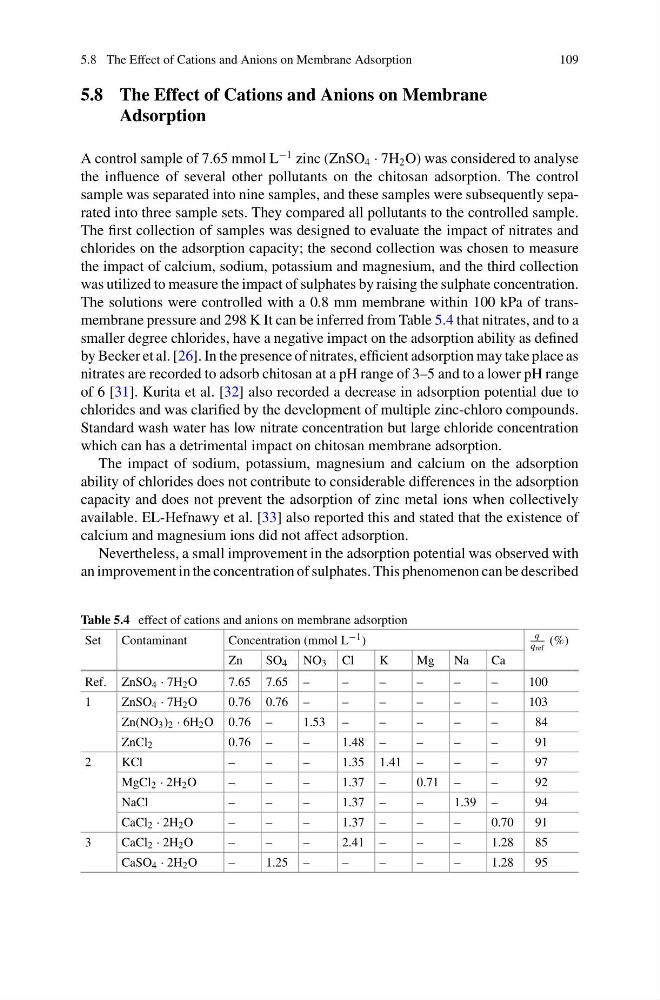
The solutions were controlled with a 0.8 mm membrane within 100 kPa of transmembrane pressure and 298 K It can be inferred from Table 5.4 that nitrates, and to a
smaller degree chlorides, have a negative impact on the adsorption ability as defined
by Becker et al. [26]. In the presence of nitrates, efficient adsorption may take place as
nitrates are recorded to adsorb chitosan at a pH range of 3–5 and to a lower pH range
of 6 [31]. Kurita et al. [32] also recorded a decrease in adsorption potential due to
chlorides and was clarified by the development of multiple zinc-chloro compounds.
Standard wash water has low nitrate concentration but large chloride concentration
which can has a detrimental impact on chitosan membrane adsorption.
The impact of sodium, potassium, magnesium and calcium on the adsorption
ability of chlorides does not contribute to considerable differences in the adsorption
capacity and does not prevent the adsorption of zinc metal ions when collectively
available. EL-Hefnawy et al. [33] also reported this and stated that the existence of
calcium and magnesium ions did not affect adsorption.
Nevertheless, a small improvement in the adsorption potential was observed with
an improvement in the concentration of sulphates. This phenomenon can be described
Table 5.4 effect of cations and anions on membrane adsorption
Set
Contaminant
Concentration (mmol L −1 )
q
qref (%)
Zn
SO 4 NO 3 Cl
K
Mg
Na
Ca
Ref. ZnSO 4 · 7H 2 O
7.65 7.65 –
–
–
–
–
–
100
1
ZnSO 4 · 7H 2 O
0.76 0.76 –
–
–
–
–
–
103
Zn(NO 3 ) 2 · 6H 2 O 0.76 –
1.53 –
–
–
–
–
84
ZnCl 2
0.76 –
–
1.48 –
–
–
–
91
2
KCl
–
–
–
1.35 1.41 –
–
–
97
MgCl 2 · 2H 2 O
–
–
–
1.37 –
0.71 –
–
92
NaCl
–
–
–
1.37 –
–
1.39 –
94
CaCl 2 · 2H 2 O
–
–
–
1.37 –
–
–
0.70
91
3
CaCl 2 · 2H 2 O
–
–
–
2.41 –
–
–
1.28
85
CaSO 4 · 2H 2 O
–
1.25 –
–
–
–
–
1.28
95
109
5.8 The Effect of Cations and Anions on Membrane
Adsorption
A control sample of 7.65 mmol L
−1 zinc (ZnSO 4 · 7H 2 O) was considered to analyse
the influence of several other pollutants on the chitosan adsorption. The control
sample was separated into nine samples, and these samples were subsequently separated into three sample sets. They compared all pollutants to the controlled sample.
The first collection of samples was designed to evaluate the impact of nitrates and
chlorides on the adsorption capacity; the second collection was chosen to measure
the impact of calcium, sodium, potassium and magnesium, and the third collection
was utilized to measure the impact of sulphates by raising the sulphate concentration.
The solutions were controlled with a 0.8 mm membrane within 100 kPa of transmembrane pressure and 298 K It can be inferred from Table 5.4 that nitrates, and to a
smaller degree chlorides, have a negative impact on the adsorption ability as defined
by Becker et al. [26]. In the presence of nitrates, efficient adsorption may take place as
nitrates are recorded to adsorb chitosan at a pH range of 3–5 and to a lower pH range
of 6 [31]. Kurita et al. [32] also recorded a decrease in adsorption potential due to
chlorides and was clarified by the development of multiple zinc-chloro compounds.
Standard wash water has low nitrate concentration but large chloride concentration
which can has a detrimental impact on chitosan membrane adsorption.
The impact of sodium, potassium, magnesium and calcium on the adsorption
ability of chlorides does not contribute to considerable differences in the adsorption
capacity and does not prevent the adsorption of zinc metal ions when collectively
available. EL-Hefnawy et al. [33] also reported this and stated that the existence of
calcium and magnesium ions did not affect adsorption.
Nevertheless, a small improvement in the adsorption potential was observed with
an improvement in the concentration of sulphates. This phenomenon can be described
Table 5.4 effect of cations and anions on membrane adsorption
Set
Contaminant
Concentration (mmol L −1 )
q
qref (%)
Zn
SO 4 NO 3 Cl
K
Mg
Na
Ca
Ref. ZnSO 4 · 7H 2 O
7.65 7.65 –
–
–
–
–
–
100
1
ZnSO 4 · 7H 2 O
0.76 0.76 –
–
–
–
–
–
103
Zn(NO 3 ) 2 · 6H 2 O 0.76 –
1.53 –
–
–
–
–
84
ZnCl 2
0.76 –
–
1.48 –
–
–
–
91
2
KCl
–
–
–
1.35 1.41 –
–
–
97
MgCl 2 · 2H 2 O
–
–
–
1.37 –
0.71 –
–
92
NaCl
–
–
–
1.37 –
–
1.39 –
94
CaCl 2 · 2H 2 O
–
–
–
1.37 –
–
–
0.70
91
3
CaCl 2 · 2H 2 O
–
–
–
2.41 –
–
–
1.28
85
CaSO 4 · 2H 2 O
–
1.25 –
–
–
–
–
1.28
95