

110
5 Biopolymer Chitosan Membranes Prepared from Fishery Waste …
in conjunction with sulphate-induced design improvements in chitosan, and such
increased capacity for transition metal ion adsorption in sulphate media has also
been documented by Mitani et al. [34].
5.9 Desorption and Recovery
The membranes that were designed for desorption experiments were initially
adsorbed. Each membrane has been controlled at a pH of 6 with a 7.65 mmol L
−1
Zn(II) solution during the adsorption procedure. The concentration of the solution
Zn(II) was measured before and after the procedure to evaluate the adsorption potential at equilibrium. Desorption, i.e. regeneration, was achieved by processing the
membranes in different samples with distilled water and hydrochloric acid solutions
(pH = 2 and 4) and sulphuric acid (pH = 2 and 4). The membranes were soaked in
an acid solution for 6 h. A volume of 200 mL of distilled water and acid was used
per treatment, respectively.
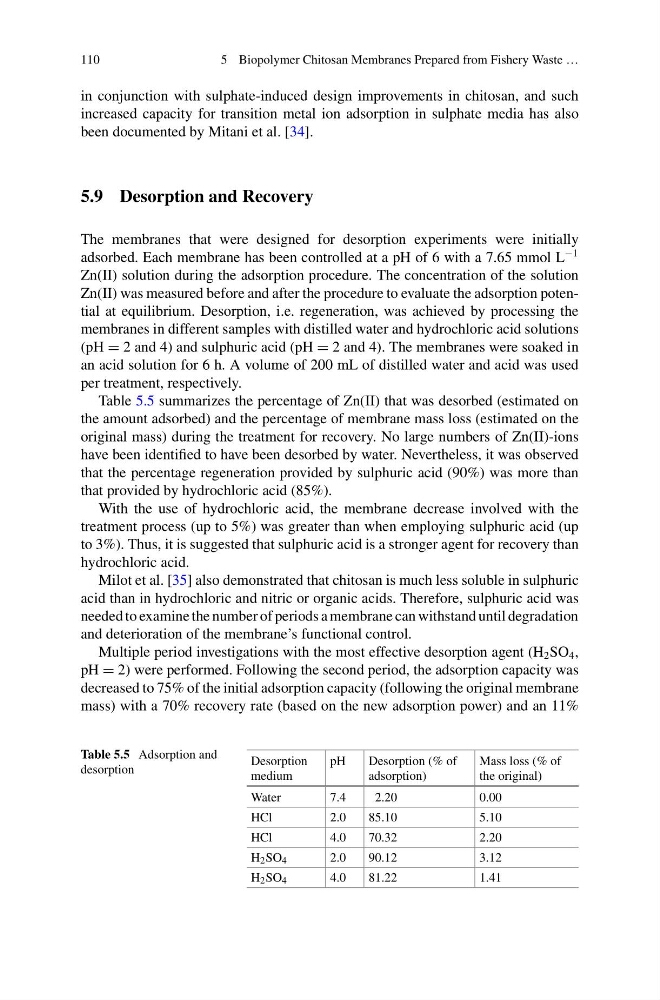
Table 5.5 summarizes the percentage of Zn(II) that was desorbed (estimated on
the amount adsorbed) and the percentage of membrane mass loss (estimated on the
original mass) during the treatment for recovery. No large numbers of Zn(II)-ions
have been identified to have been desorbed by water. Nevertheless, it was observed
that the percentage regeneration provided by sulphuric acid (90%) was more than
that provided by hydrochloric acid (85%).
With the use of hydrochloric acid, the membrane decrease involved with the
treatment process (up to 5%) was greater than when employing sulphuric acid (up
to 3%). Thus, it is suggested that sulphuric acid is a stronger agent for recovery than
hydrochloric acid.
Milot et al. [35] also demonstrated that chitosan is much less soluble in sulphuric
acid than in hydrochloric and nitric or organic acids. Therefore, sulphuric acid was
needed to examine the number of periods a membrane can withstand until degradation
and deterioration of the membrane’s functional control.
Multiple period investigations with the most effective desorption agent (H 2 SO 4 ,
pH = 2) were performed. Following the second period, the adsorption capacity was
decreased to 75% of the initial adsorption capacity (following the original membrane
mass) with a 70% recovery rate (based on the new adsorption power) and an 11%
Table 5.5 Adsorption and
desorption
Desorption
medium
pH
Desorption (% of
adsorption)
Mass loss (% of
the original)
Water
7.4
2.20
0.00
HCl
2.0
85.10
5.10
HCl
4.0
70.32
2.20
H 2 SO 4
2.0
90.12
3.12
H 2 SO 4
4.0
81.22
1.41
5 Biopolymer Chitosan Membranes Prepared from Fishery Waste …
in conjunction with sulphate-induced design improvements in chitosan, and such
increased capacity for transition metal ion adsorption in sulphate media has also
been documented by Mitani et al. [34].
5.9 Desorption and Recovery
The membranes that were designed for desorption experiments were initially
adsorbed. Each membrane has been controlled at a pH of 6 with a 7.65 mmol L
−1
Zn(II) solution during the adsorption procedure. The concentration of the solution
Zn(II) was measured before and after the procedure to evaluate the adsorption potential at equilibrium. Desorption, i.e. regeneration, was achieved by processing the
membranes in different samples with distilled water and hydrochloric acid solutions
(pH = 2 and 4) and sulphuric acid (pH = 2 and 4). The membranes were soaked in
an acid solution for 6 h. A volume of 200 mL of distilled water and acid was used
per treatment, respectively.
Table 5.5 summarizes the percentage of Zn(II) that was desorbed (estimated on
the amount adsorbed) and the percentage of membrane mass loss (estimated on the
original mass) during the treatment for recovery. No large numbers of Zn(II)-ions
have been identified to have been desorbed by water. Nevertheless, it was observed
that the percentage regeneration provided by sulphuric acid (90%) was more than
that provided by hydrochloric acid (85%).
With the use of hydrochloric acid, the membrane decrease involved with the
treatment process (up to 5%) was greater than when employing sulphuric acid (up
to 3%). Thus, it is suggested that sulphuric acid is a stronger agent for recovery than
hydrochloric acid.
Milot et al. [35] also demonstrated that chitosan is much less soluble in sulphuric
acid than in hydrochloric and nitric or organic acids. Therefore, sulphuric acid was
needed to examine the number of periods a membrane can withstand until degradation
and deterioration of the membrane’s functional control.
Multiple period investigations with the most effective desorption agent (H 2 SO 4 ,
pH = 2) were performed. Following the second period, the adsorption capacity was
decreased to 75% of the initial adsorption capacity (following the original membrane
mass) with a 70% recovery rate (based on the new adsorption power) and an 11%
Table 5.5 Adsorption and
desorption
Desorption
medium
pH
Desorption (% of
adsorption)
Mass loss (% of
the original)
Water
7.4
2.20
0.00
HCl
2.0
85.10
5.10
HCl
4.0
70.32
2.20
H 2 SO 4
2.0
90.12
3.12
H 2 SO 4
4.0
81.22
1.41