

108
5 Biopolymer Chitosan Membranes Prepared from Fishery Waste …
0.0
0.1
0.2
0.3
0.4
0.5
0.6
0.7
0.8
0.9
1.0
0
10
20
30
40
50
60
70
80
90 100 110 120 130 140 150
C
t /C
in
Equivalent membrane volume
7.65 mmol/L Zn
0.79 mmol/L Cu
1.53 mmol/L Zn
0.76 mmol/L Zn
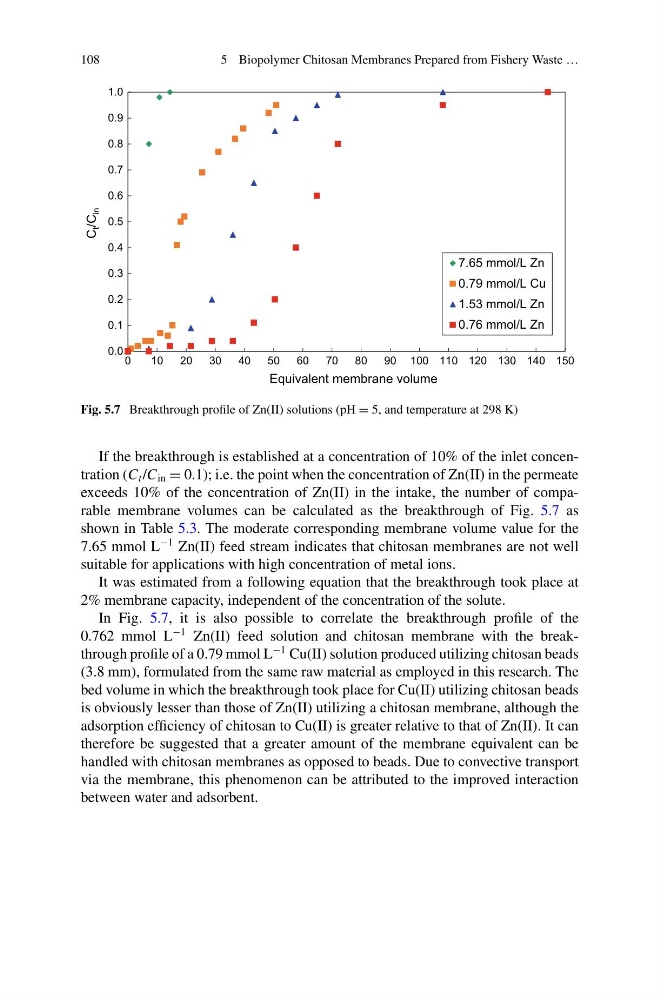
Fig. 5.7 Breakthrough profile of Zn(II) solutions (pH = 5, and temperature at 298 K)
If the breakthrough is established at a concentration of 10% of the inlet concentration (C t /C in = 0.1); i.e. the point when the concentration of Zn(II) in the permeate
exceeds 10% of the concentration of Zn(II) in the intake, the number of comparable membrane volumes can be calculated as the breakthrough of Fig. 5.7 as
shown in Table 5.3. The moderate corresponding membrane volume value for the
7.65 mmol L
−1 Zn(II) feed stream indicates that chitosan membranes are not well
suitable for applications with high concentration of metal ions.
It was estimated from a following equation that the breakthrough took place at
2% membrane capacity, independent of the concentration of the solute.
In Fig. 5.7, it is also possible to correlate the breakthrough profile of the
0.762 mmol L
−1 Zn(II) feed solution and chitosan membrane with the breakthrough profile of a 0.79 mmol L
−1 Cu(II) solution produced utilizing chitosan beads
(3.8 mm), formulated from the same raw material as employed in this research. The
bed volume in which the breakthrough took place for Cu(II) utilizing chitosan beads
is obviously lesser than those of Zn(II) utilizing a chitosan membrane, although the
adsorption efficiency of chitosan to Cu(II) is greater relative to that of Zn(II). It can
therefore be suggested that a greater amount of the membrane equivalent can be
handled with chitosan membranes as opposed to beads. Due to convective transport
via the membrane, this phenomenon can be attributed to the improved interaction
between water and adsorbent.
5 Biopolymer Chitosan Membranes Prepared from Fishery Waste …
0.0
0.1
0.2
0.3
0.4
0.5
0.6
0.7
0.8
0.9
1.0
0
10
20
30
40
50
60
70
80
90 100 110 120 130 140 150
C
t /C
in
Equivalent membrane volume
7.65 mmol/L Zn
0.79 mmol/L Cu
1.53 mmol/L Zn
0.76 mmol/L Zn
Fig. 5.7 Breakthrough profile of Zn(II) solutions (pH = 5, and temperature at 298 K)
If the breakthrough is established at a concentration of 10% of the inlet concentration (C t /C in = 0.1); i.e. the point when the concentration of Zn(II) in the permeate
exceeds 10% of the concentration of Zn(II) in the intake, the number of comparable membrane volumes can be calculated as the breakthrough of Fig. 5.7 as
shown in Table 5.3. The moderate corresponding membrane volume value for the
7.65 mmol L
−1 Zn(II) feed stream indicates that chitosan membranes are not well
suitable for applications with high concentration of metal ions.
It was estimated from a following equation that the breakthrough took place at
2% membrane capacity, independent of the concentration of the solute.
In Fig. 5.7, it is also possible to correlate the breakthrough profile of the
0.762 mmol L
−1 Zn(II) feed solution and chitosan membrane with the breakthrough profile of a 0.79 mmol L
−1 Cu(II) solution produced utilizing chitosan beads
(3.8 mm), formulated from the same raw material as employed in this research. The
bed volume in which the breakthrough took place for Cu(II) utilizing chitosan beads
is obviously lesser than those of Zn(II) utilizing a chitosan membrane, although the
adsorption efficiency of chitosan to Cu(II) is greater relative to that of Zn(II). It can
therefore be suggested that a greater amount of the membrane equivalent can be
handled with chitosan membranes as opposed to beads. Due to convective transport
via the membrane, this phenomenon can be attributed to the improved interaction
between water and adsorbent.