

5.2 Materials and Methods
97
obtained after a certain period of time and tracked accurately using a Perkin Elmer,
Analyst 200 Model B3150070 atomic absorption spectrophotometric analyser.
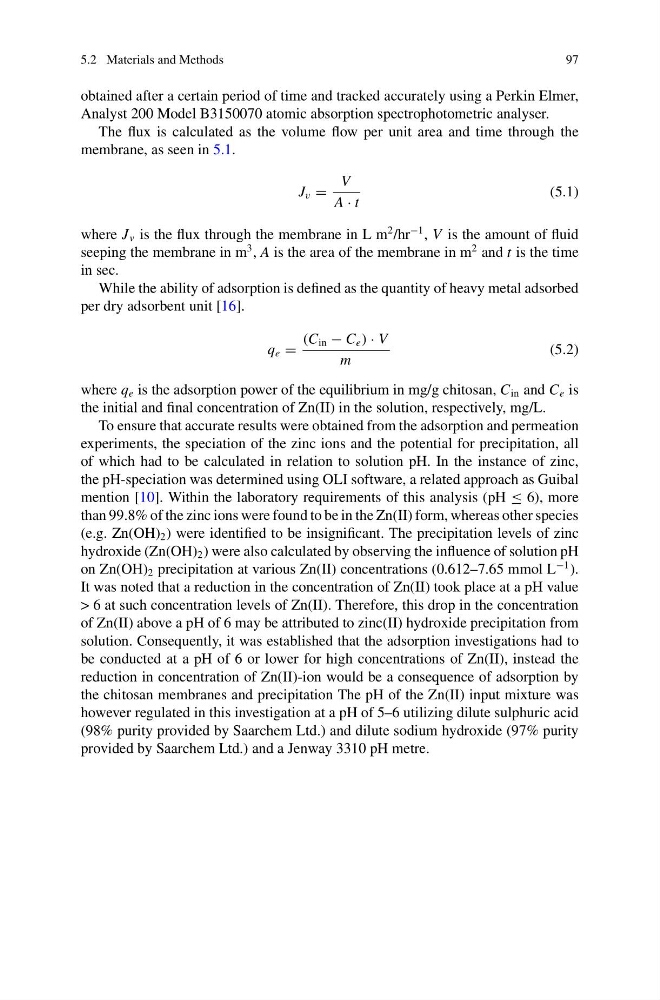
The flux is calculated as the volume flow per unit area and time through the
membrane, as seen in 5.1.
J v =
V
A · t
(5.1)
where J v is the flux through the membrane in L m
2 /hr
−1 , V is the amount of fluid
seeping the membrane in m
3 , A is the area of the membrane in m
2 and t is the time
in sec.
While the ability of adsorption is defined as the quantity of heavy metal adsorbed
per dry adsorbent unit [16].
q e =
(C in − C e ) · V
m
(5.2)
where q e is the adsorption power of the equilibrium in mg/g chitosan, C in and C e is
the initial and final concentration of Zn(II) in the solution, respectively, mg/L.
To ensure that accurate results were obtained from the adsorption and permeation
experiments, the speciation of the zinc ions and the potential for precipitation, all
of which had to be calculated in relation to solution pH. In the instance of zinc,
the pH-speciation was determined using OLI software, a related approach as Guibal
mention [10]. Within the laboratory requirements of this analysis (pH ≤ 6), more
than 99.8% of the zinc ions were found to be in the Zn(II) form, whereas other species
(e.g. Zn(OH) 2 ) were identified to be insignificant. The precipitation levels of zinc
hydroxide (Zn(OH) 2 ) were also calculated by observing the influence of solution pH
on Zn(OH) 2 precipitation at various Zn(II) concentrations (0.612–7.65 mmol L
−1 ).
It was noted that a reduction in the concentration of Zn(II) took place at a pH value
> 6 at such concentration levels of Zn(II). Therefore, this drop in the concentration
of Zn(II) above a pH of 6 may be attributed to zinc(II) hydroxide precipitation from
solution. Consequently, it was established that the adsorption investigations had to
be conducted at a pH of 6 or lower for high concentrations of Zn(II), instead the
reduction in concentration of Zn(II)-ion would be a consequence of adsorption by
the chitosan membranes and precipitation The pH of the Zn(II) input mixture was
however regulated in this investigation at a pH of 5–6 utilizing dilute sulphuric acid
(98% purity provided by Saarchem Ltd.) and dilute sodium hydroxide (97% purity
provided by Saarchem Ltd.) and a Jenway 3310 pH metre.
97
obtained after a certain period of time and tracked accurately using a Perkin Elmer,
Analyst 200 Model B3150070 atomic absorption spectrophotometric analyser.
The flux is calculated as the volume flow per unit area and time through the
membrane, as seen in 5.1.
J v =
V
A · t
(5.1)
where J v is the flux through the membrane in L m
2 /hr
−1 , V is the amount of fluid
seeping the membrane in m
3 , A is the area of the membrane in m
2 and t is the time
in sec.
While the ability of adsorption is defined as the quantity of heavy metal adsorbed
per dry adsorbent unit [16].
q e =
(C in − C e ) · V
m
(5.2)
where q e is the adsorption power of the equilibrium in mg/g chitosan, C in and C e is
the initial and final concentration of Zn(II) in the solution, respectively, mg/L.
To ensure that accurate results were obtained from the adsorption and permeation
experiments, the speciation of the zinc ions and the potential for precipitation, all
of which had to be calculated in relation to solution pH. In the instance of zinc,
the pH-speciation was determined using OLI software, a related approach as Guibal
mention [10]. Within the laboratory requirements of this analysis (pH ≤ 6), more
than 99.8% of the zinc ions were found to be in the Zn(II) form, whereas other species
(e.g. Zn(OH) 2 ) were identified to be insignificant. The precipitation levels of zinc
hydroxide (Zn(OH) 2 ) were also calculated by observing the influence of solution pH
on Zn(OH) 2 precipitation at various Zn(II) concentrations (0.612–7.65 mmol L
−1 ).
It was noted that a reduction in the concentration of Zn(II) took place at a pH value
> 6 at such concentration levels of Zn(II). Therefore, this drop in the concentration
of Zn(II) above a pH of 6 may be attributed to zinc(II) hydroxide precipitation from
solution. Consequently, it was established that the adsorption investigations had to
be conducted at a pH of 6 or lower for high concentrations of Zn(II), instead the
reduction in concentration of Zn(II)-ion would be a consequence of adsorption by
the chitosan membranes and precipitation The pH of the Zn(II) input mixture was
however regulated in this investigation at a pH of 5–6 utilizing dilute sulphuric acid
(98% purity provided by Saarchem Ltd.) and dilute sodium hydroxide (97% purity
provided by Saarchem Ltd.) and a Jenway 3310 pH metre.