

86
4 Investigation into the Adsorption of Cadmium and Lead …
beads contributed in the layer unevenness, suggesting that polyaniline was chemically
attached to the layers of the beads.
4.10 Outcome of Adsorption Investigation
4.10.1 Parameters of Isotherms Model
To evaluate the correct isotherm for cadmium and lead to GXCS, the Langmuir and
Freundlich model is utilized. From the slope and intercepts of C e /q e versus C e and
log q e versus log C e plots, the constants of the two models were measured at various
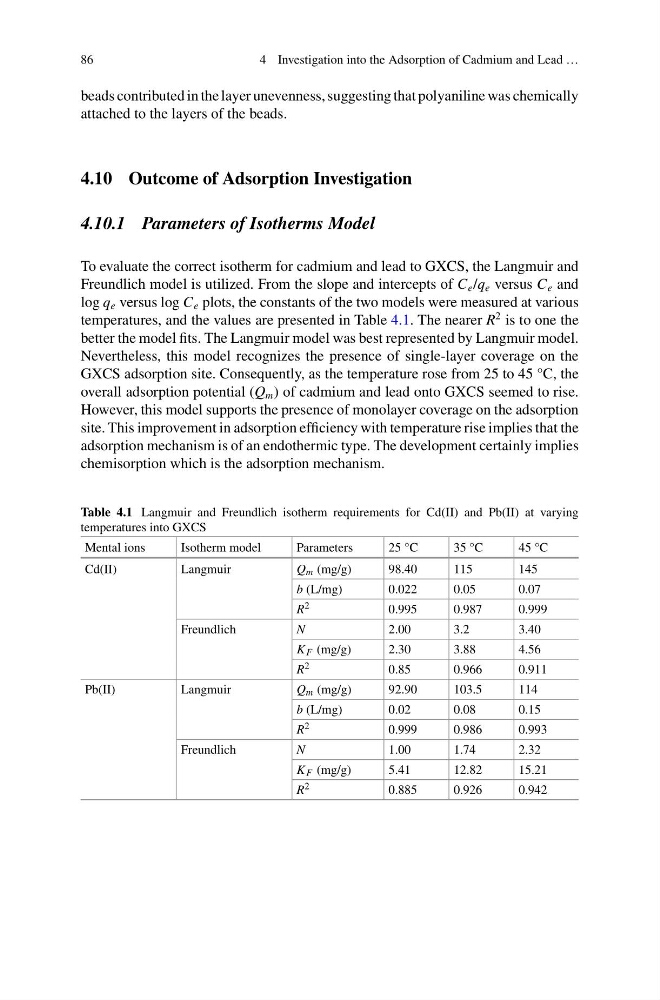
temperatures, and the values are presented in Table 4.1. The nearer R
2 is to one the
better the model fits. The Langmuir model was best represented by Langmuir model.
Nevertheless, this model recognizes the presence of single-layer coverage on the
GXCS adsorption site. Consequently, as the temperature rose from 25 to 45 °C, the
overall adsorption potential (Q m ) of cadmium and lead onto GXCS seemed to rise.
However, this model supports the presence of monolayer coverage on the adsorption
site. This improvement in adsorption efficiency with temperature rise implies that the
adsorption mechanism is of an endothermic type. The development certainly implies
chemisorption which is the adsorption mechanism.
Table 4.1 Langmuir and Freundlich isotherm requirements for Cd(II) and Pb(II) at varying
temperatures into GXCS
Mental ions
Isotherm model
Parameters
25 °C
35 °C
45 °C
Cd(II)
Langmuir
Q m (mg/g)
98.40
115
145
b (L/mg)
0.022
0.05
0.07
R 2
0.995
0.987
0.999
Freundlich
N
2.00
3.2
3.40
K F (mg/g)
2.30
3.88
4.56
R 2
0.85
0.966
0.911
Pb(II)
Langmuir
Q m (mg/g)
92.90
103.5
114
b (L/mg)
0.02
0.08
0.15
R 2
0.999
0.986
0.993
Freundlich
N
1.00
1.74
2.32
K F (mg/g)
5.41
12.82
15.21
R 2
0.885
0.926
0.942
4 Investigation into the Adsorption of Cadmium and Lead …
beads contributed in the layer unevenness, suggesting that polyaniline was chemically
attached to the layers of the beads.
4.10 Outcome of Adsorption Investigation
4.10.1 Parameters of Isotherms Model
To evaluate the correct isotherm for cadmium and lead to GXCS, the Langmuir and
Freundlich model is utilized. From the slope and intercepts of C e /q e versus C e and
log q e versus log C e plots, the constants of the two models were measured at various
temperatures, and the values are presented in Table 4.1. The nearer R
2 is to one the
better the model fits. The Langmuir model was best represented by Langmuir model.
Nevertheless, this model recognizes the presence of single-layer coverage on the
GXCS adsorption site. Consequently, as the temperature rose from 25 to 45 °C, the
overall adsorption potential (Q m ) of cadmium and lead onto GXCS seemed to rise.
However, this model supports the presence of monolayer coverage on the adsorption
site. This improvement in adsorption efficiency with temperature rise implies that the
adsorption mechanism is of an endothermic type. The development certainly implies
chemisorption which is the adsorption mechanism.
Table 4.1 Langmuir and Freundlich isotherm requirements for Cd(II) and Pb(II) at varying
temperatures into GXCS
Mental ions
Isotherm model
Parameters
25 °C
35 °C
45 °C
Cd(II)
Langmuir
Q m (mg/g)
98.40
115
145
b (L/mg)
0.022
0.05
0.07
R 2
0.995
0.987
0.999
Freundlich
N
2.00
3.2
3.40
K F (mg/g)
2.30
3.88
4.56
R 2
0.85
0.966
0.911
Pb(II)
Langmuir
Q m (mg/g)
92.90
103.5
114
b (L/mg)
0.02
0.08
0.15
R 2
0.999
0.986
0.993
Freundlich
N
1.00
1.74
2.32
K F (mg/g)
5.41
12.82
15.21
R 2
0.885
0.926
0.942