

17
Groundwater Pollution
India is largest groundwater user in the world and consumes nearly 230 km
3
of
groundwater annually. Nearly 90% of the total groundwater is used in agriculture
and only 7% is used for drinking water supply. According to CGWB and State
Groundwater Authorities, most of the aquifers in India are contaminated.
Contaminants in groundwater are arsenic (10 States, 86 Districts), fluoride (20
States, 276 districts,), salinity (9 States, 4 Union Territories), iron (24 states, 1 UT,
297 districts), nitrate (21 states, 387 districts) and heavy metals such as Pb, Cd and
Cr (15 states, 113 districts). The sources of contamination in groundwater are both
geogenic and anthropogenic. Number of states and districts contaminated with
salinity, arsenic, fluoride, iron, nitrate and heavy metals are given in Fig. 2.3.
The anthropogenic sources of groundwater are waste water from toilets, excessive use of fertilizers and pesticides, and leachate from dumping ground. In high
water table areas, waste water from toilets due to faulty toilet designs mixes with the
groundwater and creates biological contamination of groundwater. Roy et al. (2019)
have shown that faulty toilet construction in Sheohar district of Bihar resulted in
biological contamination in groundwater. Another important anthropogenic source
of groundwater contamination is the excessive use of fertilizers and pesticides in the
agricultural field to meet the food demand of the country. Majumdar and Gupta
(2000) have reported that excessive use of nitrogenous fertilizer in agricultural field
is the source of nitrate pollution in groundwater in many parts of the country.
Agarwal et al. (2015) have reported presence of organochlorine and organophosphate pesticides in groundwater in Delhi as a result of excessive use of pesticides in
the agricultural field. McArthur et al. (2018) have reported presence of anthropogenic arsenic in groundwater of Kolkata city, West Bengal. These anthropogenic
sources are polluting the available fresh water resource of the country and pose
major threat for the future.
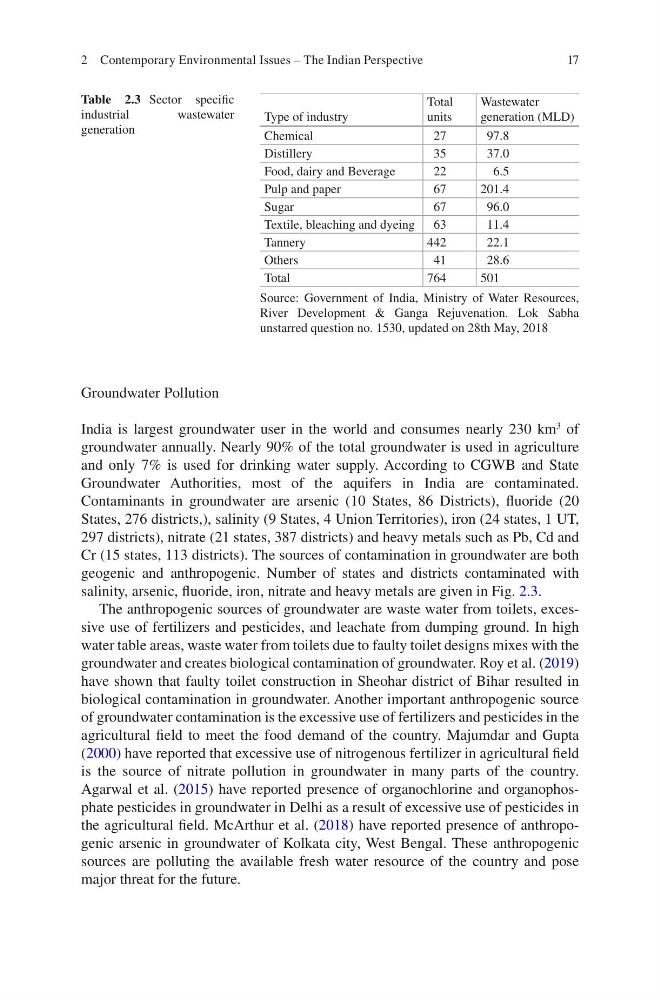
Table 2.3 Sector specific
industrial
wastewater
generation
Type of industry
Total
units
Wastewater
generation (MLD)
Chemical
27
97.8
Distillery
35
37.0
Food, dairy and Beverage
22
6.5
Pulp and paper
67
201.4
Sugar
67
96.0
Textile, bleaching and dyeing 63
11.4
Tannery
442
22.1
Others
41
28.6
Total
764
501
Source: Government of India, Ministry of Water Resources,
River Development & Ganga Rejuvenation. Lok Sabha
unstarred question no. 1530, updated on 28th May, 2018
2 Contemporary Environmental Issues – The Indian Perspective
Groundwater Pollution
India is largest groundwater user in the world and consumes nearly 230 km
3
of
groundwater annually. Nearly 90% of the total groundwater is used in agriculture
and only 7% is used for drinking water supply. According to CGWB and State
Groundwater Authorities, most of the aquifers in India are contaminated.
Contaminants in groundwater are arsenic (10 States, 86 Districts), fluoride (20
States, 276 districts,), salinity (9 States, 4 Union Territories), iron (24 states, 1 UT,
297 districts), nitrate (21 states, 387 districts) and heavy metals such as Pb, Cd and
Cr (15 states, 113 districts). The sources of contamination in groundwater are both
geogenic and anthropogenic. Number of states and districts contaminated with
salinity, arsenic, fluoride, iron, nitrate and heavy metals are given in Fig. 2.3.
The anthropogenic sources of groundwater are waste water from toilets, excessive use of fertilizers and pesticides, and leachate from dumping ground. In high
water table areas, waste water from toilets due to faulty toilet designs mixes with the
groundwater and creates biological contamination of groundwater. Roy et al. (2019)
have shown that faulty toilet construction in Sheohar district of Bihar resulted in
biological contamination in groundwater. Another important anthropogenic source
of groundwater contamination is the excessive use of fertilizers and pesticides in the
agricultural field to meet the food demand of the country. Majumdar and Gupta
(2000) have reported that excessive use of nitrogenous fertilizer in agricultural field
is the source of nitrate pollution in groundwater in many parts of the country.
Agarwal et al. (2015) have reported presence of organochlorine and organophosphate pesticides in groundwater in Delhi as a result of excessive use of pesticides in
the agricultural field. McArthur et al. (2018) have reported presence of anthropogenic arsenic in groundwater of Kolkata city, West Bengal. These anthropogenic
sources are polluting the available fresh water resource of the country and pose
major threat for the future.
Table 2.3 Sector specific
industrial
wastewater
generation
Type of industry
Total
units
Wastewater
generation (MLD)
Chemical
27
97.8
Distillery
35
37.0
Food, dairy and Beverage
22
6.5
Pulp and paper
67
201.4
Sugar
67
96.0
Textile, bleaching and dyeing 63
11.4
Tannery
442
22.1
Others
41
28.6
Total
764
501
Source: Government of India, Ministry of Water Resources,
River Development & Ganga Rejuvenation. Lok Sabha
unstarred question no. 1530, updated on 28th May, 2018
2 Contemporary Environmental Issues – The Indian Perspective