

14
sector, followed by agriculture (19.6%), industrial processes (6%), land-use change
and forestry (3.8%) and waste (1.9%) (USAID 2014).
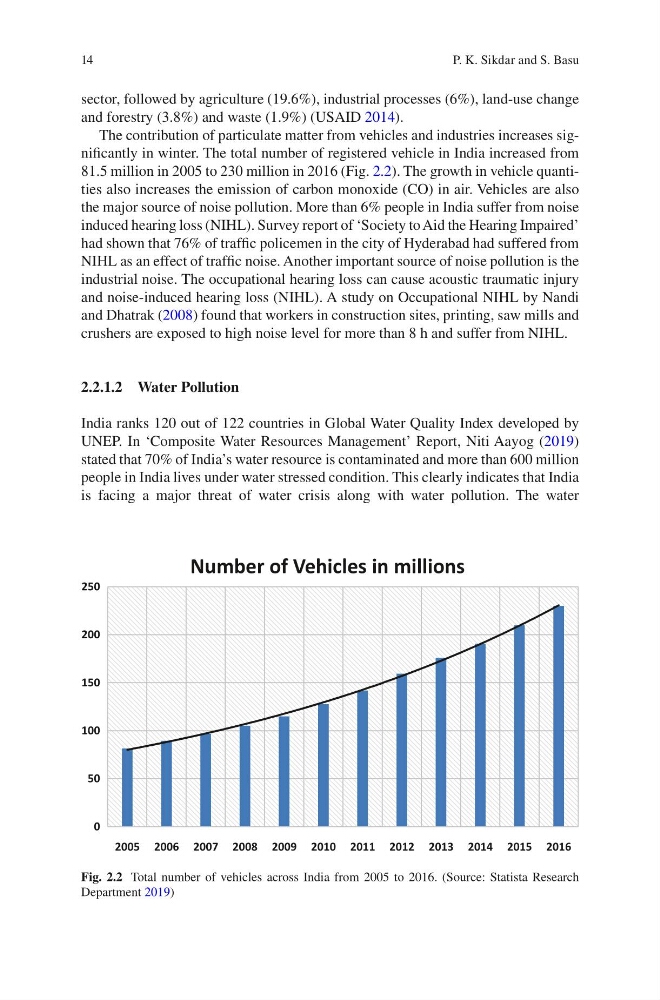
The contribution of particulate matter from vehicles and industries increases significantly in winter. The total number of registered vehicle in India increased from
81.5 million in 2005 to 230 million in 2016 (Fig. 2.2). The growth in vehicle quantities also increases the emission of carbon monoxide (CO) in air. Vehicles are also
the major source of noise pollution. More than 6% people in India suffer from noise
induced hearing loss (NIHL). Survey report of ‘Society to Aid the Hearing Impaired’
had shown that 76% of traffic policemen in the city of Hyderabad had suffered from
NIHL as an effect of traffic noise. Another important source of noise pollution is the
industrial noise. The occupational hearing loss can cause acoustic traumatic injury
and noise-induced hearing loss (NIHL). A study on Occupational NIHL by Nandi
and Dhatrak (2008) found that workers in construction sites, printing, saw mills and
crushers are exposed to high noise level for more than 8 h and suffer from NIHL.
2.2.1.2 Water Pollution
India ranks 120 out of 122 countries in Global Water Quality Index developed by
UNEP. In ‘Composite Water Resources Management’ Report, Niti Aayog (2019)
stated that 70% of India’s water resource is contaminated and more than 600 million
people in India lives under water stressed condition. This clearly indicates that India
is facing a major threat of water crisis along with water pollution. The water
0
50
100
150
200
250
2005 2006 2007 2008 2009 2010 2011 2012 2013 2014 2015 2016
Number of Vehicles in millions
Fig. 2.2 Total number of vehicles across India from 2005 to 2016. (Source: Statista Research
Department 2019)
P. K. Sikdar and S. Basu
sector, followed by agriculture (19.6%), industrial processes (6%), land-use change
and forestry (3.8%) and waste (1.9%) (USAID 2014).
The contribution of particulate matter from vehicles and industries increases significantly in winter. The total number of registered vehicle in India increased from
81.5 million in 2005 to 230 million in 2016 (Fig. 2.2). The growth in vehicle quantities also increases the emission of carbon monoxide (CO) in air. Vehicles are also
the major source of noise pollution. More than 6% people in India suffer from noise
induced hearing loss (NIHL). Survey report of ‘Society to Aid the Hearing Impaired’
had shown that 76% of traffic policemen in the city of Hyderabad had suffered from
NIHL as an effect of traffic noise. Another important source of noise pollution is the
industrial noise. The occupational hearing loss can cause acoustic traumatic injury
and noise-induced hearing loss (NIHL). A study on Occupational NIHL by Nandi
and Dhatrak (2008) found that workers in construction sites, printing, saw mills and
crushers are exposed to high noise level for more than 8 h and suffer from NIHL.
2.2.1.2 Water Pollution
India ranks 120 out of 122 countries in Global Water Quality Index developed by
UNEP. In ‘Composite Water Resources Management’ Report, Niti Aayog (2019)
stated that 70% of India’s water resource is contaminated and more than 600 million
people in India lives under water stressed condition. This clearly indicates that India
is facing a major threat of water crisis along with water pollution. The water
0
50
100
150
200
250
2005 2006 2007 2008 2009 2010 2011 2012 2013 2014 2015 2016
Number of Vehicles in millions
Fig. 2.2 Total number of vehicles across India from 2005 to 2016. (Source: Statista Research
Department 2019)
P. K. Sikdar and S. Basu