

103
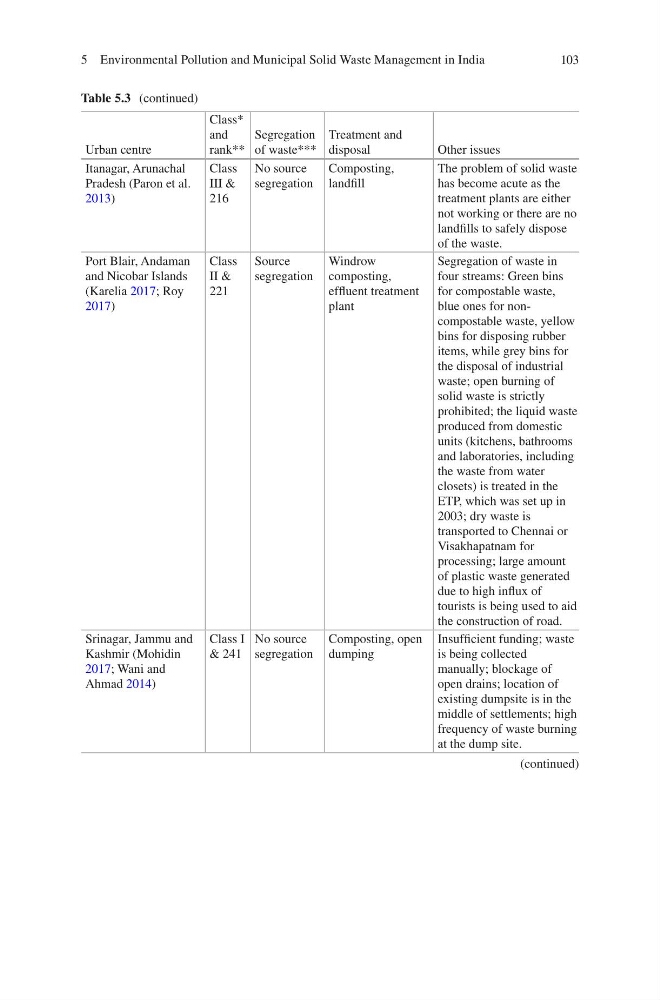
Table 5.3 (continued)
Urban centre
Class*
and
rank**
Segregation
of waste***
Treatment and
disposal
Other issues
Itanagar, Arunachal
Pradesh (Paron et al.
2013)
Class
III &
216
No source
segregation
Composting,
landfill
The problem of solid waste
has become acute as the
treatment plants are either
not working or there are no
landfills to safely dispose
of the waste.
Port Blair, Andaman
and Nicobar Islands
(Karelia 2017; Roy
2017)
Class
II &
221
Source
segregation
Windrow
composting,
effluent treatment
plant
Segregation of waste in
four streams: Green bins
for compostable waste,
blue ones for noncompostable waste, yellow
bins for disposing rubber
items, while grey bins for
the disposal of industrial
waste; open burning of
solid waste is strictly
prohibited; the liquid waste
produced from domestic
units (kitchens, bathrooms
and laboratories, including
the waste from water
closets) is treated in the
ETP, which was set up in
2003; dry waste is
transported to Chennai or
Visakhapatnam for
processing; large amount
of plastic waste generated
due to high influx of
tourists is being used to aid
the construction of road.
Srinagar, Jammu and
Kashmir (Mohidin
2017; Wani and
Ahmad 2014)
Class I
& 241
No source
segregation
Composting, open
dumping
Insufficient funding; waste
is being collected
manually; blockage of
open drains; location of
existing dumpsite is in the
middle of settlements; high
frequency of waste burning
at the dump site.
(continued)
5 Environmental Pollution and Municipal Solid Waste Management in India
Table 5.3 (continued)
Urban centre
Class*
and
rank**
Segregation
of waste***
Treatment and
disposal
Other issues
Itanagar, Arunachal
Pradesh (Paron et al.
2013)
Class
III &
216
No source
segregation
Composting,
landfill
The problem of solid waste
has become acute as the
treatment plants are either
not working or there are no
landfills to safely dispose
of the waste.
Port Blair, Andaman
and Nicobar Islands
(Karelia 2017; Roy
2017)
Class
II &
221
Source
segregation
Windrow
composting,
effluent treatment
plant
Segregation of waste in
four streams: Green bins
for compostable waste,
blue ones for noncompostable waste, yellow
bins for disposing rubber
items, while grey bins for
the disposal of industrial
waste; open burning of
solid waste is strictly
prohibited; the liquid waste
produced from domestic
units (kitchens, bathrooms
and laboratories, including
the waste from water
closets) is treated in the
ETP, which was set up in
2003; dry waste is
transported to Chennai or
Visakhapatnam for
processing; large amount
of plastic waste generated
due to high influx of
tourists is being used to aid
the construction of road.
Srinagar, Jammu and
Kashmir (Mohidin
2017; Wani and
Ahmad 2014)
Class I
& 241
No source
segregation
Composting, open
dumping
Insufficient funding; waste
is being collected
manually; blockage of
open drains; location of
existing dumpsite is in the
middle of settlements; high
frequency of waste burning
at the dump site.
(continued)
5 Environmental Pollution and Municipal Solid Waste Management in India