

102
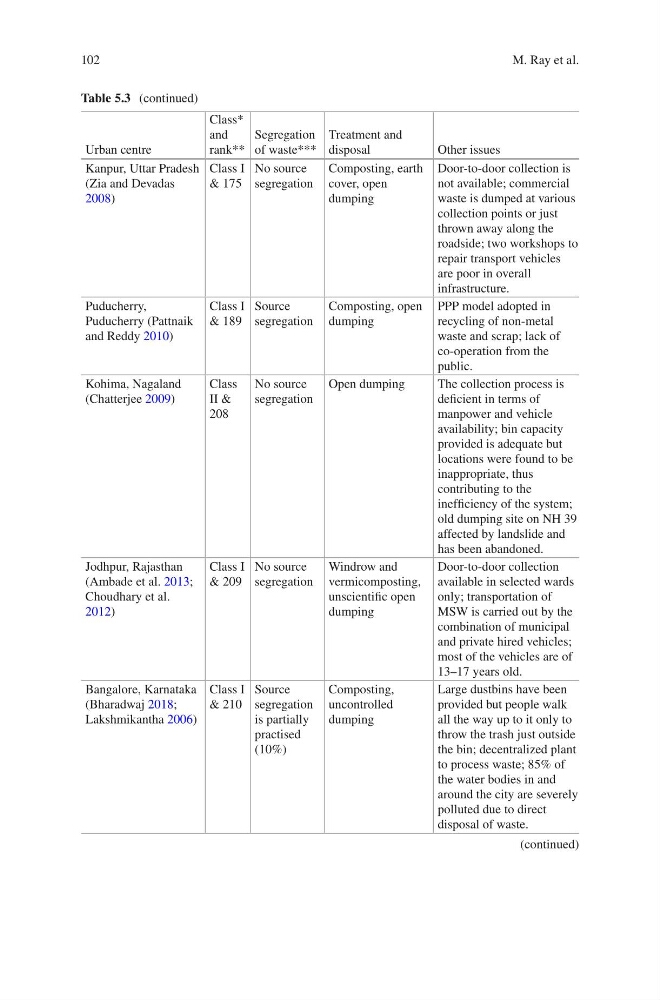
Table 5.3 (continued)
Urban centre
Class*
and
rank**
Segregation
of waste***
Treatment and
disposal
Other issues
Kanpur, Uttar Pradesh
(Zia and Devadas
2008)
Class I
& 175
No source
segregation
Composting, earth
cover, open
dumping
Door-to-door collection is
not available; commercial
waste is dumped at various
collection points or just
thrown away along the
roadside; two workshops to
repair transport vehicles
are poor in overall
infrastructure.
Puducherry,
Puducherry (Pattnaik
and Reddy 2010)
Class I
& 189
Source
segregation
Composting, open
dumping
PPP model adopted in
recycling of non-metal
waste and scrap; lack of
co-operation from the
public.
Kohima, Nagaland
(Chatterjee 2009)
Class
II &
208
No source
segregation
Open dumping
The collection process is
deficient in terms of
manpower and vehicle
availability; bin capacity
provided is adequate but
locations were found to be
inappropriate, thus
contributing to the
inefficiency of the system;
old dumping site on NH 39
affected by landslide and
has been abandoned.
Jodhpur, Rajasthan
(Ambade et al. 2013;
Choudhary et al.
2012)
Class I
& 209
No source
segregation
Windrow and
vermicomposting,
unscientific open
dumping
Door-to-door collection
available in selected wards
only; transportation of
MSW is carried out by the
combination of municipal
and private hired vehicles;
most of the vehicles are of
13–17 years old.
Bangalore, Karnataka
(Bharadwaj 2018;
Lakshmikantha 2006)
Class I
& 210
Source
segregation
is partially
practised
(10%)
Composting,
uncontrolled
dumping
Large dustbins have been
provided but people walk
all the way up to it only to
throw the trash just outside
the bin; decentralized plant
to process waste; 85% of
the water bodies in and
around the city are severely
polluted due to direct
disposal of waste.
(continued)
M. Ray et al.
Table 5.3 (continued)
Urban centre
Class*
and
rank**
Segregation
of waste***
Treatment and
disposal
Other issues
Kanpur, Uttar Pradesh
(Zia and Devadas
2008)
Class I
& 175
No source
segregation
Composting, earth
cover, open
dumping
Door-to-door collection is
not available; commercial
waste is dumped at various
collection points or just
thrown away along the
roadside; two workshops to
repair transport vehicles
are poor in overall
infrastructure.
Puducherry,
Puducherry (Pattnaik
and Reddy 2010)
Class I
& 189
Source
segregation
Composting, open
dumping
PPP model adopted in
recycling of non-metal
waste and scrap; lack of
co-operation from the
public.
Kohima, Nagaland
(Chatterjee 2009)
Class
II &
208
No source
segregation
Open dumping
The collection process is
deficient in terms of
manpower and vehicle
availability; bin capacity
provided is adequate but
locations were found to be
inappropriate, thus
contributing to the
inefficiency of the system;
old dumping site on NH 39
affected by landslide and
has been abandoned.
Jodhpur, Rajasthan
(Ambade et al. 2013;
Choudhary et al.
2012)
Class I
& 209
No source
segregation
Windrow and
vermicomposting,
unscientific open
dumping
Door-to-door collection
available in selected wards
only; transportation of
MSW is carried out by the
combination of municipal
and private hired vehicles;
most of the vehicles are of
13–17 years old.
Bangalore, Karnataka
(Bharadwaj 2018;
Lakshmikantha 2006)
Class I
& 210
Source
segregation
is partially
practised
(10%)
Composting,
uncontrolled
dumping
Large dustbins have been
provided but people walk
all the way up to it only to
throw the trash just outside
the bin; decentralized plant
to process waste; 85% of
the water bodies in and
around the city are severely
polluted due to direct
disposal of waste.
(continued)
M. Ray et al.