

101
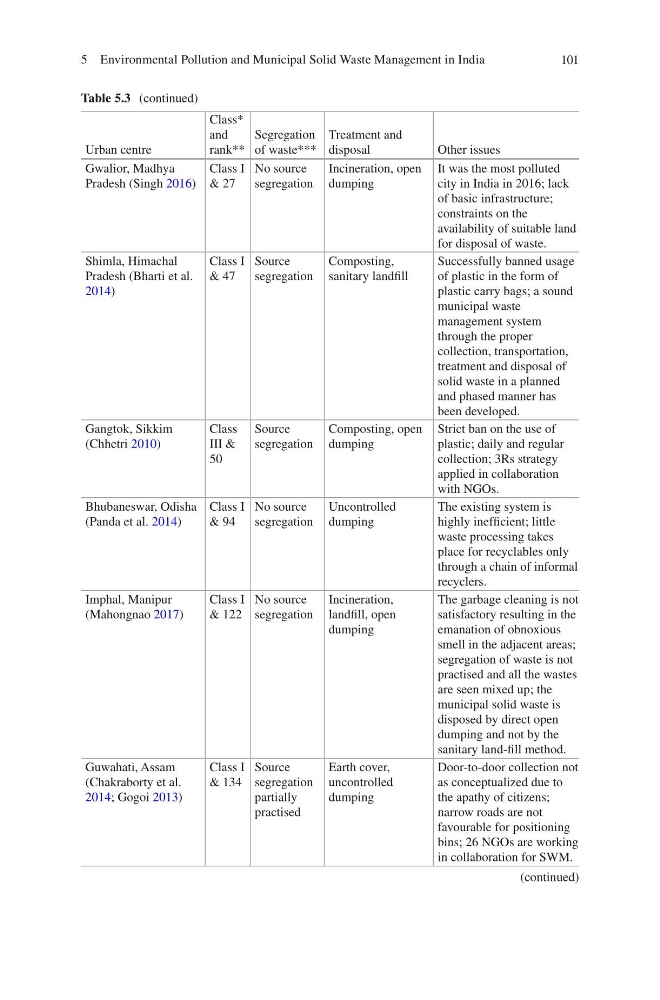
Table 5.3 (continued)
Urban centre
Class*
and
rank**
Segregation
of waste***
Treatment and
disposal
Other issues
Gwalior, Madhya
Pradesh (Singh 2016)
Class I
& 27
No source
segregation
Incineration, open
dumping
It was the most polluted
city in India in 2016; lack
of basic infrastructure;
constraints on the
availability of suitable land
for disposal of waste.
Shimla, Himachal
Pradesh (Bharti et al.
2014)
Class I
& 47
Source
segregation
Composting,
sanitary landfill
Successfully banned usage
of plastic in the form of
plastic carry bags; a sound
municipal waste
management system
through the proper
collection, transportation,
treatment and disposal of
solid waste in a planned
and phased manner has
been developed.
Gangtok, Sikkim
(Chhetri 2010)
Class
III &
50
Source
segregation
Composting, open
dumping
Strict ban on the use of
plastic; daily and regular
collection; 3Rs strategy
applied in collaboration
with NGOs.
Bhubaneswar, Odisha
(Panda et al. 2014)
Class I
& 94
No source
segregation
Uncontrolled
dumping
The existing system is
highly inefficient; little
waste processing takes
place for recyclables only
through a chain of informal
recyclers.
Imphal, Manipur
(Mahongnao 2017)
Class I
& 122
No source
segregation
Incineration,
landfill, open
dumping
The garbage cleaning is not
satisfactory resulting in the
emanation of obnoxious
smell in the adjacent areas;
segregation of waste is not
practised and all the wastes
are seen mixed up; the
municipal solid waste is
disposed by direct open
dumping and not by the
sanitary land-fill method.
Guwahati, Assam
(Chakraborty et al.
2014; Gogoi 2013)
Class I
& 134
Source
segregation
partially
practised
Earth cover,
uncontrolled
dumping
Door-to-door collection not
as conceptualized due to
the apathy of citizens;
narrow roads are not
favourable for positioning
bins; 26 NGOs are working
in collaboration for SWM.
(continued)
5 Environmental Pollution and Municipal Solid Waste Management in India
Table 5.3 (continued)
Urban centre
Class*
and
rank**
Segregation
of waste***
Treatment and
disposal
Other issues
Gwalior, Madhya
Pradesh (Singh 2016)
Class I
& 27
No source
segregation
Incineration, open
dumping
It was the most polluted
city in India in 2016; lack
of basic infrastructure;
constraints on the
availability of suitable land
for disposal of waste.
Shimla, Himachal
Pradesh (Bharti et al.
2014)
Class I
& 47
Source
segregation
Composting,
sanitary landfill
Successfully banned usage
of plastic in the form of
plastic carry bags; a sound
municipal waste
management system
through the proper
collection, transportation,
treatment and disposal of
solid waste in a planned
and phased manner has
been developed.
Gangtok, Sikkim
(Chhetri 2010)
Class
III &
50
Source
segregation
Composting, open
dumping
Strict ban on the use of
plastic; daily and regular
collection; 3Rs strategy
applied in collaboration
with NGOs.
Bhubaneswar, Odisha
(Panda et al. 2014)
Class I
& 94
No source
segregation
Uncontrolled
dumping
The existing system is
highly inefficient; little
waste processing takes
place for recyclables only
through a chain of informal
recyclers.
Imphal, Manipur
(Mahongnao 2017)
Class I
& 122
No source
segregation
Incineration,
landfill, open
dumping
The garbage cleaning is not
satisfactory resulting in the
emanation of obnoxious
smell in the adjacent areas;
segregation of waste is not
practised and all the wastes
are seen mixed up; the
municipal solid waste is
disposed by direct open
dumping and not by the
sanitary land-fill method.
Guwahati, Assam
(Chakraborty et al.
2014; Gogoi 2013)
Class I
& 134
Source
segregation
partially
practised
Earth cover,
uncontrolled
dumping
Door-to-door collection not
as conceptualized due to
the apathy of citizens;
narrow roads are not
favourable for positioning
bins; 26 NGOs are working
in collaboration for SWM.
(continued)
5 Environmental Pollution and Municipal Solid Waste Management in India