

100
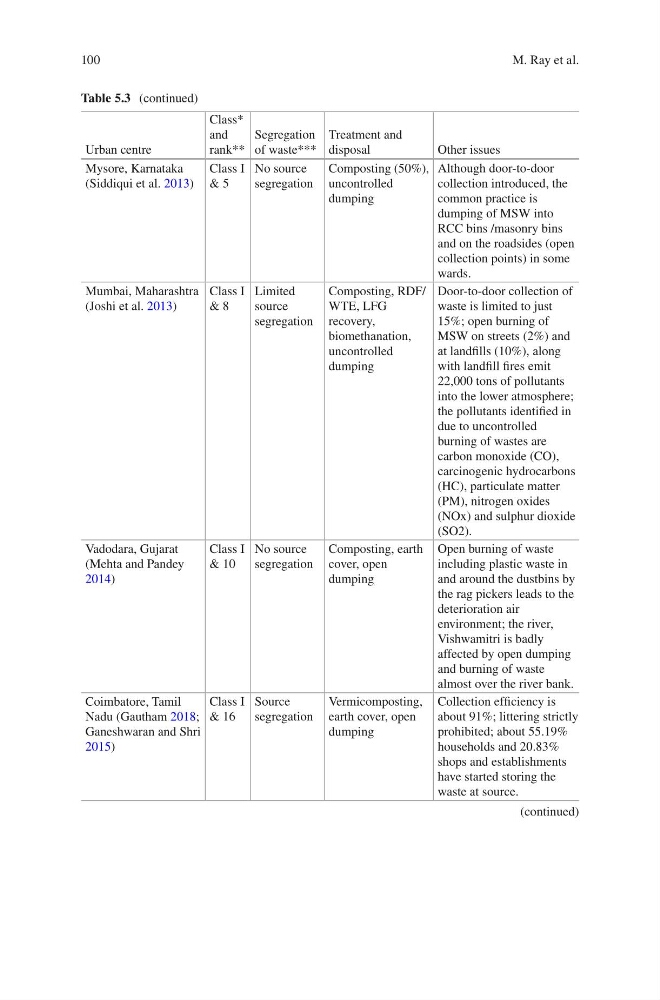
Table 5.3 (continued)
Urban centre
Class*
and
rank**
Segregation
of waste***
Treatment and
disposal
Other issues
Mysore, Karnataka
(Siddiqui et al. 2013)
Class I
& 5
No source
segregation
Composting (50%),
uncontrolled
dumping
Although door-to-door
collection introduced, the
common practice is
dumping of MSW into
RCC bins /masonry bins
and on the roadsides (open
collection points) in some
wards.
Mumbai, Maharashtra
(Joshi et al. 2013)
Class I
& 8
Limited
source
segregation
Composting, RDF/
WTE, LFG
recovery,
biomethanation,
uncontrolled
dumping
Door-to-door collection of
waste is limited to just
15%; open burning of
MSW on streets (2%) and
at landfills (10%), along
with landfill fires emit
22,000 tons of pollutants
into the lower atmosphere;
the pollutants identified in
due to uncontrolled
burning of wastes are
carbon monoxide (CO),
carcinogenic hydrocarbons
(HC), particulate matter
(PM), nitrogen oxides
(NOx) and sulphur dioxide
(SO2).
Vadodara, Gujarat
(Mehta and Pandey
2014)
Class I
& 10
No source
segregation
Composting, earth
cover, open
dumping
Open burning of waste
including plastic waste in
and around the dustbins by
the rag pickers leads to the
deterioration air
environment; the river,
Vishwamitri is badly
affected by open dumping
and burning of waste
almost over the river bank.
Coimbatore, Tamil
Nadu (Gautham 2018;
Ganeshwaran and Shri
2015)
Class I
& 16
Source
segregation
Vermicomposting,
earth cover, open
dumping
Collection efficiency is
about 91%; littering strictly
prohibited; about 55.19%
households and 20.83%
shops and establishments
have started storing the
waste at source.
(continued)
M. Ray et al.
Table 5.3 (continued)
Urban centre
Class*
and
rank**
Segregation
of waste***
Treatment and
disposal
Other issues
Mysore, Karnataka
(Siddiqui et al. 2013)
Class I
& 5
No source
segregation
Composting (50%),
uncontrolled
dumping
Although door-to-door
collection introduced, the
common practice is
dumping of MSW into
RCC bins /masonry bins
and on the roadsides (open
collection points) in some
wards.
Mumbai, Maharashtra
(Joshi et al. 2013)
Class I
& 8
Limited
source
segregation
Composting, RDF/
WTE, LFG
recovery,
biomethanation,
uncontrolled
dumping
Door-to-door collection of
waste is limited to just
15%; open burning of
MSW on streets (2%) and
at landfills (10%), along
with landfill fires emit
22,000 tons of pollutants
into the lower atmosphere;
the pollutants identified in
due to uncontrolled
burning of wastes are
carbon monoxide (CO),
carcinogenic hydrocarbons
(HC), particulate matter
(PM), nitrogen oxides
(NOx) and sulphur dioxide
(SO2).
Vadodara, Gujarat
(Mehta and Pandey
2014)
Class I
& 10
No source
segregation
Composting, earth
cover, open
dumping
Open burning of waste
including plastic waste in
and around the dustbins by
the rag pickers leads to the
deterioration air
environment; the river,
Vishwamitri is badly
affected by open dumping
and burning of waste
almost over the river bank.
Coimbatore, Tamil
Nadu (Gautham 2018;
Ganeshwaran and Shri
2015)
Class I
& 16
Source
segregation
Vermicomposting,
earth cover, open
dumping
Collection efficiency is
about 91%; littering strictly
prohibited; about 55.19%
households and 20.83%
shops and establishments
have started storing the
waste at source.
(continued)
M. Ray et al.