

99
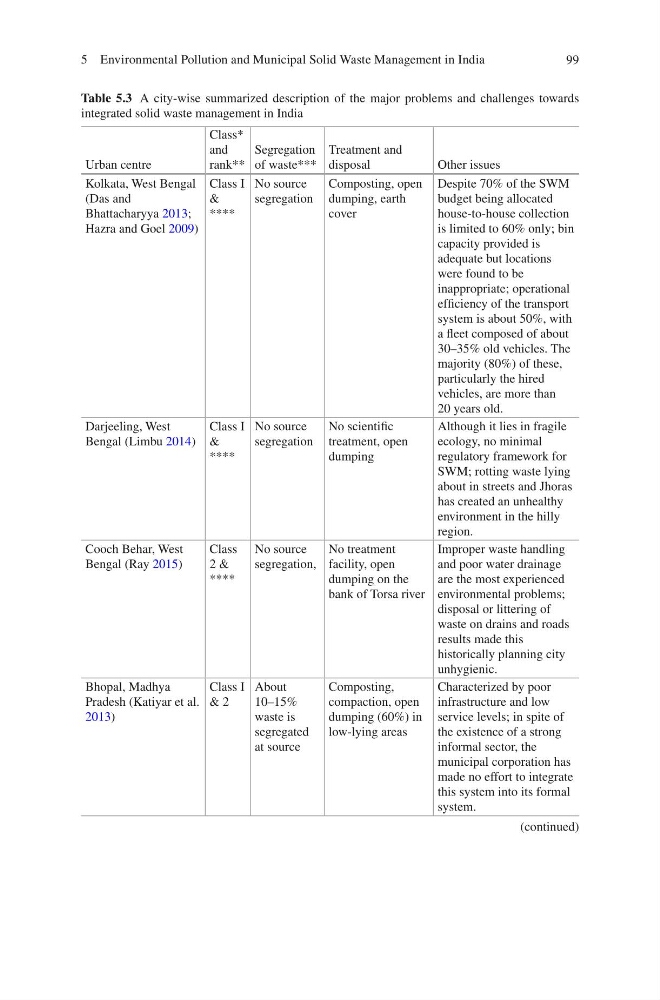
Table 5.3 A city-wise summarized description of the major problems and challenges towards
integrated solid waste management in India
Urban centre
Class*
and
rank**
Segregation
of waste***
Treatment and
disposal
Other issues
Kolkata, West Bengal
(Das and
Bhattacharyya 2013;
Hazra and Goel 2009)
Class I
&
****
No source
segregation
Composting, open
dumping, earth
cover
Despite 70% of the SWM
budget being allocated
house-to-house collection
is limited to 60% only; bin
capacity provided is
adequate but locations
were found to be
inappropriate; operational
efficiency of the transport
system is about 50%, with
a fleet composed of about
30–35% old vehicles. The
majority (80%) of these,
particularly the hired
vehicles, are more than
20 years old.
Darjeeling, West
Bengal (Limbu 2014)
Class I
&
****
No source
segregation
No scientific
treatment, open
dumping
Although it lies in fragile
ecology, no minimal
regulatory framework for
SWM; rotting waste lying
about in streets and Jhoras
has created an unhealthy
environment in the hilly
region.
Cooch Behar, West
Bengal (Ray 2015)
Class
2 &
****
No source
segregation,
No treatment
facility, open
dumping on the
bank of Torsa river
Improper waste handling
and poor water drainage
are the most experienced
environmental problems;
disposal or littering of
waste on drains and roads
results made this
historically planning city
unhygienic.
Bhopal, Madhya
Pradesh (Katiyar et al.
2013)
Class I
& 2
About
10–15%
waste is
segregated
at source
Composting,
compaction, open
dumping (60%) in
low-lying areas
Characterized by poor
infrastructure and low
service levels; in spite of
the existence of a strong
informal sector, the
municipal corporation has
made no effort to integrate
this system into its formal
system.
(continued)
5 Environmental Pollution and Municipal Solid Waste Management in India
Table 5.3 A city-wise summarized description of the major problems and challenges towards
integrated solid waste management in India
Urban centre
Class*
and
rank**
Segregation
of waste***
Treatment and
disposal
Other issues
Kolkata, West Bengal
(Das and
Bhattacharyya 2013;
Hazra and Goel 2009)
Class I
&
****
No source
segregation
Composting, open
dumping, earth
cover
Despite 70% of the SWM
budget being allocated
house-to-house collection
is limited to 60% only; bin
capacity provided is
adequate but locations
were found to be
inappropriate; operational
efficiency of the transport
system is about 50%, with
a fleet composed of about
30–35% old vehicles. The
majority (80%) of these,
particularly the hired
vehicles, are more than
20 years old.
Darjeeling, West
Bengal (Limbu 2014)
Class I
&
****
No source
segregation
No scientific
treatment, open
dumping
Although it lies in fragile
ecology, no minimal
regulatory framework for
SWM; rotting waste lying
about in streets and Jhoras
has created an unhealthy
environment in the hilly
region.
Cooch Behar, West
Bengal (Ray 2015)
Class
2 &
****
No source
segregation,
No treatment
facility, open
dumping on the
bank of Torsa river
Improper waste handling
and poor water drainage
are the most experienced
environmental problems;
disposal or littering of
waste on drains and roads
results made this
historically planning city
unhygienic.
Bhopal, Madhya
Pradesh (Katiyar et al.
2013)
Class I
& 2
About
10–15%
waste is
segregated
at source
Composting,
compaction, open
dumping (60%) in
low-lying areas
Characterized by poor
infrastructure and low
service levels; in spite of
the existence of a strong
informal sector, the
municipal corporation has
made no effort to integrate
this system into its formal
system.
(continued)
5 Environmental Pollution and Municipal Solid Waste Management in India