

104
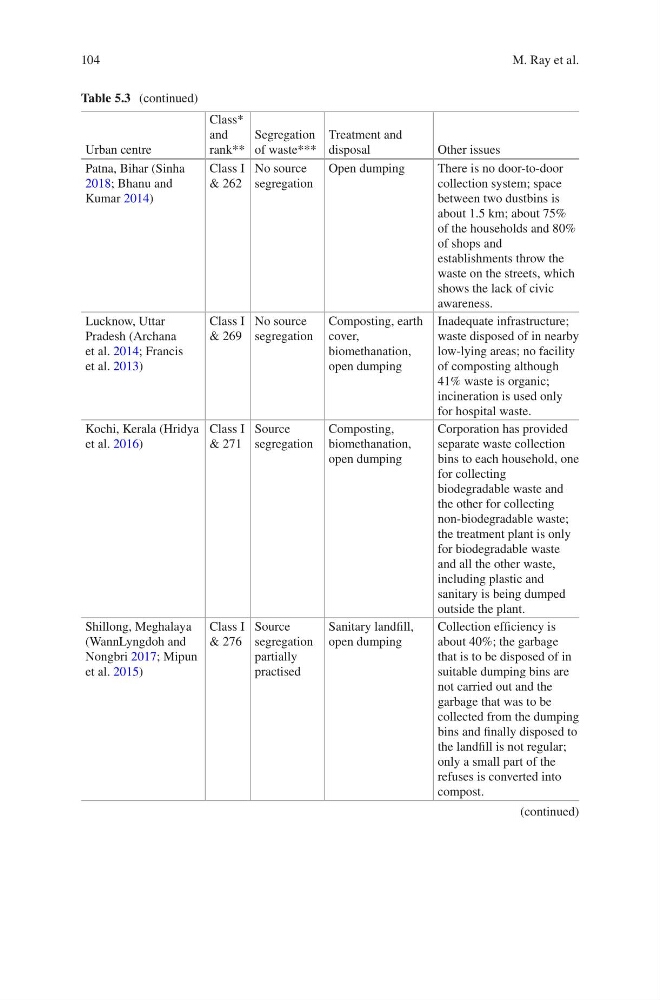
Table 5.3 (continued)
Urban centre
Class*
and
rank**
Segregation
of waste***
Treatment and
disposal
Other issues
Patna, Bihar (Sinha
2018; Bhanu and
Kumar 2014)
Class I
& 262
No source
segregation
Open dumping
There is no door-to-door
collection system; space
between two dustbins is
about 1.5 km; about 75%
of the households and 80%
of shops and
establishments throw the
waste on the streets, which
shows the lack of civic
awareness.
Lucknow, Uttar
Pradesh (Archana
et al. 2014; Francis
et al. 2013)
Class I
& 269
No source
segregation
Composting, earth
cover,
biomethanation,
open dumping
Inadequate infrastructure;
waste disposed of in nearby
low-lying areas; no facility
of composting although
41% waste is organic;
incineration is used only
for hospital waste.
Kochi, Kerala (Hridya
et al. 2016)
Class I
& 271
Source
segregation
Composting,
biomethanation,
open dumping
Corporation has provided
separate waste collection
bins to each household, one
for collecting
biodegradable waste and
the other for collecting
non-biodegradable waste;
the treatment plant is only
for biodegradable waste
and all the other waste,
including plastic and
sanitary is being dumped
outside the plant.
Shillong, Meghalaya
(WannLyngdoh and
Nongbri 2017; Mipun
et al. 2015)
Class I
& 276
Source
segregation
partially
practised
Sanitary landfill,
open dumping
Collection efficiency is
about 40%; the garbage
that is to be disposed of in
suitable dumping bins are
not carried out and the
garbage that was to be
collected from the dumping
bins and finally disposed to
the landfill is not regular;
only a small part of the
refuses is converted into
compost.
(continued)
M. Ray et al.
Table 5.3 (continued)
Urban centre
Class*
and
rank**
Segregation
of waste***
Treatment and
disposal
Other issues
Patna, Bihar (Sinha
2018; Bhanu and
Kumar 2014)
Class I
& 262
No source
segregation
Open dumping
There is no door-to-door
collection system; space
between two dustbins is
about 1.5 km; about 75%
of the households and 80%
of shops and
establishments throw the
waste on the streets, which
shows the lack of civic
awareness.
Lucknow, Uttar
Pradesh (Archana
et al. 2014; Francis
et al. 2013)
Class I
& 269
No source
segregation
Composting, earth
cover,
biomethanation,
open dumping
Inadequate infrastructure;
waste disposed of in nearby
low-lying areas; no facility
of composting although
41% waste is organic;
incineration is used only
for hospital waste.
Kochi, Kerala (Hridya
et al. 2016)
Class I
& 271
Source
segregation
Composting,
biomethanation,
open dumping
Corporation has provided
separate waste collection
bins to each household, one
for collecting
biodegradable waste and
the other for collecting
non-biodegradable waste;
the treatment plant is only
for biodegradable waste
and all the other waste,
including plastic and
sanitary is being dumped
outside the plant.
Shillong, Meghalaya
(WannLyngdoh and
Nongbri 2017; Mipun
et al. 2015)
Class I
& 276
Source
segregation
partially
practised
Sanitary landfill,
open dumping
Collection efficiency is
about 40%; the garbage
that is to be disposed of in
suitable dumping bins are
not carried out and the
garbage that was to be
collected from the dumping
bins and finally disposed to
the landfill is not regular;
only a small part of the
refuses is converted into
compost.
(continued)
M. Ray et al.