

China and Global Internet Governance
179
Denationalized
liberalism
Networked
nationalism
Global
governmentality
CyberReactionaries
Transnational
National
Networking
Hierarchy
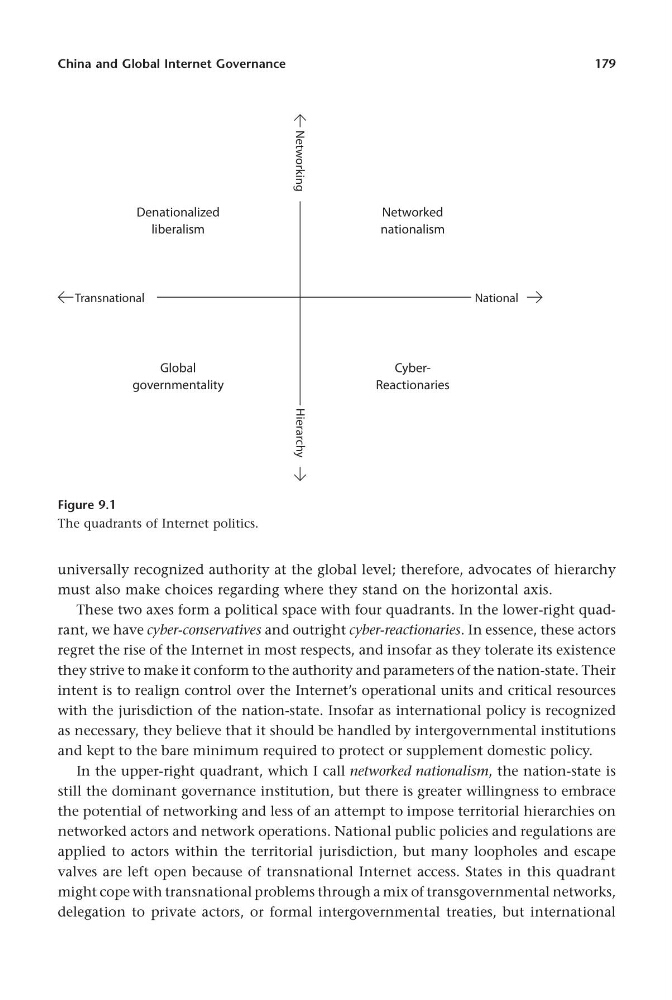
Figure 9.1
The quadrants of Internet politics.
universally recognized authority at the global level; therefore, advocates of hierarchy
must also make choices regarding where they stand on the horizontal axis.
These two axes form a political space with four quadrants. In the lower-right quadrant, we have cyber-conservatives and outright cyber-reactionaries . In essence, these actors
regret the rise of the Internet in most respects, and insofar as they tolerate its existence
they strive to make it conform to the authority and parameters of the nation-state. Their
intent is to realign control over the Internet ’ s operational units and critical resources
with the jurisdiction of the nation-state. Insofar as international policy is recognized
as necessary, they believe that it should be handled by intergovernmental institutions
and kept to the bare minimum required to protect or supplement domestic policy.
In the upper-right quadrant, which I call networked nationalism , the nation-state is
still the dominant governance institution, but there is greater willingness to embrace
the potential of networking and less of an attempt to impose territorial hierarchies on
networked actors and network operations. National public policies and regulations are
applied to actors within the territorial jurisdiction, but many loopholes and escape
valves are left open because of transnational Internet access. States in this quadrant
might cope with transnational problems through a mix of transgovernmental networks,
delegation to private actors, or formal intergovernmental treaties, but international
179
Denationalized
liberalism
Networked
nationalism
Global
governmentality
CyberReactionaries
Transnational
National
Networking
Hierarchy
Figure 9.1
The quadrants of Internet politics.
universally recognized authority at the global level; therefore, advocates of hierarchy
must also make choices regarding where they stand on the horizontal axis.
These two axes form a political space with four quadrants. In the lower-right quadrant, we have cyber-conservatives and outright cyber-reactionaries . In essence, these actors
regret the rise of the Internet in most respects, and insofar as they tolerate its existence
they strive to make it conform to the authority and parameters of the nation-state. Their
intent is to realign control over the Internet ’ s operational units and critical resources
with the jurisdiction of the nation-state. Insofar as international policy is recognized
as necessary, they believe that it should be handled by intergovernmental institutions
and kept to the bare minimum required to protect or supplement domestic policy.
In the upper-right quadrant, which I call networked nationalism , the nation-state is
still the dominant governance institution, but there is greater willingness to embrace
the potential of networking and less of an attempt to impose territorial hierarchies on
networked actors and network operations. National public policies and regulations are
applied to actors within the territorial jurisdiction, but many loopholes and escape
valves are left open because of transnational Internet access. States in this quadrant
might cope with transnational problems through a mix of transgovernmental networks,
delegation to private actors, or formal intergovernmental treaties, but international