

ortho groups to be present, in order to inhibit free rotation. Compounds with three
and even two groups, if large enough, can exhibit hindered rotation and, if suitably
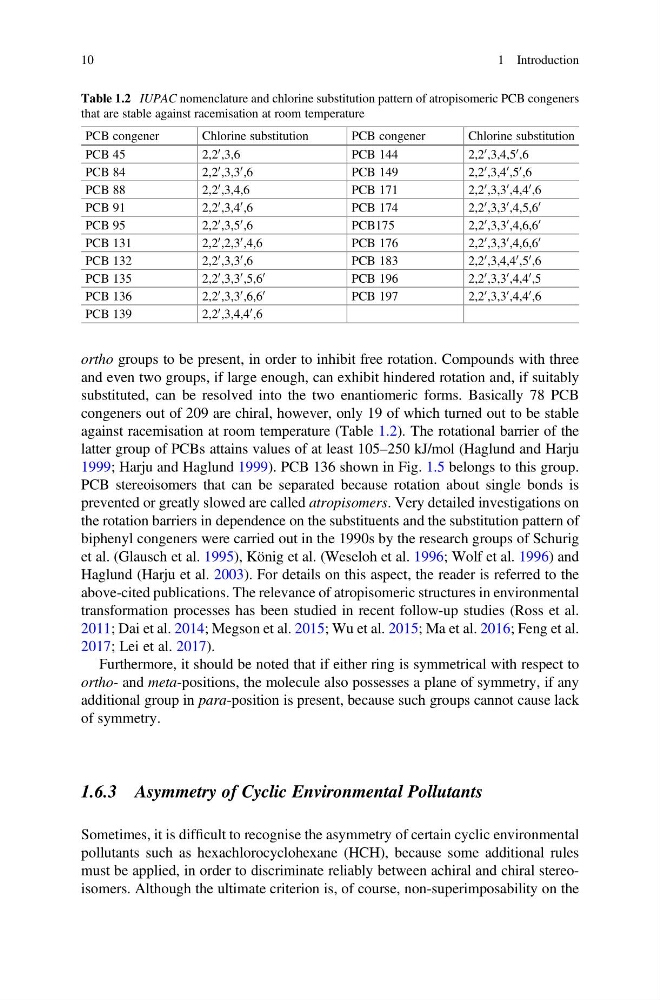
substituted, can be resolved into the two enantiomeric forms. Basically 78 PCB
congeners out of 209 are chiral, however, only 19 of which turned out to be stable
against racemisation at room temperature (Table 1.2). The rotational barrier of the
latter group of PCBs attains values of at least 105–250 kJ/mol (Haglund and Harju
1999; Harju and Haglund 1999). PCB 136 shown in Fig. 1.5 belongs to this group.
PCB stereoisomers that can be separated because rotation about single bonds is
prevented or greatly slowed are called atropisomers. Very detailed investigations on
the rotation barriers in dependence on the substituents and the substitution pattern of
biphenyl congeners were carried out in the 1990s by the research groups of Schurig
et al. (Glausch et al. 1995), König et al. (Weseloh et al. 1996; Wolf et al. 1996) and
Haglund (Harju et al. 2003). For details on this aspect, the reader is referred to the
above-cited publications. The relevance of atropisomeric structures in environmental
transformation processes has been studied in recent follow-up studies (Ross et al.
2011; Dai et al. 2014; Megson et al. 2015; Wu et al. 2015; Ma et al. 2016; Feng et al.
2017; Lei et al. 2017).
Furthermore, it should be noted that if either ring is symmetrical with respect to
ortho- and meta-positions, the molecule also possesses a plane of symmetry, if any
additional group in para-position is present, because such groups cannot cause lack
of symmetry.
1.6.3 Asymmetry of Cyclic Environmental Pollutants
Sometimes, it is difficult to recognise the asymmetry of certain cyclic environmental
pollutants such as hexachlorocyclohexane (HCH), because some additional rules
must be applied, in order to discriminate reliably between achiral and chiral stereoisomers. Although the ultimate criterion is, of course, non-superimposability on the
Table 1.2 IUPAC nomenclature and chlorine substitution pattern of atropisomeric PCB congeners
that are stable against racemisation at room temperature
PCB congener
Chlorine substitution
PCB congener
Chlorine substitution
PCB 45
2,2
0 ,3,6
PCB 144
2,2
0 ,3,4,5
0 ,6
PCB 84
2,2
0 ,3,3
0 ,6
PCB 149
2,2
0 ,3,4
0 ,5
0 ,6
PCB 88
2,2
0 ,3,4,6
PCB 171
2,2
0 ,3,3
0 ,4,4
0 ,6
PCB 91
2,2
0 ,3,4
0 ,6
PCB 174
2,2
0 ,3,3
0 ,4,5,6
0
PCB 95
2,2
0 ,3,5
0 ,6
PCB175
2,2
0 ,3,3
0 ,4,6,6
0
PCB 131
2,2
0 ,2,3
0 ,4,6
PCB 176
2,2
0 ,3,3
0 ,4,6,6
0
PCB 132
2,2
0 ,3,3
0 ,6
PCB 183
2,2
0 ,3,4,4
0 ,5
0 ,6
PCB 135
2,2
0 ,3,3
0 ,5,6
0
PCB 196
2,2
0 ,3,3
0 ,4,4
0 ,5
PCB 136
2,2
0 ,3,3
0 ,6,6
0
PCB 197
2,2
0 ,3,3
0 ,4,4
0 ,6
PCB 139
2,2
0 ,3,4,4
0 ,6
10
1 Introduction
and even two groups, if large enough, can exhibit hindered rotation and, if suitably
substituted, can be resolved into the two enantiomeric forms. Basically 78 PCB
congeners out of 209 are chiral, however, only 19 of which turned out to be stable
against racemisation at room temperature (Table 1.2). The rotational barrier of the
latter group of PCBs attains values of at least 105–250 kJ/mol (Haglund and Harju
1999; Harju and Haglund 1999). PCB 136 shown in Fig. 1.5 belongs to this group.
PCB stereoisomers that can be separated because rotation about single bonds is
prevented or greatly slowed are called atropisomers. Very detailed investigations on
the rotation barriers in dependence on the substituents and the substitution pattern of
biphenyl congeners were carried out in the 1990s by the research groups of Schurig
et al. (Glausch et al. 1995), König et al. (Weseloh et al. 1996; Wolf et al. 1996) and
Haglund (Harju et al. 2003). For details on this aspect, the reader is referred to the
above-cited publications. The relevance of atropisomeric structures in environmental
transformation processes has been studied in recent follow-up studies (Ross et al.
2011; Dai et al. 2014; Megson et al. 2015; Wu et al. 2015; Ma et al. 2016; Feng et al.
2017; Lei et al. 2017).
Furthermore, it should be noted that if either ring is symmetrical with respect to
ortho- and meta-positions, the molecule also possesses a plane of symmetry, if any
additional group in para-position is present, because such groups cannot cause lack
of symmetry.
1.6.3 Asymmetry of Cyclic Environmental Pollutants
Sometimes, it is difficult to recognise the asymmetry of certain cyclic environmental
pollutants such as hexachlorocyclohexane (HCH), because some additional rules
must be applied, in order to discriminate reliably between achiral and chiral stereoisomers. Although the ultimate criterion is, of course, non-superimposability on the
Table 1.2 IUPAC nomenclature and chlorine substitution pattern of atropisomeric PCB congeners
that are stable against racemisation at room temperature
PCB congener
Chlorine substitution
PCB congener
Chlorine substitution
PCB 45
2,2
0 ,3,6
PCB 144
2,2
0 ,3,4,5
0 ,6
PCB 84
2,2
0 ,3,3
0 ,6
PCB 149
2,2
0 ,3,4
0 ,5
0 ,6
PCB 88
2,2
0 ,3,4,6
PCB 171
2,2
0 ,3,3
0 ,4,4
0 ,6
PCB 91
2,2
0 ,3,4
0 ,6
PCB 174
2,2
0 ,3,3
0 ,4,5,6
0
PCB 95
2,2
0 ,3,5
0 ,6
PCB175
2,2
0 ,3,3
0 ,4,6,6
0
PCB 131
2,2
0 ,2,3
0 ,4,6
PCB 176
2,2
0 ,3,3
0 ,4,6,6
0
PCB 132
2,2
0 ,3,3
0 ,6
PCB 183
2,2
0 ,3,4,4
0 ,5
0 ,6
PCB 135
2,2
0 ,3,3
0 ,5,6
0
PCB 196
2,2
0 ,3,3
0 ,4,4
0 ,5
PCB 136
2,2
0 ,3,3
0 ,6,6
0
PCB 197
2,2
0 ,3,3
0 ,4,4
0 ,6
PCB 139
2,2
0 ,3,4,4
0 ,6
10
1 Introduction