

1.6.2 Environmental Pollutants with Axial Chirality
Certain compounds that do not contain asymmetric atoms may nevertheless be
chiral, if they contain a structure represented, for example, by a sub-group of
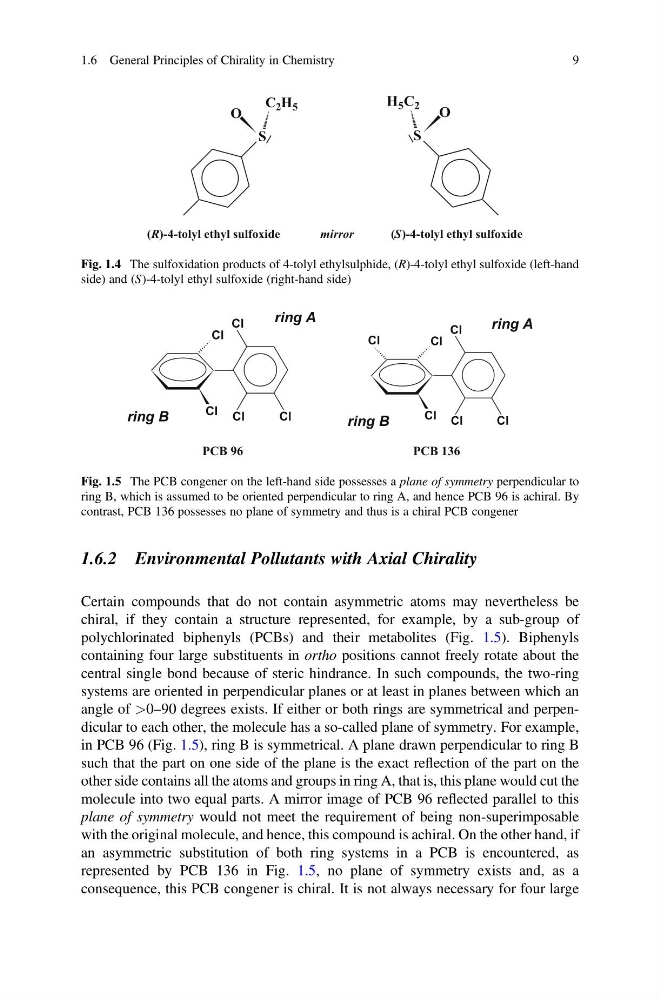
polychlorinated biphenyls (PCBs) and their metabolites (Fig. 1.5). Biphenyls
containing four large substituents in ortho positions cannot freely rotate about the
central single bond because of steric hindrance. In such compounds, the two-ring
systems are oriented in perpendicular planes or at least in planes between which an
angle of >0–90 degrees exists. If either or both rings are symmetrical and perpendicular to each other, the molecule has a so-called plane of symmetry. For example,
in PCB 96 (Fig. 1.5), ring B is symmetrical. A plane drawn perpendicular to ring B
such that the part on one side of the plane is the exact reflection of the part on the
other side contains all the atoms and groups in ring A, that is, this plane would cut the
molecule into two equal parts. A mirror image of PCB 96 reflected parallel to this
plane of symmetry would not meet the requirement of being non-superimposable
with the original molecule, and hence, this compound is achiral. On the other hand, if
an asymmetric substitution of both ring systems in a PCB is encountered, as
represented by PCB 136 in Fig. 1.5, no plane of symmetry exists and, as a
consequence, this PCB congener is chiral. It is not always necessary for four large
(R)-4-tolyl ethyl sulfoxide
mirror
(S)-4-tolyl ethyl sulfoxide
O
C 2 H 5
S
H 5 C 2 O
S
Fig. 1.4 The sulfoxidation products of 4-tolyl ethylsulphide, (R)-4-tolyl ethyl sulfoxide (left-hand
side) and (S)-4-tolyl ethyl sulfoxide (right-hand side)
PCB 96
PCB 136
Cl
Cl
Cl
Cl Cl
ring B
ring B
ring A
ring A
Cl
Cl
Cl
Cl Cl
Cl
Fig. 1.5 The PCB congener on the left-hand side possesses a plane of symmetry perpendicular to
ring B, which is assumed to be oriented perpendicular to ring A, and hence PCB 96 is achiral. By
contrast, PCB 136 possesses no plane of symmetry and thus is a chiral PCB congener
1.6 General Principles of Chirality in Chemistry
9
Certain compounds that do not contain asymmetric atoms may nevertheless be
chiral, if they contain a structure represented, for example, by a sub-group of
polychlorinated biphenyls (PCBs) and their metabolites (Fig. 1.5). Biphenyls
containing four large substituents in ortho positions cannot freely rotate about the
central single bond because of steric hindrance. In such compounds, the two-ring
systems are oriented in perpendicular planes or at least in planes between which an
angle of >0–90 degrees exists. If either or both rings are symmetrical and perpendicular to each other, the molecule has a so-called plane of symmetry. For example,
in PCB 96 (Fig. 1.5), ring B is symmetrical. A plane drawn perpendicular to ring B
such that the part on one side of the plane is the exact reflection of the part on the
other side contains all the atoms and groups in ring A, that is, this plane would cut the
molecule into two equal parts. A mirror image of PCB 96 reflected parallel to this
plane of symmetry would not meet the requirement of being non-superimposable
with the original molecule, and hence, this compound is achiral. On the other hand, if
an asymmetric substitution of both ring systems in a PCB is encountered, as
represented by PCB 136 in Fig. 1.5, no plane of symmetry exists and, as a
consequence, this PCB congener is chiral. It is not always necessary for four large
(R)-4-tolyl ethyl sulfoxide
mirror
(S)-4-tolyl ethyl sulfoxide
O
C 2 H 5
S
H 5 C 2 O
S
Fig. 1.4 The sulfoxidation products of 4-tolyl ethylsulphide, (R)-4-tolyl ethyl sulfoxide (left-hand
side) and (S)-4-tolyl ethyl sulfoxide (right-hand side)
PCB 96
PCB 136
Cl
Cl
Cl
Cl Cl
ring B
ring B
ring A
ring A
Cl
Cl
Cl
Cl Cl
Cl
Fig. 1.5 The PCB congener on the left-hand side possesses a plane of symmetry perpendicular to
ring B, which is assumed to be oriented perpendicular to ring A, and hence PCB 96 is achiral. By
contrast, PCB 136 possesses no plane of symmetry and thus is a chiral PCB congener
1.6 General Principles of Chirality in Chemistry
9