

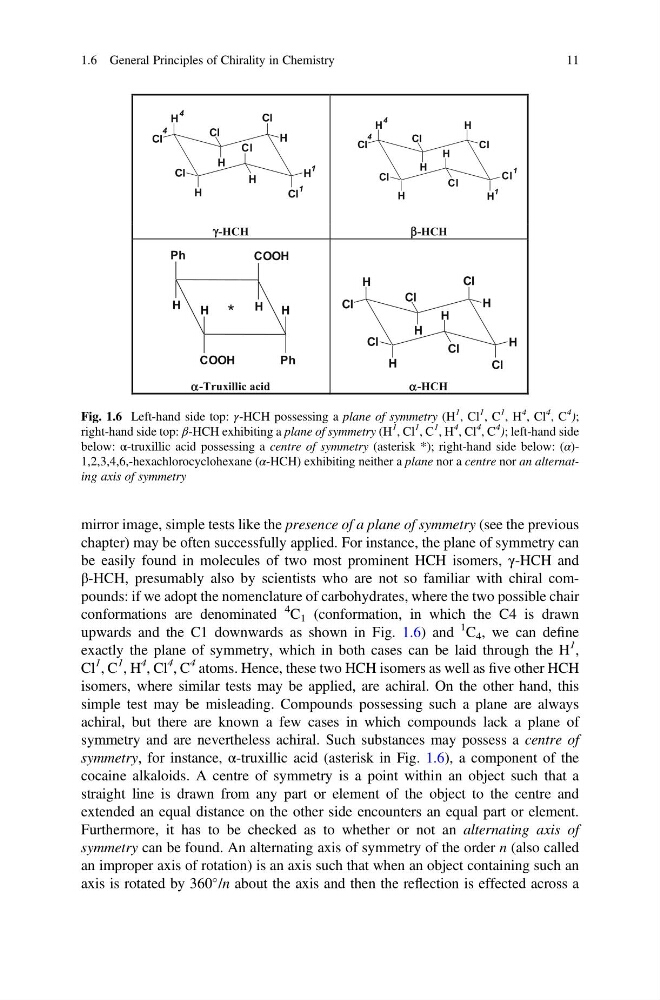
mirror image, simple tests like the presence of a plane of symmetry (see the previous
chapter) may be often successfully applied. For instance, the plane of symmetry can
be easily found in molecules of two most prominent HCH isomers, γ-HCH and
β-HCH, presumably also by scientists who are not so familiar with chiral compounds: if we adopt the nomenclature of carbohydrates, where the two possible chair
conformations are denominated
4 C 1 (conformation, in which the C4 is drawn
upwards and the C1 downwards as shown in Fig. 1.6) and
1 C 4 , we can define
exactly the plane of symmetry, which in both cases can be laid through the H
1 ,
Cl
1 , C
1 , H
4 , Cl
4 , C
4 atoms. Hence, these two HCH isomers as well as five other HCH
isomers, where similar tests may be applied, are achiral. On the other hand, this
simple test may be misleading. Compounds possessing such a plane are always
achiral, but there are known a few cases in which compounds lack a plane of
symmetry and are nevertheless achiral. Such substances may possess a centre of
symmetry, for instance, α-truxillic acid (asterisk in Fig. 1.6), a component of the
cocaine alkaloids. A centre of symmetry is a point within an object such that a
straight line is drawn from any part or element of the object to the centre and
extended an equal distance on the other side encounters an equal part or element.
Furthermore, it has to be checked as to whether or not an alternating axis of
symmetry can be found. An alternating axis of symmetry of the order n (also called
an improper axis of rotation) is an axis such that when an object containing such an
axis is rotated by 360
/n about the axis and then the reflection is effected across a
-HCH
-HCH
-Truxillic acid
-HCH
1
4
4
Cl
Cl
Cl
Cl
Cl
H
H
H
H
H
Cl
H
1
1
1
Cl
H
4
4
Cl
Cl
Cl
H
H
H
Cl
H
Cl
H
H
H
H
H
Ph
Ph
COOH
COOH
*
Cl
Cl
Cl
Cl
Cl
Cl
H
H
H
H
H
H
a
a
g
b
Fig. 1.6 Left-hand side top: γ-HCH possessing a plane of symmetry (H
1
, Cl
1
, C
1
, H
4
, Cl
4
, C
4
);
right-hand side top: β-HCH exhibiting a plane of symmetry (H
1
, Cl
1
, C
1
, H
4
, Cl
4
, C
4
); left-hand side
below: α-truxillic acid possessing a centre of symmetry (asterisk *); right-hand side below: (α)1,2,3,4,6,-hexachlorocyclohexane (α-HCH) exhibiting neither a plane nor a centre nor an alternating axis of symmetry
1.6 General Principles of Chirality in Chemistry
11
chapter) may be often successfully applied. For instance, the plane of symmetry can
be easily found in molecules of two most prominent HCH isomers, γ-HCH and
β-HCH, presumably also by scientists who are not so familiar with chiral compounds: if we adopt the nomenclature of carbohydrates, where the two possible chair
conformations are denominated
4 C 1 (conformation, in which the C4 is drawn
upwards and the C1 downwards as shown in Fig. 1.6) and
1 C 4 , we can define
exactly the plane of symmetry, which in both cases can be laid through the H
1 ,
Cl
1 , C
1 , H
4 , Cl
4 , C
4 atoms. Hence, these two HCH isomers as well as five other HCH
isomers, where similar tests may be applied, are achiral. On the other hand, this
simple test may be misleading. Compounds possessing such a plane are always
achiral, but there are known a few cases in which compounds lack a plane of
symmetry and are nevertheless achiral. Such substances may possess a centre of
symmetry, for instance, α-truxillic acid (asterisk in Fig. 1.6), a component of the
cocaine alkaloids. A centre of symmetry is a point within an object such that a
straight line is drawn from any part or element of the object to the centre and
extended an equal distance on the other side encounters an equal part or element.
Furthermore, it has to be checked as to whether or not an alternating axis of
symmetry can be found. An alternating axis of symmetry of the order n (also called
an improper axis of rotation) is an axis such that when an object containing such an
axis is rotated by 360
/n about the axis and then the reflection is effected across a
-HCH
-HCH
-Truxillic acid
-HCH
1
4
4
Cl
Cl
Cl
Cl
Cl
H
H
H
H
H
Cl
H
1
1
1
Cl
H
4
4
Cl
Cl
Cl
H
H
H
Cl
H
Cl
H
H
H
H
H
Ph
Ph
COOH
COOH
*
Cl
Cl
Cl
Cl
Cl
Cl
H
H
H
H
H
H
a
a
g
b
Fig. 1.6 Left-hand side top: γ-HCH possessing a plane of symmetry (H
1
, Cl
1
, C
1
, H
4
, Cl
4
, C
4
);
right-hand side top: β-HCH exhibiting a plane of symmetry (H
1
, Cl
1
, C
1
, H
4
, Cl
4
, C
4
); left-hand side
below: α-truxillic acid possessing a centre of symmetry (asterisk *); right-hand side below: (α)1,2,3,4,6,-hexachlorocyclohexane (α-HCH) exhibiting neither a plane nor a centre nor an alternating axis of symmetry
1.6 General Principles of Chirality in Chemistry
11