

enantiomers) of trans-chlordane, cis-chlordane and heptachlor exoepoxide, a major
metabolite of heptachlor (Table 8.5). The ER values determined for heptachlor
exoepoxide ranged between 1.47 and 1.76, which implies a preferential formation
of the (+)-enantiomer. The range of ERs was tight considering the wide expanse
covered by the stations. The two chlordane isomers trans- and cis-chlordane were
close to racemic in the dissolved phase (ER ¼ 0.94-1.06).
Although HCHs were > 99% in the dissolved phase at most stations, levels of
HCHs in water were high enough to allow ER values to be measured on the filters of
the large volume samples. The particulate α-HCH showed the same, or more
enantioselective transformation than the dissolved fraction (Table 8.5). Both fractions were depleted in the same enantiomer at most stations, but there appeared to be
no relationship between the two and reversal in the depleted enantiomer was found at
stations 16 and 29. Some particulate samples showed the enhanced transformation of
α-HCH compared to the dissolved phase. For example, the ER of dissolved α-HCH
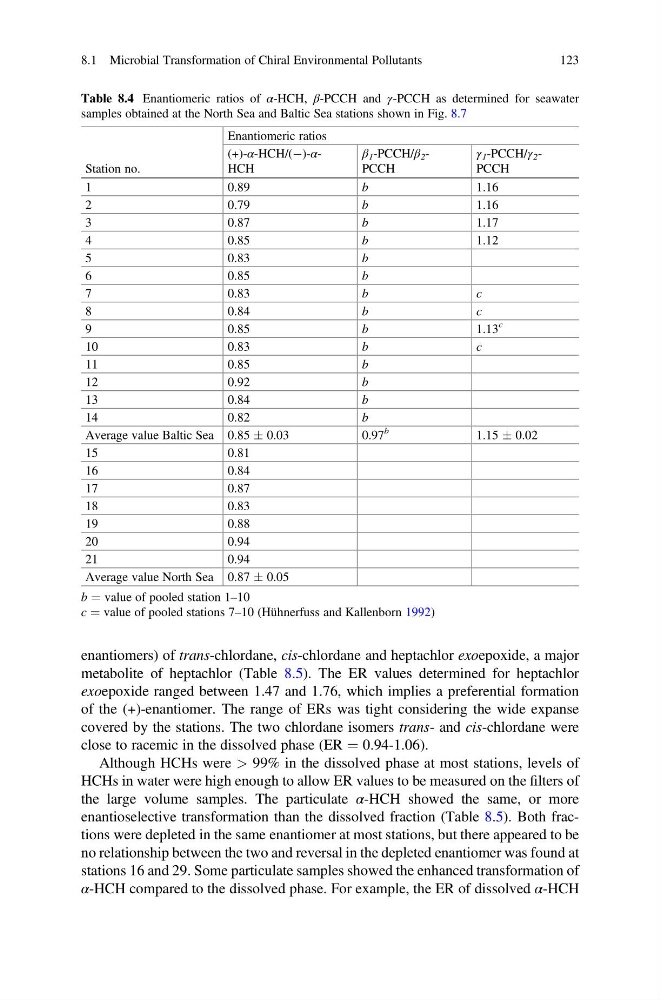
Table 8.4 Enantiomeric ratios of α-HCH, β-PCCH and γ-PCCH as determined for seawater
samples obtained at the North Sea and Baltic Sea stations shown in Fig. 8.7
Station no.
Enantiomeric ratios
(+)-α-HCH/(À)-αHCH
β 1 -PCCH/β 2 -
PCCH
γ 1 -PCCH/γ 2 -
PCCH
1
0.89
b
1.16
2
0.79
b
1.16
3
0.87
b
1.17
4
0.85
b
1.12
5
0.83
b
6
0.85
b
7
0.83
b
c
8
0.84
b
c
9
0.85
b
1.13
c
10
0.83
b
c
11
0.85
b
12
0.92
b
13
0.84
b
14
0.82
b
Average value Baltic Sea 0.85 Æ 0.03
0.97
b
1.15 Æ 0.02
15
0.81
16
0.84
17
0.87
18
0.83
19
0.88
20
0.94
21
0.94
Average value North Sea 0.87 Æ 0.05
b ¼ value of pooled station 1–10
c ¼ value of pooled stations 7–10 (Hühnerfuss and Kallenborn 1992)
8.1 Microbial Transformation of Chiral Environmental Pollutants
123
metabolite of heptachlor (Table 8.5). The ER values determined for heptachlor
exoepoxide ranged between 1.47 and 1.76, which implies a preferential formation
of the (+)-enantiomer. The range of ERs was tight considering the wide expanse
covered by the stations. The two chlordane isomers trans- and cis-chlordane were
close to racemic in the dissolved phase (ER ¼ 0.94-1.06).
Although HCHs were > 99% in the dissolved phase at most stations, levels of
HCHs in water were high enough to allow ER values to be measured on the filters of
the large volume samples. The particulate α-HCH showed the same, or more
enantioselective transformation than the dissolved fraction (Table 8.5). Both fractions were depleted in the same enantiomer at most stations, but there appeared to be
no relationship between the two and reversal in the depleted enantiomer was found at
stations 16 and 29. Some particulate samples showed the enhanced transformation of
α-HCH compared to the dissolved phase. For example, the ER of dissolved α-HCH
Table 8.4 Enantiomeric ratios of α-HCH, β-PCCH and γ-PCCH as determined for seawater
samples obtained at the North Sea and Baltic Sea stations shown in Fig. 8.7
Station no.
Enantiomeric ratios
(+)-α-HCH/(À)-αHCH
β 1 -PCCH/β 2 -
PCCH
γ 1 -PCCH/γ 2 -
PCCH
1
0.89
b
1.16
2
0.79
b
1.16
3
0.87
b
1.17
4
0.85
b
1.12
5
0.83
b
6
0.85
b
7
0.83
b
c
8
0.84
b
c
9
0.85
b
1.13
c
10
0.83
b
c
11
0.85
b
12
0.92
b
13
0.84
b
14
0.82
b
Average value Baltic Sea 0.85 Æ 0.03
0.97
b
1.15 Æ 0.02
15
0.81
16
0.84
17
0.87
18
0.83
19
0.88
20
0.94
21
0.94
Average value North Sea 0.87 Æ 0.05
b ¼ value of pooled station 1–10
c ¼ value of pooled stations 7–10 (Hühnerfuss and Kallenborn 1992)
8.1 Microbial Transformation of Chiral Environmental Pollutants
123