

at station 20 was 0.82, whereas the ER on the filter was 0.18. The ERs for dissolved
α-HCH generally decreased with depth. At stations 37 and 38 north of Spitsbergen,
surface ERs were 0.82, decreased to 0.64 at 109 m, 0.45 at 235 m and 0.14 at
762 m. Jantunen and Bidleman offer two explanations for the greater
enantioselectivity with depth: As particles settle from the surface, the sorbed αHCH is metabolised and released back into the dissolved phase. Alternatively, the
ERs may be typical of older, Atlantic-layer water, which lies below the pycnoline.
The study by Franke et al. (1998) extended the spectrum of chiral target pollutant
analysis with enantiomer-selective cGC methods for the first time towards the group
of halogenated ethers. The authors investigated the chlorinated bis (propyl) ethers
(Cl x BPE; x ¼ 2–4), used as solvent or in metallurgic applications, as an important
new class of environmental contaminants in the river Elbe from the border to the
Czech Republic to the river mouth in the German Bight (Franke et al. 1998).
Quantitative analysis during the period 1992–1995 revealed total concentrations of
up to 30 μg/L close to the Czech border and a gradual decrease to 4–2 μg/L towards
the central part of the river. The authors conjectured that this change in concentration
cannot solely be attributed to the diluting effect caused by uncontaminated tributaries, because their water supply is insufficient to account for this. The source of
Cl 4 BPE (Fig. 8.9) is identified as a production site for epichlorohydrin close to the
Czech border emitting considerable amounts of these compounds as side product
wastes.
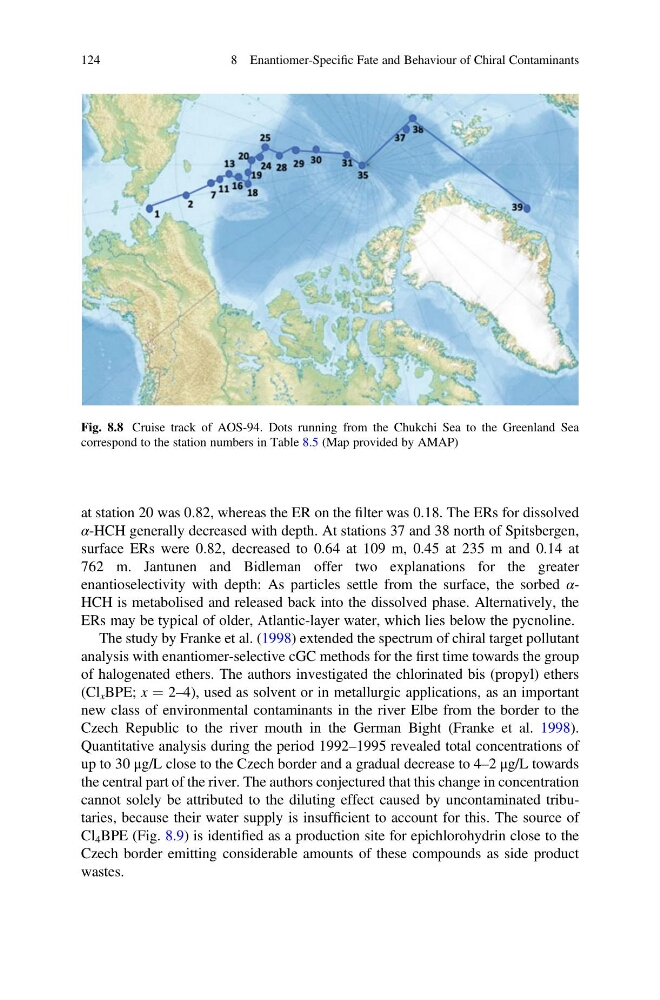
Fig. 8.8 Cruise track of AOS-94. Dots running from the Chukchi Sea to the Greenland Sea
correspond to the station numbers in Table 8.5 (Map provided by AMAP)
124
8 Enantiomer-Specific Fate and Behaviour of Chiral Contaminants
α-HCH generally decreased with depth. At stations 37 and 38 north of Spitsbergen,
surface ERs were 0.82, decreased to 0.64 at 109 m, 0.45 at 235 m and 0.14 at
762 m. Jantunen and Bidleman offer two explanations for the greater
enantioselectivity with depth: As particles settle from the surface, the sorbed αHCH is metabolised and released back into the dissolved phase. Alternatively, the
ERs may be typical of older, Atlantic-layer water, which lies below the pycnoline.
The study by Franke et al. (1998) extended the spectrum of chiral target pollutant
analysis with enantiomer-selective cGC methods for the first time towards the group
of halogenated ethers. The authors investigated the chlorinated bis (propyl) ethers
(Cl x BPE; x ¼ 2–4), used as solvent or in metallurgic applications, as an important
new class of environmental contaminants in the river Elbe from the border to the
Czech Republic to the river mouth in the German Bight (Franke et al. 1998).
Quantitative analysis during the period 1992–1995 revealed total concentrations of
up to 30 μg/L close to the Czech border and a gradual decrease to 4–2 μg/L towards
the central part of the river. The authors conjectured that this change in concentration
cannot solely be attributed to the diluting effect caused by uncontaminated tributaries, because their water supply is insufficient to account for this. The source of
Cl 4 BPE (Fig. 8.9) is identified as a production site for epichlorohydrin close to the
Czech border emitting considerable amounts of these compounds as side product
wastes.
Fig. 8.8 Cruise track of AOS-94. Dots running from the Chukchi Sea to the Greenland Sea
correspond to the station numbers in Table 8.5 (Map provided by AMAP)
124
8 Enantiomer-Specific Fate and Behaviour of Chiral Contaminants