

A more complex situation was encountered during a Canadian research cruise in
northern marine waters (Jantunen and Bidleman 1998). In the summers of 1993 and
1994, seawater samples from the surface layer (40–60 m) were collected to determine the spatial distribution of α-HCH and organochlorine pesticides on expeditions
that crossed the Arctic Ocean from the Bering and Chukchi sea to the North Pole, to
a station north of Spitsbergen, and then south into the Greenland Sea (Fig. 8.8).
The enantiomeric ratios of dissolved α-HCH in Arctic waters were generally ER
> 1.00 in the Bering-Chukchi Seas, while depletion of the (+)-α-HCH was found in
the Arctic Ocean and the Greenland Sea, with ERs < 1.00 (Table 8.5). Similar to the
results reported by Faller et al. (1991a, b) for the western and eastern parts of the
North Sea, different microbial transformation pathways can be assumed for the
Bering-Chukchi Seas and for the Arctic Ocean: in the former case preferential
microbial degradation of (À)-α-HCH was observed, which implies that (+)-α-HCH
appears to be more resistant to microbial attack (ER > 1), while in the latter case, a
preferential transformation of the (+)-α-HCH was determined (ER < 1.00).
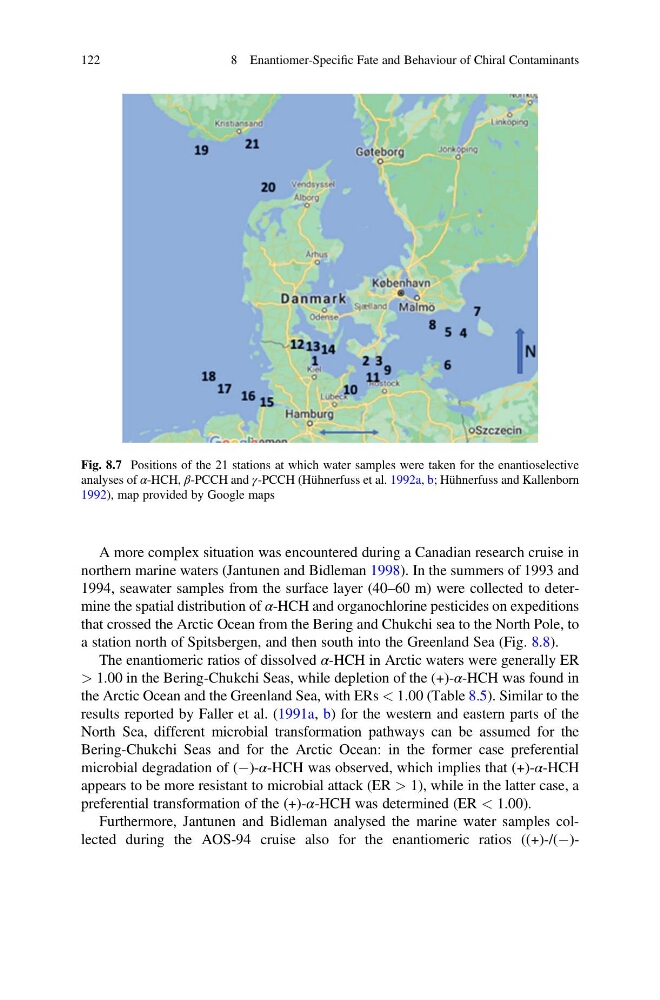
Furthermore, Jantunen and Bidleman analysed the marine water samples collected during the AOS-94 cruise also for the enantiomeric ratios ((+)-/(À)Fig. 8.7 Positions of the 21 stations at which water samples were taken for the enantioselective
analyses of α-HCH, β-PCCH and γ-PCCH (Hühnerfuss et al. 1992a, b; Hühnerfuss and Kallenborn
1992), map provided by Google maps
122
8 Enantiomer-Specific Fate and Behaviour of Chiral Contaminants
northern marine waters (Jantunen and Bidleman 1998). In the summers of 1993 and
1994, seawater samples from the surface layer (40–60 m) were collected to determine the spatial distribution of α-HCH and organochlorine pesticides on expeditions
that crossed the Arctic Ocean from the Bering and Chukchi sea to the North Pole, to
a station north of Spitsbergen, and then south into the Greenland Sea (Fig. 8.8).
The enantiomeric ratios of dissolved α-HCH in Arctic waters were generally ER
> 1.00 in the Bering-Chukchi Seas, while depletion of the (+)-α-HCH was found in
the Arctic Ocean and the Greenland Sea, with ERs < 1.00 (Table 8.5). Similar to the
results reported by Faller et al. (1991a, b) for the western and eastern parts of the
North Sea, different microbial transformation pathways can be assumed for the
Bering-Chukchi Seas and for the Arctic Ocean: in the former case preferential
microbial degradation of (À)-α-HCH was observed, which implies that (+)-α-HCH
appears to be more resistant to microbial attack (ER > 1), while in the latter case, a
preferential transformation of the (+)-α-HCH was determined (ER < 1.00).
Furthermore, Jantunen and Bidleman analysed the marine water samples collected during the AOS-94 cruise also for the enantiomeric ratios ((+)-/(À)Fig. 8.7 Positions of the 21 stations at which water samples were taken for the enantioselective
analyses of α-HCH, β-PCCH and γ-PCCH (Hühnerfuss et al. 1992a, b; Hühnerfuss and Kallenborn
1992), map provided by Google maps
122
8 Enantiomer-Specific Fate and Behaviour of Chiral Contaminants