

of the order of 7 ng/L were found. These findings were later supported and confirmed
by other studies also in other environmental media (Harrison et al. 1998; Garrison
et al. 2008; Wu et al. 2017).
In the case of the two chiral phenoxyalkanoic acid derivatives investigated here,
only the R-enantiomer is an active herbicide. In some commercially available
mixtures, however, the racemate is prevailing (Martin-Biosca et al. 2001). As a
consequence, both the R- and the S-enantiomer are transported into the North Sea,
thus potentially influencing the marine ecosystem (Ludwig 1991). Therefore,
Ludwig et al. focused on the question, whether or not a microbial marine culture is
able to degrade the two enantiomers of chiral phenoxyalkanoic acid derivatives or
rather one enantiomer is being accumulated in the marine ecosystem (Ludwig et al.
1992a). The here-studied phenoxyalkanoic acid derivatives were separated with
HPLC using α 1 -AGP as chiral stationary phase (for details on the CSP, see
Chap. 3). For the microbial transformation experiment, Ludwig et al. used the
same mixed culture of marine micro-organisms as previously reported for the αHCH (Ludwig et al. 1992a).
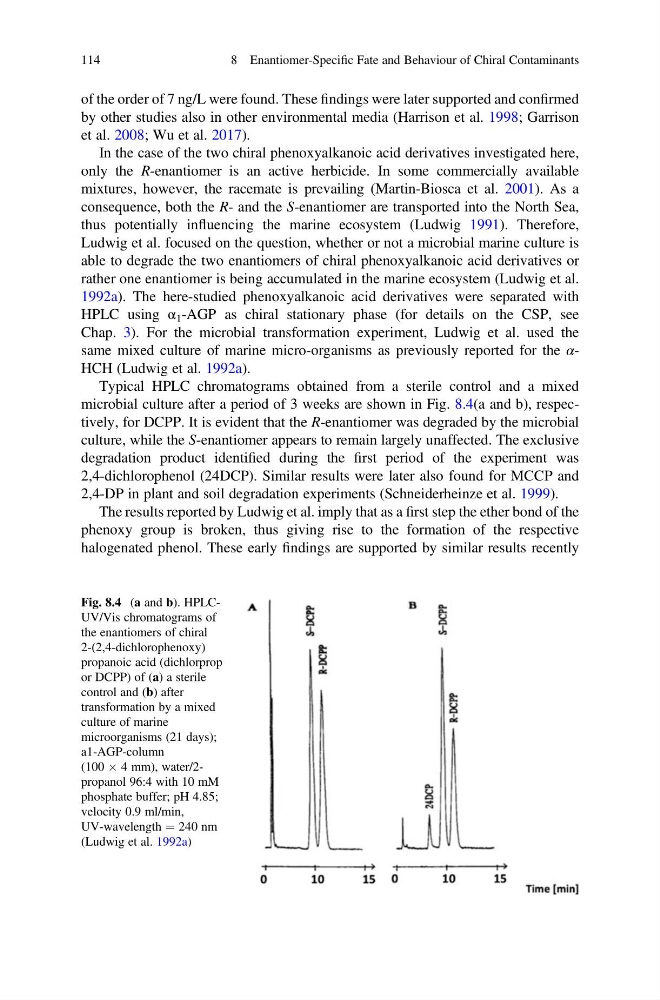
Typical HPLC chromatograms obtained from a sterile control and a mixed
microbial culture after a period of 3 weeks are shown in Fig. 8.4(a and b), respectively, for DCPP. It is evident that the R-enantiomer was degraded by the microbial
culture, while the S-enantiomer appears to remain largely unaffected. The exclusive
degradation product identified during the first period of the experiment was
2,4-dichlorophenol (24DCP). Similar results were later also found for MCCP and
2,4-DP in plant and soil degradation experiments (Schneiderheinze et al. 1999).
The results reported by Ludwig et al. imply that as a first step the ether bond of the
phenoxy group is broken, thus giving rise to the formation of the respective
halogenated phenol. These early findings are supported by similar results recently
Fig. 8.4 (a and b). HPLCUV/Vis chromatograms of
the enantiomers of chiral
2-(2,4-dichlorophenoxy)
propanoic acid (dichlorprop
or DCPP) of (a) a sterile
control and (b) after
transformation by a mixed
culture of marine
microorganisms (21 days);
a1-AGP-column
(100 Â 4 mm), water/2propanol 96:4 with 10 mM
phosphate buffer; pH 4.85;
velocity 0.9 ml/min,
UV-wavelength ¼ 240 nm
(Ludwig et al. 1992a)
114
8 Enantiomer-Specific Fate and Behaviour of Chiral Contaminants
by other studies also in other environmental media (Harrison et al. 1998; Garrison
et al. 2008; Wu et al. 2017).
In the case of the two chiral phenoxyalkanoic acid derivatives investigated here,
only the R-enantiomer is an active herbicide. In some commercially available
mixtures, however, the racemate is prevailing (Martin-Biosca et al. 2001). As a
consequence, both the R- and the S-enantiomer are transported into the North Sea,
thus potentially influencing the marine ecosystem (Ludwig 1991). Therefore,
Ludwig et al. focused on the question, whether or not a microbial marine culture is
able to degrade the two enantiomers of chiral phenoxyalkanoic acid derivatives or
rather one enantiomer is being accumulated in the marine ecosystem (Ludwig et al.
1992a). The here-studied phenoxyalkanoic acid derivatives were separated with
HPLC using α 1 -AGP as chiral stationary phase (for details on the CSP, see
Chap. 3). For the microbial transformation experiment, Ludwig et al. used the
same mixed culture of marine micro-organisms as previously reported for the αHCH (Ludwig et al. 1992a).
Typical HPLC chromatograms obtained from a sterile control and a mixed
microbial culture after a period of 3 weeks are shown in Fig. 8.4(a and b), respectively, for DCPP. It is evident that the R-enantiomer was degraded by the microbial
culture, while the S-enantiomer appears to remain largely unaffected. The exclusive
degradation product identified during the first period of the experiment was
2,4-dichlorophenol (24DCP). Similar results were later also found for MCCP and
2,4-DP in plant and soil degradation experiments (Schneiderheinze et al. 1999).
The results reported by Ludwig et al. imply that as a first step the ether bond of the
phenoxy group is broken, thus giving rise to the formation of the respective
halogenated phenol. These early findings are supported by similar results recently
Fig. 8.4 (a and b). HPLCUV/Vis chromatograms of
the enantiomers of chiral
2-(2,4-dichlorophenoxy)
propanoic acid (dichlorprop
or DCPP) of (a) a sterile
control and (b) after
transformation by a mixed
culture of marine
microorganisms (21 days);
a1-AGP-column
(100 Â 4 mm), water/2propanol 96:4 with 10 mM
phosphate buffer; pH 4.85;
velocity 0.9 ml/min,
UV-wavelength ¼ 240 nm
(Ludwig et al. 1992a)
114
8 Enantiomer-Specific Fate and Behaviour of Chiral Contaminants