

metabolomic strategies. The microbial degradation of HCH is today comprehensively understood (Lal et al. 2010). Thus, α-HCH is now frequently used for
designing suitable remediation and treatment models for the enantiomer-selective
removal of halogenated chiral substances in wastes and/or sewage (Alvarez et al.
2012). A recent study developed a new bioscreen for the continuous treatment of
liquid biowastes and wastewater. This method was found highly effective in reducing HCH contamination and resulted in the transformation into benzene and chlorobenzene, which could be further mineralised aerobically on site during the
wastewater treatment (Langenhoff et al. 2013). Selective microbial degradation
was also proposed by Garg et al. for the rapid and effective remediation of HCHs
in contaminated soils (Garg et al. 2016). Similar methods have been applied to largescale remediation of HCH-contaminated locations (Liang et al. 2014; Laquitaine
et al. 2016).
The laboratory transformation experiment performed by Ludwig et al. (1992a),
however, with α-HCH transformed by micro-organisms isolated off the island of
Heligoland illustrated for the first time the microbial transformation potential of
marine microorganisms derived from the open sea. In addition to the non-polar
chlorinated hydrocarbons with α-HCH as a prominent example (Bethan et al. 2001),
several other organic pesticides were also identified as relevant pollutants in the
marine ecosystem (Hühnerfuss et al. 1993; Borga and Bidleman 2005; Jin et al.
2017). As shown by Ludwig (1991), phenoxyalkanoic acid herbicides may reach
considerable concentrations in the German Bight, for example, the achiral
2,4-dichlorophenoxyacetic acid (the so-called 2,4-D) of the order of 10 ng/L, the
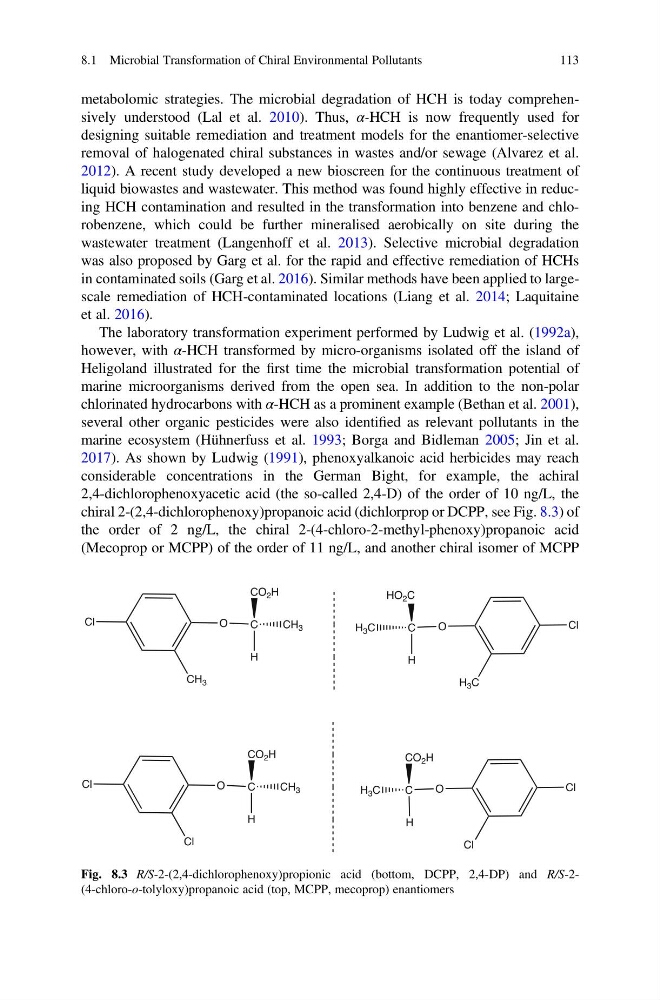
chiral 2-(2,4-dichlorophenoxy)propanoic acid (dichlorprop or DCPP, see Fig. 8.3) of
the order of 2 ng/L, the chiral 2-(4-chloro-2-methyl-phenoxy)propanoic acid
(Mecoprop or MCPP) of the order of 11 ng/L, and another chiral isomer of MCPP
Fig. 8.3 R/S-2-(2,4-dichlorophenoxy)propionic acid (bottom, DCPP, 2,4-DP) and R/S-2(4-chloro-o-tolyloxy)propanoic acid (top, MCPP, mecoprop) enantiomers
8.1 Microbial Transformation of Chiral Environmental Pollutants
113
designing suitable remediation and treatment models for the enantiomer-selective
removal of halogenated chiral substances in wastes and/or sewage (Alvarez et al.
2012). A recent study developed a new bioscreen for the continuous treatment of
liquid biowastes and wastewater. This method was found highly effective in reducing HCH contamination and resulted in the transformation into benzene and chlorobenzene, which could be further mineralised aerobically on site during the
wastewater treatment (Langenhoff et al. 2013). Selective microbial degradation
was also proposed by Garg et al. for the rapid and effective remediation of HCHs
in contaminated soils (Garg et al. 2016). Similar methods have been applied to largescale remediation of HCH-contaminated locations (Liang et al. 2014; Laquitaine
et al. 2016).
The laboratory transformation experiment performed by Ludwig et al. (1992a),
however, with α-HCH transformed by micro-organisms isolated off the island of
Heligoland illustrated for the first time the microbial transformation potential of
marine microorganisms derived from the open sea. In addition to the non-polar
chlorinated hydrocarbons with α-HCH as a prominent example (Bethan et al. 2001),
several other organic pesticides were also identified as relevant pollutants in the
marine ecosystem (Hühnerfuss et al. 1993; Borga and Bidleman 2005; Jin et al.
2017). As shown by Ludwig (1991), phenoxyalkanoic acid herbicides may reach
considerable concentrations in the German Bight, for example, the achiral
2,4-dichlorophenoxyacetic acid (the so-called 2,4-D) of the order of 10 ng/L, the
chiral 2-(2,4-dichlorophenoxy)propanoic acid (dichlorprop or DCPP, see Fig. 8.3) of
the order of 2 ng/L, the chiral 2-(4-chloro-2-methyl-phenoxy)propanoic acid
(Mecoprop or MCPP) of the order of 11 ng/L, and another chiral isomer of MCPP
Fig. 8.3 R/S-2-(2,4-dichlorophenoxy)propionic acid (bottom, DCPP, 2,4-DP) and R/S-2(4-chloro-o-tolyloxy)propanoic acid (top, MCPP, mecoprop) enantiomers
8.1 Microbial Transformation of Chiral Environmental Pollutants
113